Hurricane from Space
Steer a hurricane from orbit, start new storms and cross the equator.
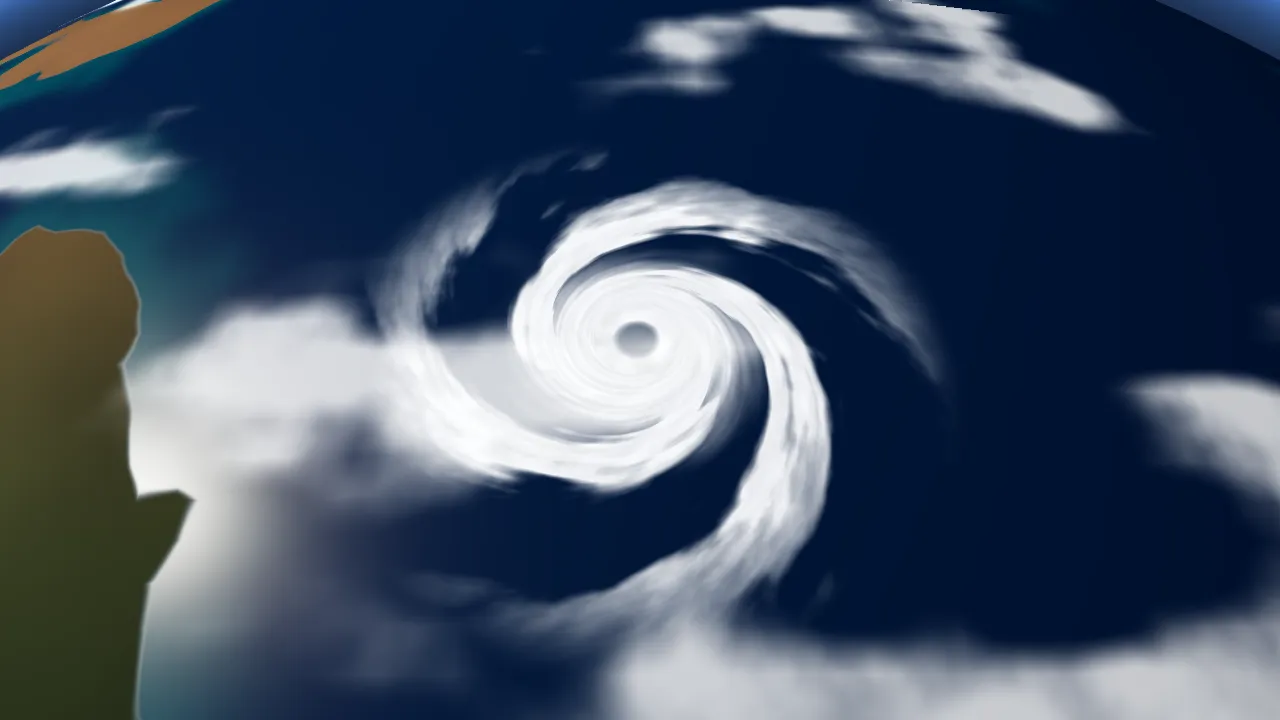
How to play
- Drag the hurricane across the ocean. Warm tropical water feeds it and it grows; land and cooler sea starve it.
- Tap open ocean to start a new tropical storm there, north or south of the equator, and see which way it turns.
- Drag a storm across the equator: it falls apart where the Coriolis effect vanishes, then re-forms spinning the other way.
- Let go and it drifts west with the trade winds, then curves away poleward, while the view follows it like a satellite.
- Try the three Challenges, or open Lab to warm the ocean. Drag empty space to look around the planet.
Challenges
- Steer the storm over warm sea until it becomes a category 3 hurricane
- Drive a hurricane onto land and watch it weaken below hurricane strength
- Start a storm south of the equator and grow it into a clockwise hurricane
Try this
- Drag the hurricane onto the continent and watch its category fall as it loses its supply of warm, moist air.
- Pull it towards the equator. Close to it the Coriolis effect fades away, and the storm cannot keep its spin.
- Warm the ocean by 2 °C, start a new storm and compare how strong it grows.
Fun facts
- Hurricanes, typhoons and cyclones are the same kind of storm. The name depends on the ocean where it forms.
- Tropical cyclones turn anticlockwise in the Northern Hemisphere and clockwise in the Southern Hemisphere.
- They usually need sea-surface temperatures of about 26.5 °C or more to form.
- The Saffir–Simpson scale ranks hurricanes from category 1 to 5 by their maximum sustained wind speed.
A heat engine that spins with the planet
A hurricane is a heat engine powered by warm ocean water. Over a tropical sea at 26 °C or more, huge amounts of water evaporate into the air. When that moist air is drawn into the storm and rises, the vapour condenses into cloud and releases the heat it took to evaporate it. That heat warms the core of the storm, lowers the pressure at the surface, and pulls in yet more moist air from all around. As long as the sea stays warm and nothing tears the storm apart, the cycle feeds itself.
Why it spins, and which way
Air flowing towards the low pressure does not travel in a straight line. Because the Earth rotates beneath it, moving air is deflected sideways, an effect called the Coriolis effect. In the Northern Hemisphere the deflection is to the right, so air spiralling inwards ends up turning anticlockwise. In the Southern Hemisphere it is deflected to the left and turns clockwise. The strength of the effect depends on latitude: it is zero at the equator and grows towards the poles. That is why hurricanes almost never form within about five degrees of the equator, and why in this simulation the spin reverses when you move the storm to the other hemisphere.
The eye and the rainbands
The strongest winds blow in the eyewall, a ring of towering cloud around the centre. Inside it, in the eye, air slowly sinks and warms as it descends, which dries it out and clears the sky. Further out, inflowing air rises in long spiral rainbands that curl in towards the centre, the pattern you see from orbit.
Why storms weaken
Take away the warm water and the engine stalls. Over land a hurricane loses its fuel, and the rougher ground also slows the winds through friction. Over cooler water it weakens too. Drag the storm onto the continent and you will see its category drop within a few simulated hours.
For the curious
The Coriolis parameter is f = 2Ω sin φ, where Ω = 7.29 × 10⁻⁵ s⁻¹ is the Earth’s rotation rate and φ is the latitude. At 17° north, f ≈ 4.3 × 10⁻⁵ s⁻¹. This toy uses a simple model of intensity: the wind relaxes towards a maximum that rises with sea-surface temperature above about 26 °C, and decays quickly over land. The cloud pattern turns faster near the centre than at the edge, as the real winds do. Time is sped up, so one second here stands for roughly an hour of a real storm’s life.
Questions people ask
Why do hurricanes spin in different directions in each hemisphere?
Because of the Coriolis effect. The Earth’s rotation deflects moving air to the right in the Northern Hemisphere and to the left in the Southern Hemisphere, so air spiralling into a low-pressure centre turns anticlockwise in the north and clockwise in the south.
Why does a hurricane have an eye?
In the eye, air sinks slowly from high up and warms as it descends, which dries it out and clears the clouds. Around it, the eyewall holds the strongest winds and the heaviest rain.
Why do hurricanes weaken over land?
Over land they lose their fuel, the warm, moist air rising off the sea. Friction with the rougher ground also slows the winds, so the storm winds down within a day or two.