Why Sunsets Are Red
Drag the sun down to the sea and fire photons through the sky.
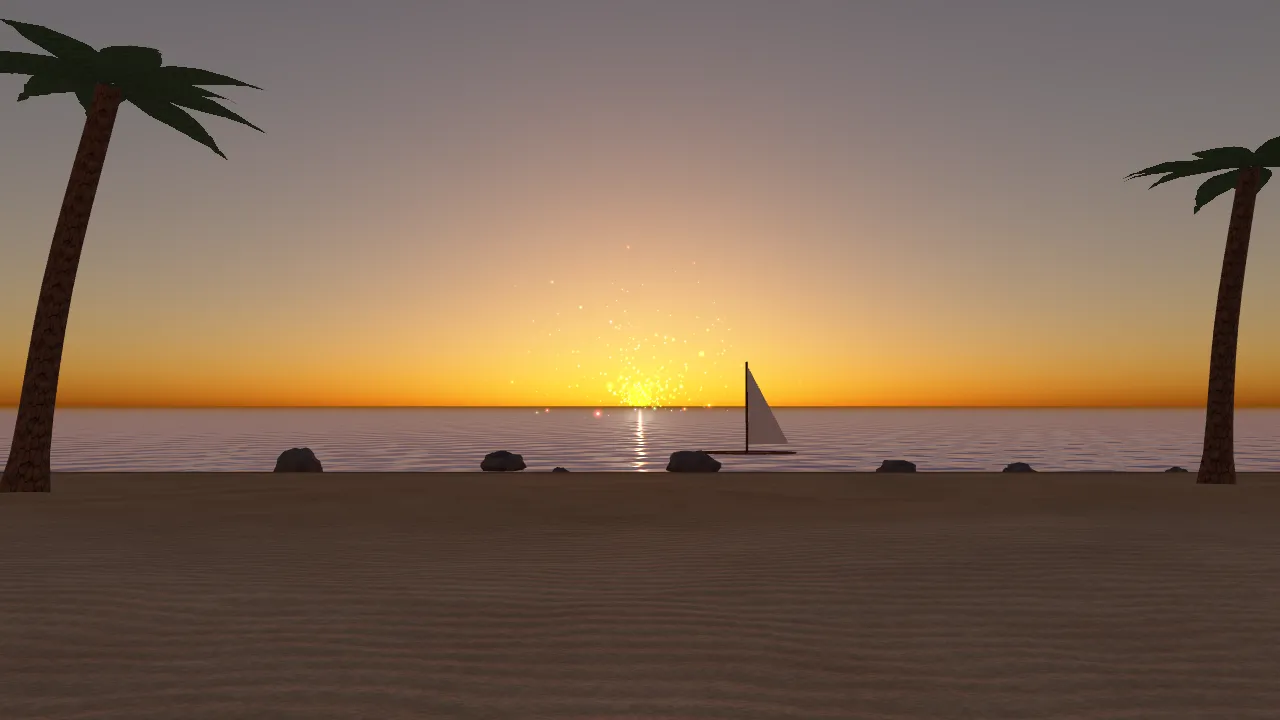
How to play
- Drag the sun itself up or down, or drag anywhere in the sky. The whole sky is recalculated from how air scatters each colour.
- Tap the sky to fire a burst of photons from the sun, 20 of each colour. The readout counts how many reach the beach.
- Watch the steady stream of photons too: blue ones are knocked out of the beam far more often than red ones.
- Try the three Challenges, or open Lab to add haze or jump to noon, golden hour or sunset.
Challenges
- Lower the sun until its light is ten times richer in red than in blue
- Drag the sun right down until it touches the sea
- Sink the sun 4° below the horizon for the deep-blue twilight
Try this
- Watch the photons at noon, then at sunset. With the sun on the horizon, almost every blue photon is scattered away before it reaches the beach.
- Raise the haze. Dust and droplets scatter all colours alike, so the sky turns paler and whiter.
- Lower the sun from 10° to 1° and watch the path-length readout: the light crosses several times more air.
Fun facts
- Air molecules scatter blue light at around 450 nm roughly four times more strongly than red light at around 650 nm, because the scattering goes as one over the wavelength to the fourth power.
- This scattering is named after Lord Rayleigh, who worked out its theory in the 1870s.
- Light from a sun on the horizon passes through roughly 38 times as much air as light from a sun directly overhead.
- Ozone high in the atmosphere absorbs some orange and yellow light, which helps keep the sky blue during twilight.
The long road that turns sunlight red
Sunlight looks white, but it contains every colour of the rainbow. As it passes through the air, a little of it bounces off the air molecules themselves, nitrogen and oxygen, and is sent off in new directions. This is Rayleigh scattering, and it depends very strongly on colour: it goes as one over the wavelength to the fourth power. Blue light, with its shorter wavelength, is scattered about four times more strongly than red.
Why the sky is blue
When you look at any part of the sky away from the Sun, you are seeing sunlight that has been scattered towards you by the air. Since blue is scattered most, that light is mostly blue, and the whole sky glows blue. Violet is scattered even more, but sunlight contains less violet to begin with, some of it is absorbed high in the atmosphere, and our eyes are less sensitive to it, so the mix we see looks sky blue.
Why sunsets are red
When the Sun is high, its light crosses a fairly thin layer of air to reach you. When it sits on the horizon, the light comes in sideways and travels through roughly 38 times as much air. Along that long path, the blue light is scattered out of the beam again and again until hardly any is left. What still reaches you directly is the light that scatters least: orange and red. The photons in this simulation show exactly that: at sunset the blue ones are knocked aside before they reach the beach, while most of the red ones get through.
Haze, dust and ozone
Larger particles such as dust, smoke and water droplets scatter all colours more evenly. A hazy sky looks paler, and fine dust high in the air, for example after a big volcanic eruption, can make sunsets especially vivid. Ozone, high in the atmosphere, absorbs some orange and yellow light. During twilight, when the sky above you is lit by light that has travelled a long way through the upper atmosphere, that absorption helps keep the sky overhead blue.
For the curious
At sea level the Rayleigh scattering coefficient is about 5.8, 13.6 and 33.1 × 10⁻⁶ per metre for red (680 nm), green (550 nm) and blue (440 nm) light, falling off with height over a scale of about 8 km. This sky is computed by single scattering: for each direction the program steps along your line of sight, and at each point it works out how much sunlight arrives (dimmed by the air between it and the Sun), how much is scattered towards you, and how much of that survives the rest of the way. Haze adds Mie scattering, which is stronger in the forward direction and makes the bright glow around the Sun. The path-length readout uses Kasten and Young’s formula for air mass, AM = 1/(sin h + 0.50572 (h + 6.07995°)−1.6364), where h is the Sun’s height.
Questions people ask
Why is the sky blue?
Air molecules scatter short-wavelength blue light much more strongly than red light. The sky you see away from the Sun is sunlight scattered towards you by the air, and because blue is scattered most, the sky looks blue.
Why are sunsets red and orange?
At sunset, sunlight travels through many times more air to reach you. Along the way most of the blue light is scattered out of the beam, so the light that arrives directly from the Sun is mostly orange and red.
Why isn’t the sky violet?
Violet light is scattered even more than blue, but sunlight contains less violet, some of it is absorbed high in the atmosphere, and our eyes are much less sensitive to it. The overall mix we see looks blue.