Sea Turtle Hatchlings
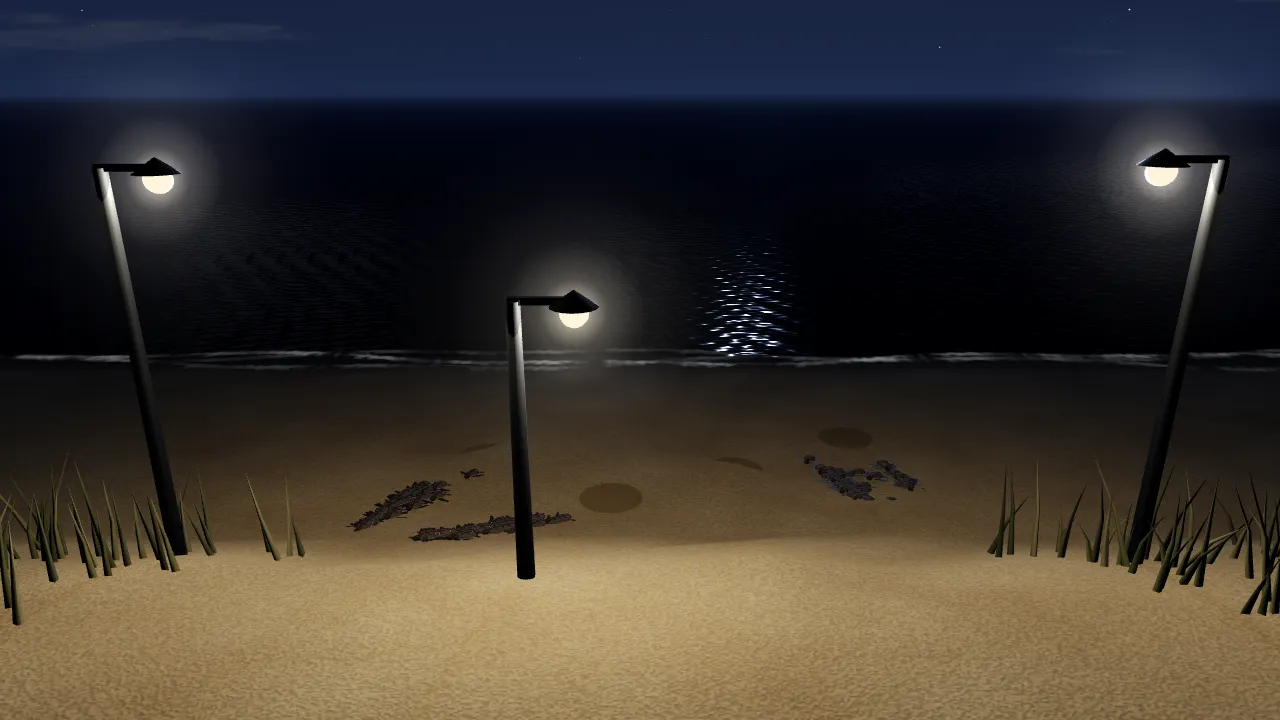
Help hatchlings find the moonlit sea by switching off the beach lights.
How to play
- Tap a nest scar in the sand to make it hatch, and watch the hatchlings choose a direction.
- Tap a lamp on the dune to switch it off or on, and watch the hatchlings change course.
- Press and hold on the sand to shine your torch there, and drag to move it. Hatchlings nearby turn toward it, which is why real turtle beaches ask visitors to keep lights off.
- Try the three Challenges, or open Lab for amber turtle-friendly lamps, shields, a red filter for your torch, or a cloudy night with no moon.
Challenges
- Hold your torch on the sand and see five hatchlings crawl toward it
- Switch off every lamp on the dune and see ten hatchlings reach the sea
- Get forty hatchlings safely into the sea
Try this
- Leave the bright white lamps on and tap the nest nearest the dune. Count how many crawl inland before you switch the lamps off.
- Choose amber lamps. They are still on, but most hatchlings now ignore them and head for the sea.
- Pick “Cloudy, no moon”. The sea horizon is dimmer, so even shielded white lamps start to confuse some hatchlings.
Fun facts
- Sea turtle hatchlings usually leave the nest at night and head toward the brightest direction, which on a natural beach is the open sky over the sea.
- Artificial lights near nesting beaches can lead hatchlings inland, where many die from exhaustion, predators or traffic.
- Hatchlings respond much less to long-wavelength amber and red light than to white or blue light, which is why turtle-friendly lighting uses those colours.
- In sea turtles, the temperature of the nest helps decide whether hatchlings become male or female, with warmer nests producing more females.
Finding the sea by its light
A hatchling sea turtle digs its way out of the sand, usually at night, and has to reach the water quickly. It can’t see the sea from down on the sand, so it relies on a simple, reliable cue: move toward the brightest part of the horizon. On a natural beach, the open sky above the water is brighter than the land behind, where dunes, plants and trees block the sky. Moonlight and starlight reflected off the sea add to the glow.
A low, wide view
Hatchlings judge brightness across a broad sweep of the horizon, close to the ground, rather than staring at any single point. That makes the cue robust: a cloudy night or a bright patch of sky in one spot doesn’t send them astray. The hatchlings here do the same. Each one compares the brightness in twelve directions around it, turns toward the brightest, and keeps checking as it crawls.
When lamps outshine the sea
A lamp behind the dune can easily be brighter than the natural glow over the water, especially for a hatchling close to it. Then the brightest direction points inland, and the hatchlings crawl the wrong way, toward roads, gardens and buildings. This is why many coastal communities have lighting rules during nesting season, and why volunteers monitor nests.
Turtle-friendly light
Hatchlings are most sensitive to short wavelengths of light, such as blue, green and white light, and much less sensitive to long-wavelength amber and red. Turtle-friendly lighting is often summed up as keeping lights low, using long wavelengths and keeping them shielded, so the bulb itself can’t be seen from the beach. Turning lights off altogether works best of all. In the Lab you can compare white, amber and shielded lamps and see the effect on the beach.
For the curious
For each of twelve directions φ, a hatchling adds up the light it would see. The natural horizon contributes 0.45 + 0.55 cos(φ − φsea), dimmer without the moon, and the moon adds a glow centred on its direction. Each lamp adds I × s × e−Δ²/0.18 / (1 + r²/9), where Δ is the angle between φ and the lamp, r its distance in metres, and s its spectral weight: 1 for white, 0.12 for amber, multiplied by 0.22 when shielded. The hatchling turns toward the brightest direction at a limited rate, crawling in rhythm with its flipper strokes. These weights are chosen to show the idea, not measured values for any one species.
Questions people ask
How do baby sea turtles know where the ocean is?
They head for the brightest part of the horizon. On a natural beach at night, the open sky over the sea is brighter than the land behind the beach, where dunes and vegetation block the sky. Once in the water, they use other cues, such as the direction of the waves, to swim offshore.
Why are lights bad for sea turtle hatchlings?
Artificial lights can be brighter than the natural glow over the sea, so hatchlings crawl toward them instead of the water. Lost hatchlings can die from exhaustion, dehydration, predators or traffic.
What kind of lighting is safe near sea turtle nesting beaches?
Turtle-friendly lighting is low, shielded so the bulb cannot be seen from the beach, and uses long-wavelength amber or red light, which hatchlings respond to much less. Turning lights off during nesting season is best. Always follow local guidance where you live or visit.