Sardine Bait Ball
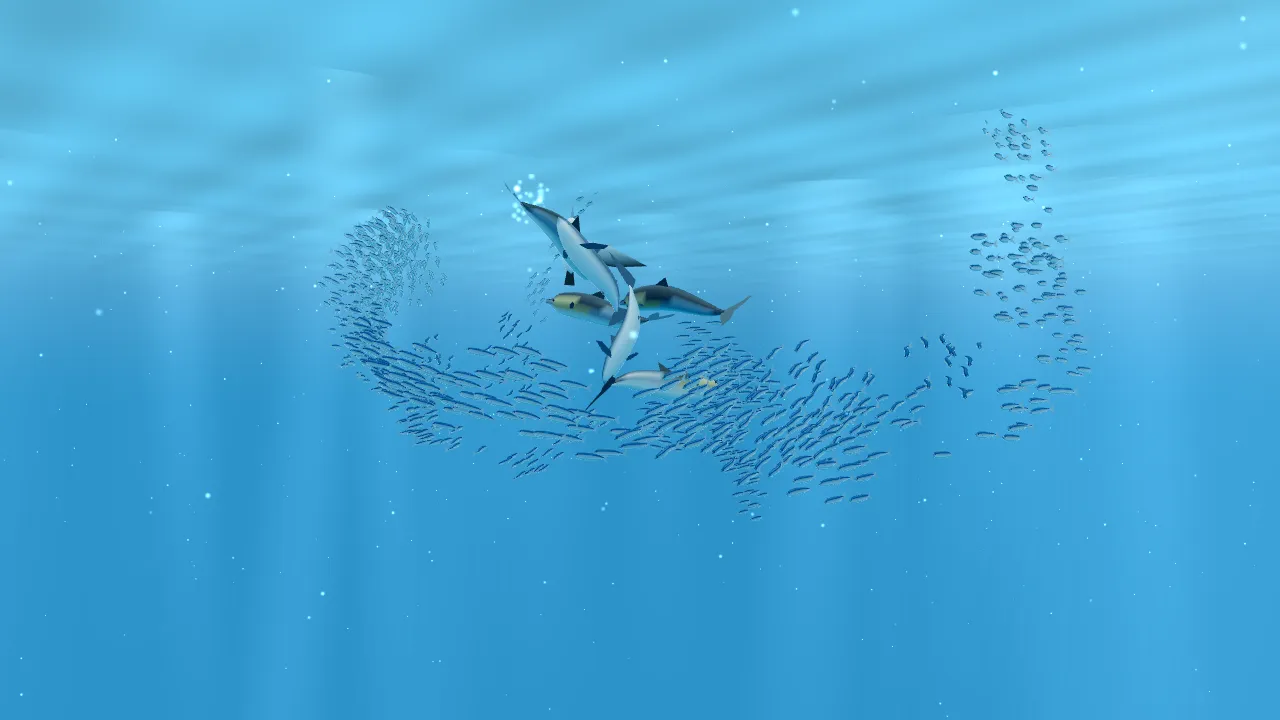
Join dolphins, sharks and diving gannets around a swirling bait ball.
How to play
- Press and drag to steer a dolphin into the bait ball. Let go and it rejoins the others.
- Tap the bright surface above the ball to send a gannet plunging in at that spot.
- Swim your dolphin along the edge of the ball and see the sardines nearest it dive for the middle.
- Tap Predators attack! in the Lab to send everyone in at once. Right-drag to look around.
Challenges
- Steer a dolphin right through the middle of the bait ball
- Snatch a sardine with the dolphin you’re steering
- Tap the surface to send a gannet diving into the ball
Try this
- Lower the cohesion slider and attack. With a weaker pull toward each other, the ball breaks up and fish scatter far more.
- Watch one edge of the ball as a dolphin passes: fish there dive inward, toward the middle, putting their neighbours between themselves and the predator.
- Zoom out until you can see the surface, then wait for a gannet. It folds its wings back into an arrow just before it hits the water.
Fun facts
- Each year around the southern winter, huge shoals of sardines move along the east coast of South Africa, an event known as the sardine run, followed by dolphins, sharks, seabirds and whales.
- Bait balls form when predators drive schooling fish into a tight sphere, often pinned against the surface, which blocks their escape upward.
- Gannets catch fish by plunge-diving: they fold their wings back and hit the water like darts, and air sacs under their skin help cushion the impact.
- Gannets have no external nostrils on their beaks, which helps keep water out when they plunge.
Why sardines pack into a ball
A bait ball is what a school of small fish becomes under attack from several directions at once. The fish crowd into a tight, slowly rotating sphere, every one of them trying to stay away from the edge. It looks like a strategy, but it emerges from each fish’s own interest.
The selfish herd
In 1971 the biologist W. D. Hamilton described the selfish herd: when danger can come from anywhere, each animal is safest if others stand between it and the predator. Every fish therefore tries to move toward the middle, and the group packs tighter and tighter. The sardines in this simulation have a strong pull toward their neighbours, keep a small personal space, and flee sideways from any predator that comes close. The result is a dense, shifting ball that splits around attackers and re-forms behind them.
Milling
Instead of all heading one way, the fish in a bait ball often swim in a circle around its centre, a pattern called milling. A milling school stays in one place and keeps moving, so no fish is ever stationary. Here each sardine gets a gentle push around the ball’s vertical axis.
Predators working together
Dolphins circle a bait ball and drive it toward the surface, where the fish can no longer escape upward. Then they take turns dashing through to feed. Sharks cruise below and seabirds attack from the air. The predators don’t need to plan: each one simply hunts, and the combined pressure keeps the ball tight.
For the curious: a gannet’s dive
A bird falling freely from a height h reaches a speed of about v = √(2gh) if air resistance is ignored. From 20 metres that is roughly 20 m/s, or about 70 km/h. Gannets streamline their bodies and fold their wings back so they slice into the water with as little drag as possible, then use their remaining speed underwater before floating back up. In this simulation, the gannets fall under gravity, brake quickly in the water, chase the fish for a moment, then bob back to the surface. The sardines treat a gannet underwater as one more predator to avoid. They are drawn at twice life size so you can follow them.
Questions people ask
What is a bait ball?
A bait ball is a tight sphere of small schooling fish, such as sardines, formed when predators attack. Each fish tries to move toward the centre, away from danger, so the school packs closely together and often mills in a circle.
What is the sardine run?
It is a mass movement of sardines along the east coast of South Africa around the southern winter. The vast shoals attract dolphins, sharks, gannets and other predators, making it one of the ocean’s great wildlife gatherings.
How do gannets dive without getting hurt?
They fold their wings back and enter the water in a streamlined shape, which reduces the impact. Air sacs under the skin of their face and chest help cushion the blow, and they have no external nostrils for water to rush into.