Salt Crystal Lattice
Pull ions, fill the gaps with Na⁺ and Cl⁻, and melt table salt.
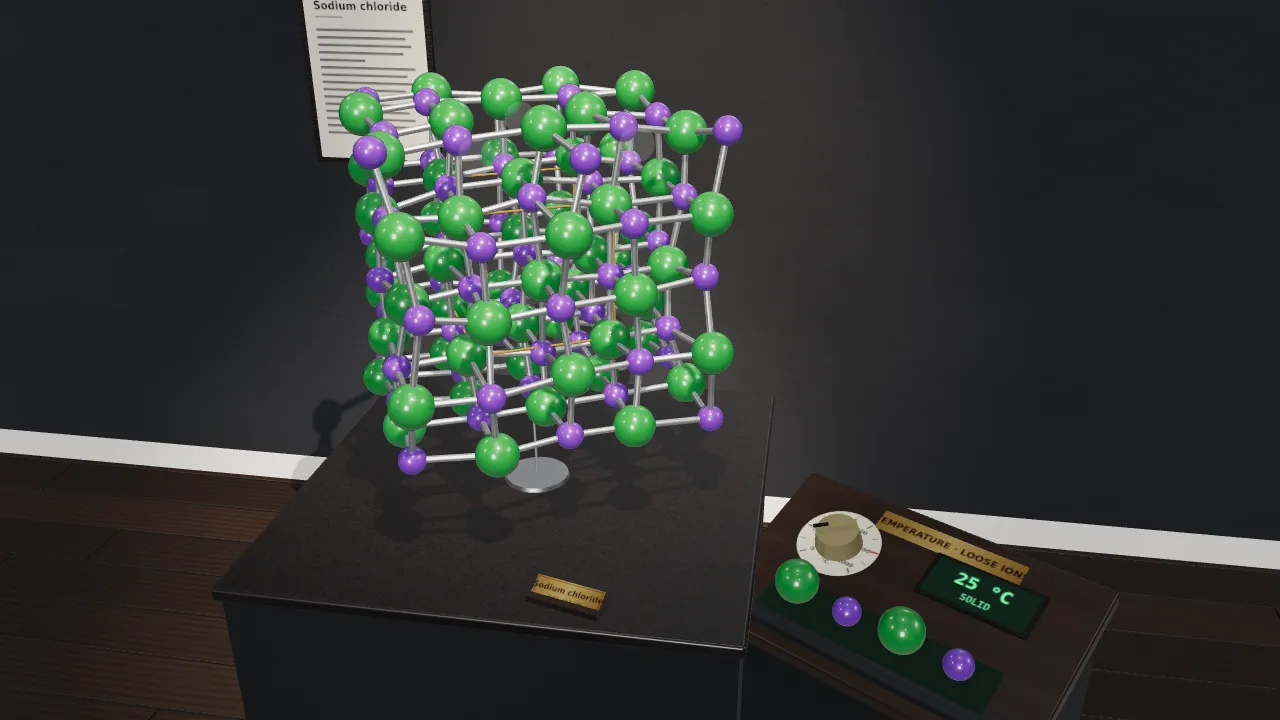
How to play
- Grab any ion and pull it out of place. Let go and the springs of its six neighbours pull it back.
- Three sites on the top face are empty. Pick up a loose ion from the tray on the console and carry it over: the right one clicks in, a like charge is pushed away.
- Turn the brass temperature knob on the console. Above 801 °C the ions leave their sites and the crystal melts.
- Tap an ion in the middle to see the octahedron of its six neighbours. Open Lab for space-filling and the unit cell.
Challenges
- Pull an ion out of place and let the lattice spring it back
- Fill the three empty sites with the right ions
- Turn the heat up past 801 °C and melt the crystal
Try this
- Switch to space-filling. With real ionic radii the ions touch along every edge: the big green ones are chloride.
- Tap an ion in the middle. Its six neighbours form an octahedron, whether you pick sodium or chloride.
- Heat it slowly and watch the Lindemann ratio. Around 12% the crystal can no longer hold together and it melts.
Fun facts
- A salt crystal contains no separate NaCl molecules: every ion is surrounded by six ions of the opposite charge.
- Table salt melts at 801 °C.
- Salt grains are often little cubes because the lattice itself is cubic.
- William Henry Bragg and his son William Lawrence Bragg worked out the structure of sodium chloride with X-rays in 1913.
Billions of ions in a perfect grid
Table salt is sodium chloride, but you will never find a “molecule” of it. A sodium atom gives its outer electron to a chlorine atom, leaving a positive sodium ion (Na⁺) and a negative chloride ion (Cl⁻). Opposite charges attract strongly in every direction, so the ions don’t pair off: they stack into a vast three-dimensional grid called a crystal lattice, with sodium and chloride alternating along every line.
The rock-salt structure
Each ion sits at the centre of six ions of the opposite charge: one above, one below, and four around it, at the corners of an octahedron. Neighbouring sodium and chloride ions are 2.82 Å apart. The smallest repeating block, the unit cell, is a cube 5.64 Å along each edge, and it contains the equivalent of four sodium and four chloride ions. This arrangement is so common that it is named after salt itself: the rock-salt structure.
Why salt forms cubes
A crystal grows by adding ions to its faces, and the cubic lattice grows most easily into cube-shaped crystals. Look at salt grains through a magnifying glass and you will often see tiny cubes; slow evaporation of salt water can grow cubes centimetres across.
Why it is so hard to melt
The electrostatic attraction between ions is strong, and every ion is held by six neighbours. Breaking up the lattice takes a lot of energy, so salt melts only at 801 °C and boils at around 1,400 °C. Yet it dissolves easily in water, because water’s polar molecules crowd around each ion and pull it out of the lattice.
For the curious: density and melting
From the unit cell you can calculate salt’s density: four NaCl units (4 × 58.44 g/mol ÷ Avogadro’s number) in a cube of (5.64 × 10⁻⁸ cm)³ gives about 2.16 g/cm³, matching the measured value. Heat makes every ion vibrate about its site. The simulation uses an Einstein model, treating each ion as a three-dimensional oscillator with a spring constant of about 40 N/m, so the mean square displacement along each axis is kT/kspring. The Lindemann criterion says a crystal melts when the vibrations reach roughly a tenth of the spacing between atoms; in this model the ratio reaches about 12% at the melting point. The vibrations are drawn twice as large as the model predicts so you can see them. When you pull an ion, it is held by springs between neighbours whose stiffness follows salt’s measured elastic constants.
Questions people ask
What is the crystal structure of salt?
Sodium chloride has the rock-salt structure: sodium and chloride ions alternate on a cubic grid, 2.82 Å apart, so every ion is surrounded by six ions of the opposite charge in an octahedron. The unit cell is a cube 5.64 Å across.
Why does salt form cubes?
Its ions are arranged in a cubic lattice, and crystals grow by adding ions to their faces, which naturally builds cube-shaped crystals.
Why does salt have such a high melting point?
Each ion is held by strong electrostatic attraction to six neighbours of opposite charge. Breaking up this lattice takes a lot of energy, so salt melts only at 801 °C.