Salmon Leaping Upstream
Aim a sockeye salmon’s leap and launch it up a mountain waterfall.
How to play
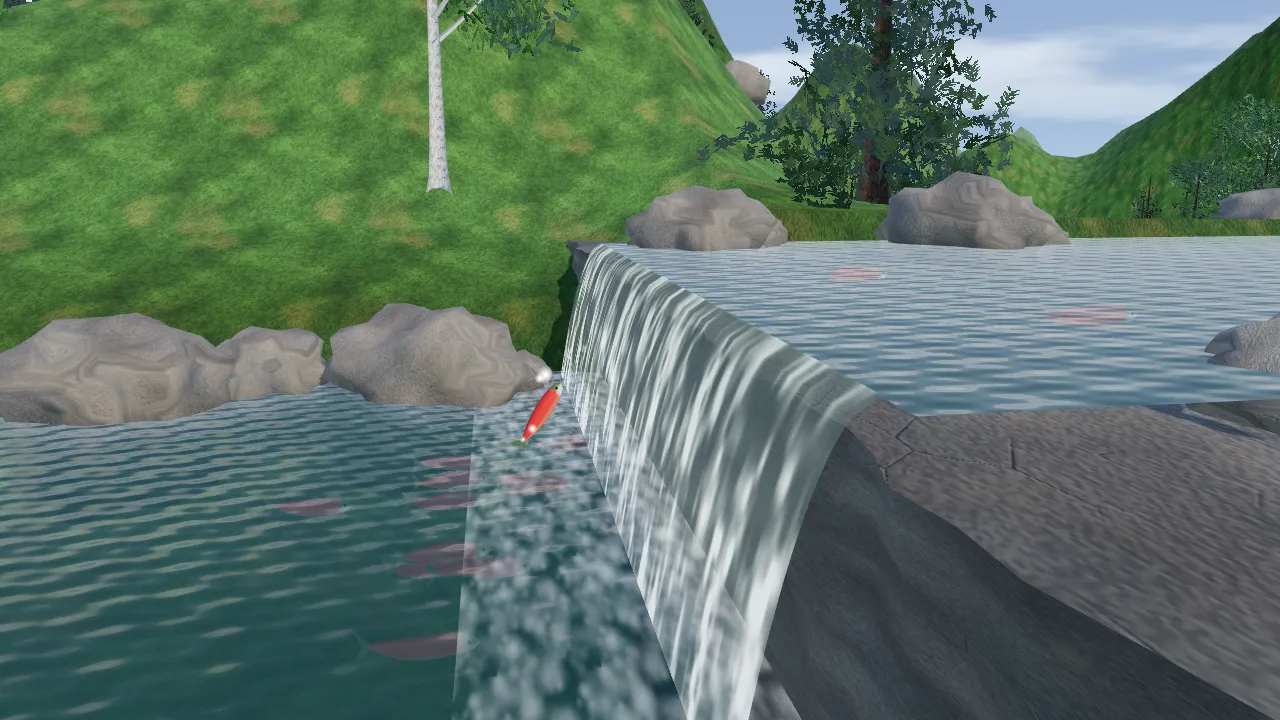
- Press on a salmon in the pool and drag up and away from it to aim. The dotted arc shows its path. Let go to launch.
- A salmon has to clear the falling water and land above the lip: one that hits the curtain is knocked back.
- Open Lab to change the waterfall height and the current, or tap Everyone jump!
- Drag empty space to look around. Pinch or scroll to zoom.
Challenges
- Aim a leap that carries a salmon over the falls
- Get a salmon over the falls on a launch speed under 6.5 m/s
- Send three salmon over the falls in a row without a miss
Try this
- Aim a steep leap from right below the falls. The fish may rise high enough but slams into the falling water, which knocks it back. Try launching from farther out.
- Raise the waterfall to 2.4 m and watch the “Vertical speed needed” readout. To reach a height H you need an upward speed of at least √(2gH), whatever the angle.
- Make the falls low, then watch how many fish make it compared with the tallest setting.
Fun facts
- Sockeye salmon spend most of their adult lives at sea, then turn bright red with green heads as they swim back up rivers to spawn.
- Salmon find their home stream largely by smell, recognising the water they imprinted on when they were young.
- Pacific salmon such as sockeye die after spawning once, while Atlantic salmon can return to spawn more than once.
- Fish ladders, a series of small steps or pools beside a dam, give migrating salmon a way past barriers they could not leap.
The physics of a salmon’s leap
Every year, salmon that have grown up at sea fight their way back up the rivers where they hatched. Rapids and waterfalls stand in the way, and where the water is too fast to swim through, salmon jump. A leap is a short flight through the air, and from the moment the fish leaves the water, physics takes over: it becomes a projectile.
A projectile with fins
If a salmon leaves the water at speed v₀ and angle θ, its horizontal speed stays roughly constant, v₀ cos θ, while gravity steadily removes its upward speed, v₀ sin θ − g·t. Its path is a parabola. Air resistance is small over such a short, quick flight, so this simulation ignores it. The highest point comes when the upward speed reaches zero, at a height of (v₀ sin θ)² / 2g. Turn that around and you get the key number for any jump: to rise a height H, the fish must leave the water with an upward speed of at least √(2gH). For a 1.6 m waterfall that is about 5.6 m/s, before even counting the distance to the lip.
Height is not enough
A salmon also has to get past the curtain of falling water. Water pouring over the lip keeps moving outward as it falls, so the curtain curves away from the rock, and any fish that hits it is pushed back down. A good leap starts some way out from the falls, often from where the water is churning, so that the fish is still rising, or near the top of its arc, as it passes over the lip. Too steep and it hits the curtain; too shallow and it doesn’t gain enough height. Try both in the Lab.
Why salmon make the journey
Salmon return to spawn in the gravel beds of their home streams, using their sense of smell to recognise the water. The journey is exhausting, and Pacific salmon such as sockeye die after spawning, their bodies feeding the stream and the forest around it, from insects and trees to bears and eagles.
For the curious
Each leap is integrated in small time steps: vy ← vy − g·Δt, x ← x + vxΔt, y ← y + vyΔt, with g = 9.81 m/s². Water leaves the lip at 0.9 m/s, so at height y below the lip the curtain is at x = −0.9 × √(2(H − y)/g). A fish that crosses the curtain, or hits the rock face below the lip, loses its forward speed and falls back into the pool. A fish succeeds if it is past the lip and higher than the upper water surface as it comes down. The fish you don’t aim leap from 0.7 to 1.5 m out, at 5.6 to 7.9 m/s and 57° to 76°, so some make it and some don’t.
Questions people ask
How do salmon jump up waterfalls?
They swim hard from the pool below, burst out of the water and fly through the air in an arc, like a thrown ball. To clear the falls they need enough upward speed to reach the lip, and a path that carries them over the curtain of falling water rather than into it.
Why do salmon swim upstream?
To spawn. Adult salmon return from the sea to the stream where they hatched, finding it largely by smell, and lay their eggs in gravel beds. Pacific salmon, such as sockeye, die after spawning.
How much speed does a fish need to jump a waterfall?
To rise a height H, an object must leave the water with an upward speed of at least √(2gH). For a 1.6 metre waterfall that is about 5.6 metres per second straight up, and more if part of the speed goes forward to reach the lip.