Roller Coaster Builder
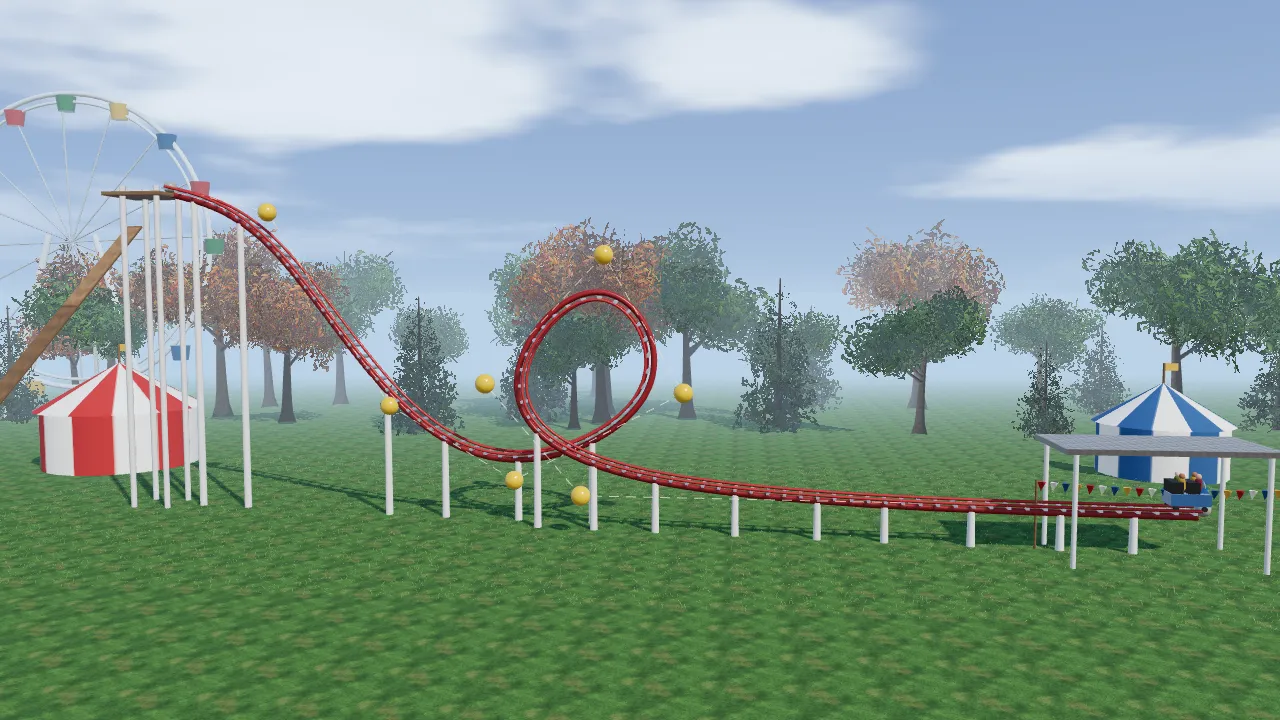
Drag the track of a steel coaster and ride hills, valleys and loops.
How to play
- Drag a yellow handle to reshape the track. The track bends smoothly towards the handles, and the car sets off again when you let go.
- Watch the speed and g-force readouts as the car rides. If a hill is too high, the car rolls back.
- To build a loop, pull a handle up and back over the one before it, then bring the next handles round and down.
- Tap the car to send it again, or open Lab to go back to the first track.
Challenges
- Lower the hills so the car rides all the way to the station without stalling
- Shape a full ride that never pulls more than 4 g
- Drag four handles into a loop and send the car all the way round it
Try this
- Make the first valley sharper. The g-force readout jumps: the same speed round a tighter bend needs a bigger push from the track.
- Raise a hill until it is almost as high as the start. The car crawls over the top, because friction and air drag have used up a little of its energy.
- Build a loop, then make it taller. The car slows down near the top, and if the loop is too tall it cannot get round.
Fun facts
- A coaster car that simply rolls can never climb higher than where it started, because friction and air drag keep taking a little of its energy.
- The g-force you feel is the push of the seat on you compared with your weight. Sitting still you feel 1 g.
- A car racing through a circular loop that only just keeps contact at the top feels about 6 g at the bottom, which is why modern loops are taller than they are wide, shaped like a teardrop.
How a roller coaster trades height for speed
A roller coaster has no engine on the ride itself. The car starts high and simply rolls, and everything that happens after that is a conversation between gravity, the shape of the track and a little friction.
Height becomes speed
At the top of the first hill the car has potential energy, mgh. As it drops, that energy turns into kinetic energy, ½mv². Without losses, the speed at any point would depend only on how far below the start the car is: v = √(2g·Δh), about 18 m/s after a 16 m drop. Climbing a hill turns speed back into height. A rolling car can never get higher than its starting point, and in reality a little less, because rolling friction and air drag take away energy the whole way. That is why the tall second hill on the first track stops the car.
Bends and g-forces
To follow a curve, the car needs a push towards the centre of the curve of v²/r, where r is the radius of the bend. The track provides it, and the riders feel it as extra weight in a valley, or as lightness over the top of a hill. The g-force readout shows that push compared with ordinary gravity. Double the speed and the push grows four times; halve the radius and it doubles. So a sharp valley at the bottom of a big drop is where the g-forces pile up. Making the bend wider is the cure.
Loops
At the top of a loop the riders are upside down, and the car must be going fast enough that the track still has to push on it: v² ≥ g·r at the top. For a circular loop, that means entering very fast, and the tight circle at the bottom then pulls about 6 g. Real designers use teardrop-shaped loops: wide and gentle at the bottom, where the car is fast, and tight at the top, where it is slow. The handles in this builder let you shape your own.
For the curious
The track is a smooth cubic B-spline through the handles’ outline, so its curvature changes continuously, as on real steel track. Along the track, the car obeys s″ = −g·Ty − μ|N| − k·v|v|, with rolling friction μ = 0.015 and air drag k = 0.0014 per metre. The track’s push per kilogram is N = v²K − g⊥, where K is the curvature vector of the track and g⊥ the part of gravity across it, and the g-force is |N|/g. Brakes slow the car at 6 m/s² into the station.
Questions people ask
Why can’t the second hill be higher than the first?
A rolling car only has the energy it got from the first drop. Climbing turns its speed back into height, but friction and air drag have taken some energy on the way, so it runs out of speed before it reaches the starting height. Rides that go higher later use a lift hill or a launch to add energy.
What does g-force mean on a roller coaster?
It compares the push of the seat on you with your normal weight. At 1 g you feel as heavy as usual. In a fast, tight valley you might feel 3 or 4 g, three or four times your weight, and over the top of a hill you can feel almost weightless.
Why are roller coaster loops teardrop-shaped?
A car needs a certain speed at the top of a loop to stay pressed against the track. With a circular loop, the speed needed at the bottom makes the forces there very large. A teardrop shape keeps the bottom wide and gentle and the top tight, so the car gets round with much smaller g-forces.