Ring Toss (Mela Game)
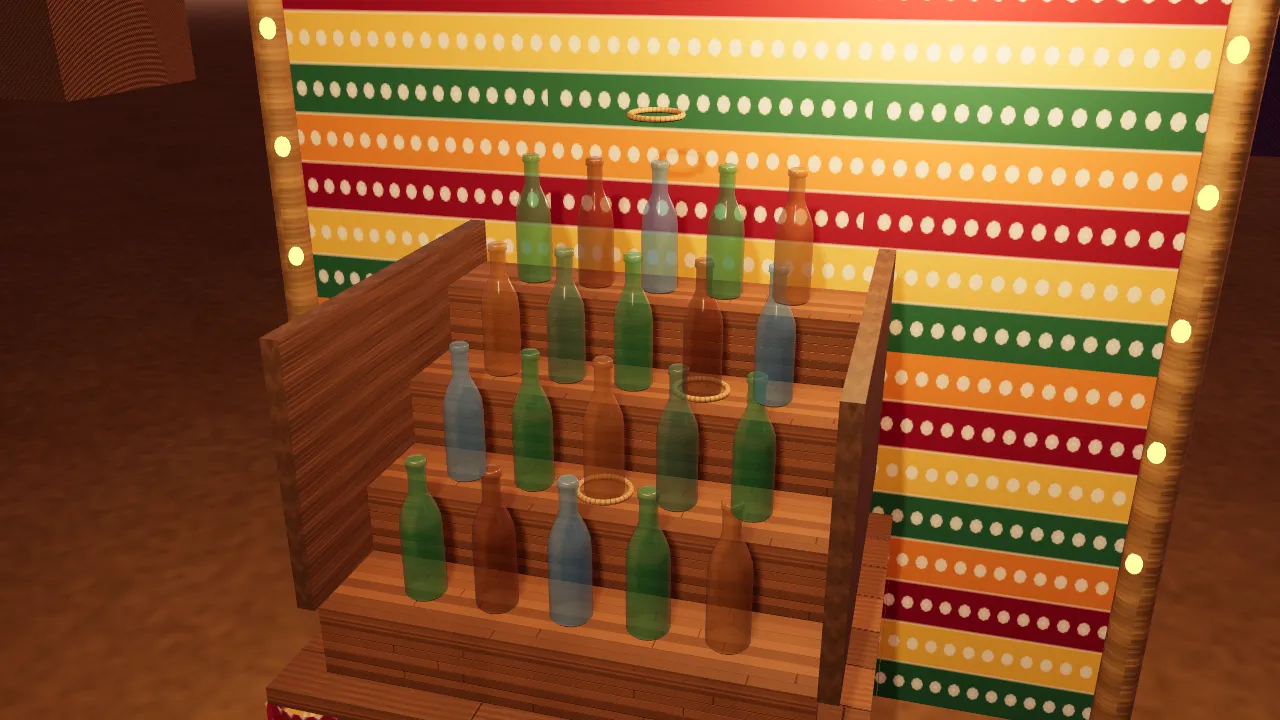
Flick bamboo rings over glass bottles at an evening mela stall.
How to play
- Put your finger on the ring, flick it toward a bottle and let go. A longer flick throws further; the dotted arc shows the start of the throw.
- A ring that comes to rest around a bottle is a ringer. Bottles further back score more: 10, 20, 30 and 50 points, row by row.
- Five rings make a round. Then the rings are collected and you get five more.
- In the Lab, change how much spin your flick gives the ring or the release angle, and watch a ring thrown with no spin tumble in the air.
Challenges
- Ring a bottle: land a ring over its neck
- Ring a bottle in the back row
- Ring two bottles in one round of five rings
Try this
- Set the spin to zero in the Lab and toss a few rings. Without spin, the small wobble of your release tips the ring over in flight, and it lands on its edge.
- Lower the release angle in the Lab and throw flatter. The ring arrives moving forward fast, catches the neck with its back edge and flips off; a high lob drops onto the necks far more kindly.
- Aim a ring between two bottles and watch it clink from shoulder to shoulder before it settles: each bounce loses some energy and turns some of the throw into spin.
Fun facts
- A spinning ring keeps the direction of its axis in flight unless a twisting force acts on it, because its angular momentum stays the same.
- For a thin ring, the moment of inertia about its axis is twice that about a diameter. The more spin it carries, the less a wobble from the release can tilt it.
- A ring only drops over a bottle if the neck passes through its hole. A ring tilted at an angle presents a narrower opening, roughly its inner width times the cosine of the tilt.
- Ring toss stalls are a familiar sight at melas and village fairs across India, often with the prizes set out on stepped stands.
Spin, lobs and glass: the physics of a ring toss
A ring toss looks like a game of luck, but a good throw depends on three pieces of physics: the spin that keeps the ring flat, the shape of its flight, and what happens when cane meets glass.
Spin keeps the ring flat
When you flick a ring, your fingers set it spinning about its own axis. A spinning object carries angular momentum, and that does not change unless something twists it. In the air nothing does, so the ring holds its plane steady like a little gyroscope. No release is perfect: your hand always adds a small wobble about a diameter. In a ring with plenty of spin, that wobble only makes the axis trace a narrow cone. Without spin the same wobble simply turns the ring over and over, and it arrives on its edge. A ring is especially steady because almost all of its mass sits at the rim, which makes its spin axis the one with the largest moment of inertia.
A lob drops onto the neck
To ring a bottle the neck has to pass through the hole while the ring comes down. A ring thrown flat arrives moving forward quickly: the neck is inside the hole for only a moment, the back edge of the ring meets the glass and the ring flips away. A higher lob comes down more steeply, so the ring travels only a little sideways while it drops past the lip, and the neck stays inside the hole all the way down.
Cane on glass
When the ring hits a bottle, the glass pushes back along the line between the two surfaces, and friction drags at the ring along the surface. Both act at the edge of the ring, not at its centre, so every bounce changes its spin as well as its speed. Some energy is lost each time, heard as the clink, so a ring that rattles between bottles soon settles. If it settles with a bottle through its hole, it is a ringer.
For the curious
For a thin ring of mass m and radius R, the moment of inertia about its axis is Is = mR² and about a diameter It = ½mR². With spin ωs and a release wobble ωt, the angular momentum is L = Isωs + Itωt, and the axis cones around L by an angle with tan θ = Itωt / (Isωs) = ωt / (2ωs). At 4 turns a second (ωs ≈ 25 rad/s) a wobble of 1 rad/s tilts the ring only about 1°. A ring falling at angle φ below the horizontal moves sideways by about h / tan φ while it drops a height h, so the neck stays in the hole through a drop of roughly (2(a − b)) · tan φ, where a is the hole’s radius and b the radius of the lip. In each contact the ring receives an impulse J along the contact normal n, changing its velocity by J/m and its angular momentum by r × (J·n), where r runs from the ring’s centre to the contact point.
Questions people ask
Why should you spin the ring?
Spin gives the ring angular momentum about its axis, which keeps its plane steady in flight. Any wobble from your hand then only makes the axis trace a small cone, so the ring arrives flat instead of tumbling onto its edge.
Is it better to throw high or flat?
High. A ring that drops steeply moves only a little sideways while it falls past the bottle’s lip, so the neck stays inside the hole. A flat throw arrives moving forward fast, and the back edge of the ring usually strikes the neck and flips it away.
Is ring toss skill or luck?
Both. Aim, the length of your flick and a steady spin are skill, and in this game they decide most throws. Once a ring touches glass, small differences in where it lands decide which way it bounces, which is where the luck comes in.