Cornhole Toss
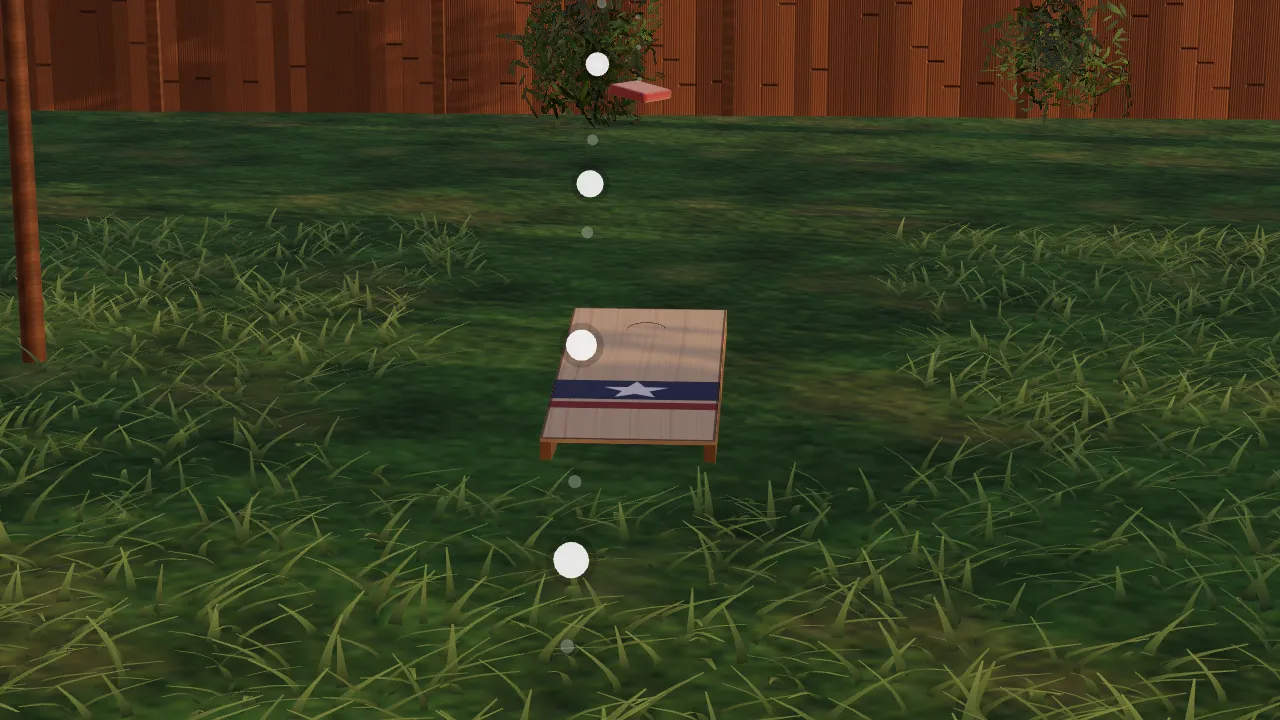
Toss bean bags at a backyard cornhole board and slide one into the hole.
How to play
- Drag back from anywhere and let go to toss the bag. The further you pull, the further it flies.
- Drag a little to the left or right to line up with the board.
- A bag in the hole scores 3 and a bag on the board scores 1. Each inning has four bags.
- The board starts at 15 feet and moves back each inning to the regulation 27 feet. Or drag the far board yourself: it settles at 15, 21 or 27 feet.
Challenges
- Land a bag on the board
- Slide a bag up the board and into the hole
- Sink an airmail: straight into the hole without touching the board
Try this
- Land a bag just short of the hole and let it slide in. Then try “airmail”: drop it straight in without touching the board.
- Change the Toss angle to 25° and then to 55°. Flat throws skid a long way, high lobs stop almost where they land.
- Try the Moon’s gravity at 27 feet. You need far less speed, and bags slide further because they press on the board less.
Fun facts
- A regulation cornhole board is 2 ft by 4 ft (61 × 122 cm) with a 6 in (15 cm) hole centred 9 in from the top edge.
- At regulation distance the front edges of the two boards are 27 ft (8.2 m) apart.
- Standard scoring gives 3 points for a bag through the hole and 1 point for a bag that stays on the board.
Why bean bags slide instead of bounce
A bean bag is about the least bouncy object you can throw. It is a fabric pouch loosely filled with small grains, so when it lands, the grains shift and rub against each other and the fabric flattens. Almost all of the energy of the fall turns into a little heat and sound. Physicists describe this with a coefficient of restitution: a superball is close to 0.9, while a bean bag is close to zero. In this game it is 0.05, so bags land with a soft thud and stay put.
The slide
What the bag keeps after landing is its sideways speed, and friction has to remove it. Kinetic friction pushes back with a force of μN, where N is how hard the bag presses on the board and μ is a property of the two surfaces. A smooth painted board is slippery (μ ≈ 0.38 here) and grass is much grippier. On the board, a bag slides a distance of roughly v² / (2μg), so a bag that lands moving at 2 m/s along the board slides about half a metre. Twice the speed means four times the slide, which is why soft arcs are easier to control than flat fastballs.
The tilt
The board slopes up from the front edge (3 in high in this game) to the back edge, 12 in high: an angle of about 11°. The slope slows bags sliding up the board and helps them stop. A bag resting on the slope stays put because friction can hold far more than the gentle downhill pull of gravity (μ cos θ ≈ 0.37 compared with sin θ ≈ 0.19). A bag only drops into the hole once its middle is over the opening, because a soft bag droops in from there.
The flight
A 16 oz bag is dense and compact, so air resistance is small over 27 ft and the flight is close to an ideal projectile path. Players usually give the bag a flat spin, which keeps it level so it lands face-down and slides smoothly instead of tumbling.
For the curious
The bag is a 0.454 kg body integrated 240 times a second with gravity and a little drag. When it touches the board, the normal impulse removes its downward speed and Coulomb friction removes sliding speed up to the limit μN. The bag is given a very large rotational inertia in the contact model, so friction slows it down without setting it rolling like a ball. The board is a tilted plane with a round hole cut out of it.
Questions people ask
How far apart are cornhole boards?
At regulation distance, the front edges of the two boards are 27 feet (about 8.2 metres) apart. Casual and younger players often stand closer.
How do you score in cornhole?
A bag that goes through the hole scores 3 points and a bag that ends on the board scores 1. In a match, the points of the two players cancel out each inning, so only the difference counts.
Should you throw a cornhole bag high or flat?
A smooth, medium arc with a flat spin is easiest to control. Too flat and the bag skids off the back of the board, too high and it can bounce off at odd angles. The best throw lands just short of the hole and slides in.