Rangoli Designer
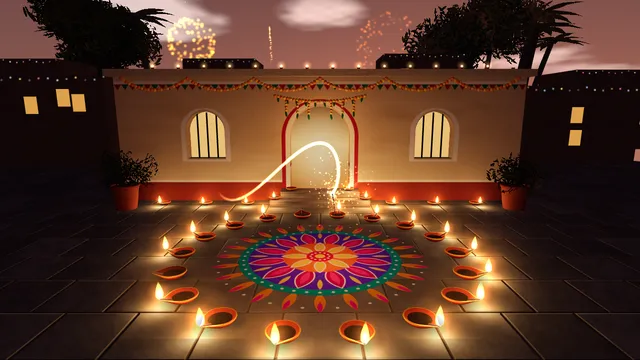
Pour coloured powder into a mirrored rangoli at a doorstep on Diwali.
How to play
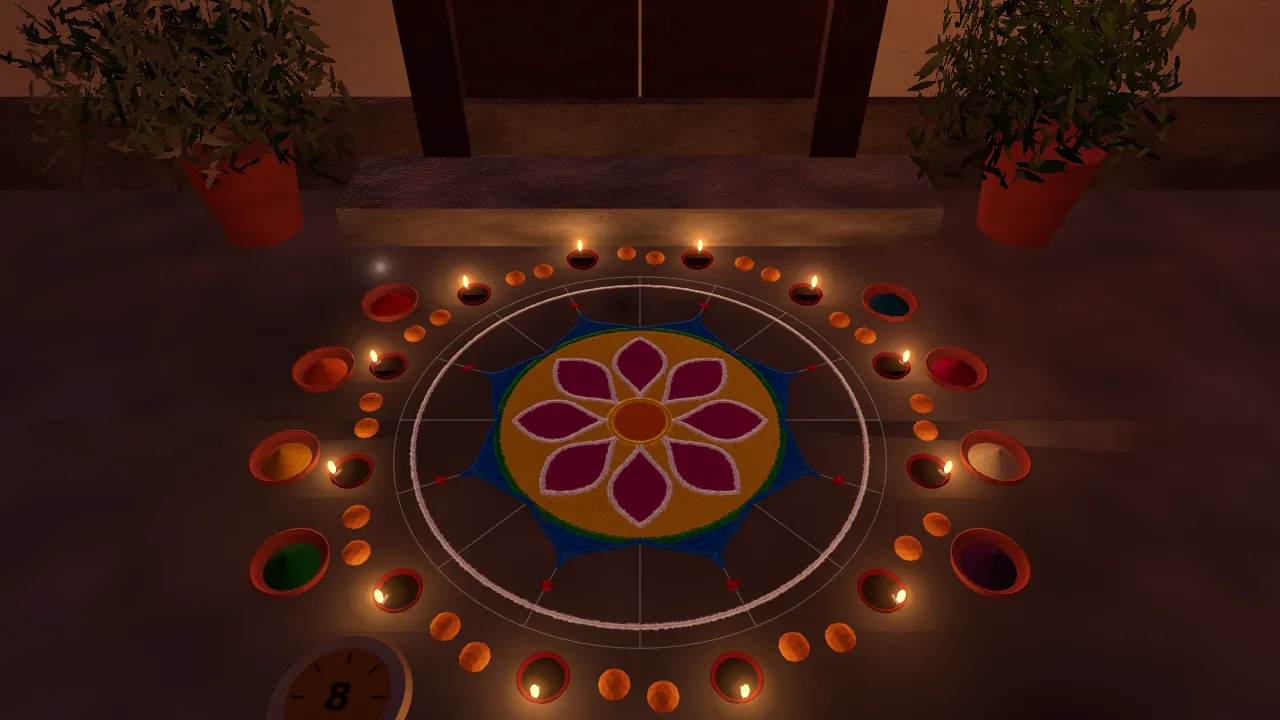
- Drag on the courtyard floor to pour a line of powder. Every line is mirrored round the circle, so one stroke draws a whole pattern.
- Move slowly for a bold line and quickly for a fine one, or hold still to let a dot pile up.
- Tap inside a closed shape to fill it: all its mirror images fill at once. Tap a bowl for another colour and tap the brass plate to change the symmetry.
- Tap a diya to light it. Try the three Challenges, or open Lab for the pour rate, the guide lines and a fresh floor.
Challenges
- Switch the brass plate to 8-fold and pour a design with eight-fold symmetry
- Use four different colours of powder in one rangoli
- Draw one closed petal and fill it to make a ring of lotus petals
Try this
- Draw half a petal that starts and ends on a chalk guide line. Its mirror image closes it into a whole petal, ready to fill.
- Compare the same stroke in 4-fold and 12-fold symmetry. Twelve-fold copies it 24 times, so even a simple curve becomes a lace-like ring.
- Raise the pour rate in Lab and draw at the same speed: the line widens with the square root of the pour rate, so four times the powder makes it only twice as wide.
Fun facts
- Rangoli is a folk art from India: patterns of coloured powder, rice flour, sand or flower petals, often made at the entrance of a home to welcome guests.
- Many regions have their own names and styles, such as kolam in Tamil Nadu, muggulu in Andhra Pradesh and Telangana, and alpana in Bengal.
- Kolam is traditionally drawn with rice flour, often around a grid of dots, and is said to offer food to ants and small birds.
- A pattern with N-fold mirror symmetry has exactly 2N symmetries: N rotations and N reflections. Mathematicians call this the dihedral group.
Mirrors, rotations and the physics of a line of powder
During Diwali, the festival of lights, many families draw a rangoli at their doorstep and set small clay oil lamps, diyas, around it as evening falls. The designs welcome guests and, for many households, the goddess Lakshmi. Styles, materials and names change from region to region, and most are drawn freehand by people who have practised for years. This toy borrows two pieces of science that every rangoli quietly uses: symmetry and the way powder flows.
One line becomes many
Many rangoli designs look the same after you turn them by a fraction of a full turn, and look the same in a mirror held along certain lines. A design with N-fold mirror symmetry has N rotations (by 360°/N) and N mirror lines through its centre. Together these 2N moves form the dihedral group. Here every point you pour is copied by all of them: a point at distance r and angle φ appears at φ + k·360°/N and at −φ + k·360°/N. In 8-fold symmetry one stroke is drawn 16 times.
Mirrors also explain the petal trick. A curve that starts and ends on a mirror line meets its own reflection at both ends, so half a petal becomes a closed petal, and the rotations turn it into a whole ring. A closed shape can then be filled: its outline is a wall that the colour cannot cross.
How wide is a line of powder?
Powder trickles from the fingers at some rate Q and settles on the floor as a little ridge. Dry grains pile up at a steady slope called the angle of repose, about 30 to 40 degrees for powders like these. The ridge must hold all the powder poured onto each centimetre of floor, so moving your hand slowly leaves more powder and a wider ridge, and moving quickly leaves a thinner line. Hold still and the powder piles up into a round dot.
For the curious
A ridge of width w at the angle of repose θ has a triangular cross-section of area A = w²·tan θ / 4. Pouring at rate Q while moving at speed v lays down A = Q / v, so w = 2·√(Q / (v·tan θ)): the width falls with the square root of the speed. The images of a point under the dihedral group DN are (r, φ + 2πk/N) and (r, −φ + 2πk/N) for k = 0 … N−1. Filling uses a flood fill on a map of the lines, starting from every mirror image of the point you tap. The diyas light the floor with an inverse-square law, which is why each lamp makes its own warm pool.
Questions people ask
Why is rangoli made during Diwali?
Rangoli is drawn at the entrance of homes to welcome guests and, for many families, the goddess Lakshmi during Diwali. It is also made for other festivals, weddings and everyday occasions, and customs vary between regions and communities.
What is rangoli powder made of?
Traditional materials include rice flour, coloured rice, powdered chalk or stone, coloured sand and flower petals. Kolam in South India is often drawn with rice flour alone. Many shop-bought rangoli colours are dyed powders.
What does N-fold symmetry mean?
A pattern has N-fold rotational symmetry if it looks the same after turning it by 360°/N. With mirror symmetry as well, it also matches its reflection in N lines through the centre, giving 2N symmetries in all.