Ramadan Lanterns
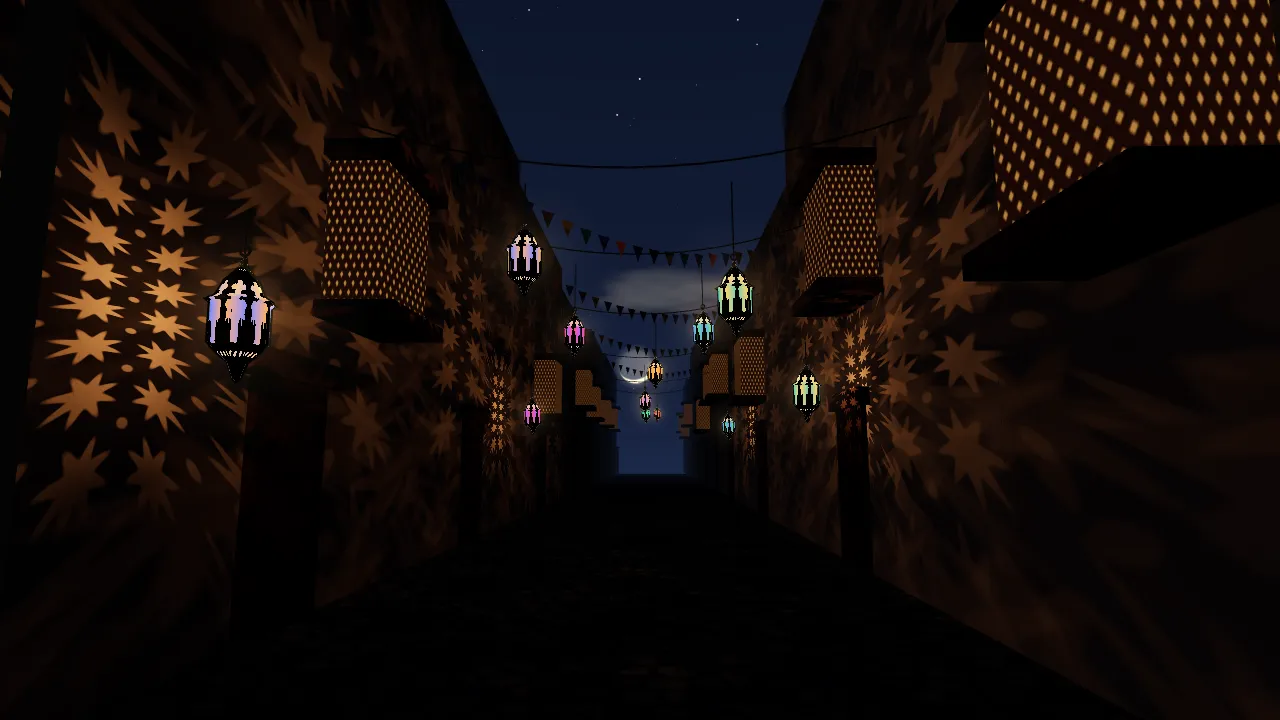
Light fanous lanterns in an old lane and swing their star patterns.
How to play
- Tap a dark lantern to light it: its pierced brass shell casts stars of light on the walls.
- Grab a lit lantern, pull it aside and let go. Its star pattern slides and stretches as it swings.
- Tap a swinging lantern to give it a gentle push along its swing.
- Try the three Challenges, or open Lab to light every lantern or change the breeze.
Challenges
- Tap a dark lantern to light it
- Light every lantern in the lane
- Swing a lantern hard so its stars sweep along the wall
Try this
- Light one lantern near a wall and watch its star pattern. Then tap it to set it swinging and see the pattern slide and stretch.
- Compare the patterns from a lantern close to the wall and one further away: the further one throws bigger, fainter stars.
- Look at the crescent moon. Its bright edge points down towards the horizon, where the Sun has set.
Fun facts
- Ramadan is the ninth month of the Islamic calendar; because that calendar follows the Moon, Ramadan begins about 11 days earlier each year in the solar calendar.
- The lit side of a crescent Moon always faces the Sun, so a young crescent seen after sunset turns its bright edge towards where the Sun has gone down.
- The faint glow on the dark part of a crescent Moon is earthshine: sunlight reflected from Earth onto the Moon and back again.
- Light travels in straight lines, so each hole in a pierced lantern throws its own spot of light, and the pattern grows larger the further away the wall is.
Stars of light from a pierced lantern
Ramadan is the month in which Muslims fast from dawn until sunset, and it traditionally begins with the sighting of the new crescent Moon. In many places evenings are a time for family, shared meals and lights in the streets, and customs vary from country to country. In Egypt especially, the fanous, a lantern of metal and coloured glass, is one of the best-loved symbols of the month; popular stories link the custom to Cairo many centuries ago. This calm lane, with its bunting and swaying lanterns, is a tribute to that tradition.
How the patterns form
Each lantern here has a small light inside a brass shell pierced with star shapes. Light travels in straight lines, so every hole lets through a narrow cone of light that lands on the wall as a bright spot shaped like the hole. Because the cones spread out as they travel, a pattern thrown onto a wall twice as far away is twice as large. The scene works this out for every lantern and every point on the walls and floor, using each lantern’s real position and tilt, so the stars move when the lantern moves.
Why far patterns are fainter
The same light spread over a larger area must be dimmer. A small lamp’s light thins out with the square of the distance, the inverse-square law: at twice the distance, each star is a quarter as bright. A wall that faces the lantern also catches more light than one it meets at a slant, which the scene includes too.
Swaying in the breeze
A hanging lantern is a pendulum. Pushed by a gust, it swings back towards the lowest point and overshoots, again and again, slowly losing energy to the air. Its rhythm depends on the length from the hook to the lantern’s middle, not on how heavy it is: lanterns on short cords swing quickly, those on long cords swing slowly.
The crescent in the sky
A thin crescent is the Moon a day or two after it passes between Earth and the Sun. Only a sliver of its sunlit half faces us, and the bright edge always points towards the Sun, which is just below the western horizon in the evening. The rest of the disc often glows faintly with earthshine.
For the curious
By similar triangles, a hole of width a at distance d from a point light throws a spot of width a·D/d on a wall at distance D, and its brightness falls as 1/D². A pendulum’s period is T = 2π√(L/g).
Questions people ask
What is a fanous?
A fanous (plural fawanees) is a lantern traditionally made of metal and coloured glass. It is one of the most familiar symbols of Ramadan in Egypt and is also popular in other countries.
Why does Ramadan start on a different date each year?
The Islamic calendar is lunar, with months that follow the Moon. Its year is about 11 days shorter than the solar year, so Ramadan moves earlier through the seasons over the years.
Why do lanterns cast patterns of light?
Light travels in straight lines, so each hole in a pierced lantern lets out a narrow beam that lands on nearby surfaces as a spot the shape of the hole. The further the surface, the bigger and fainter the spots.