Rainbow Maker
Aim a garden hose, move the sun and find the rainbow’s 42° circle.
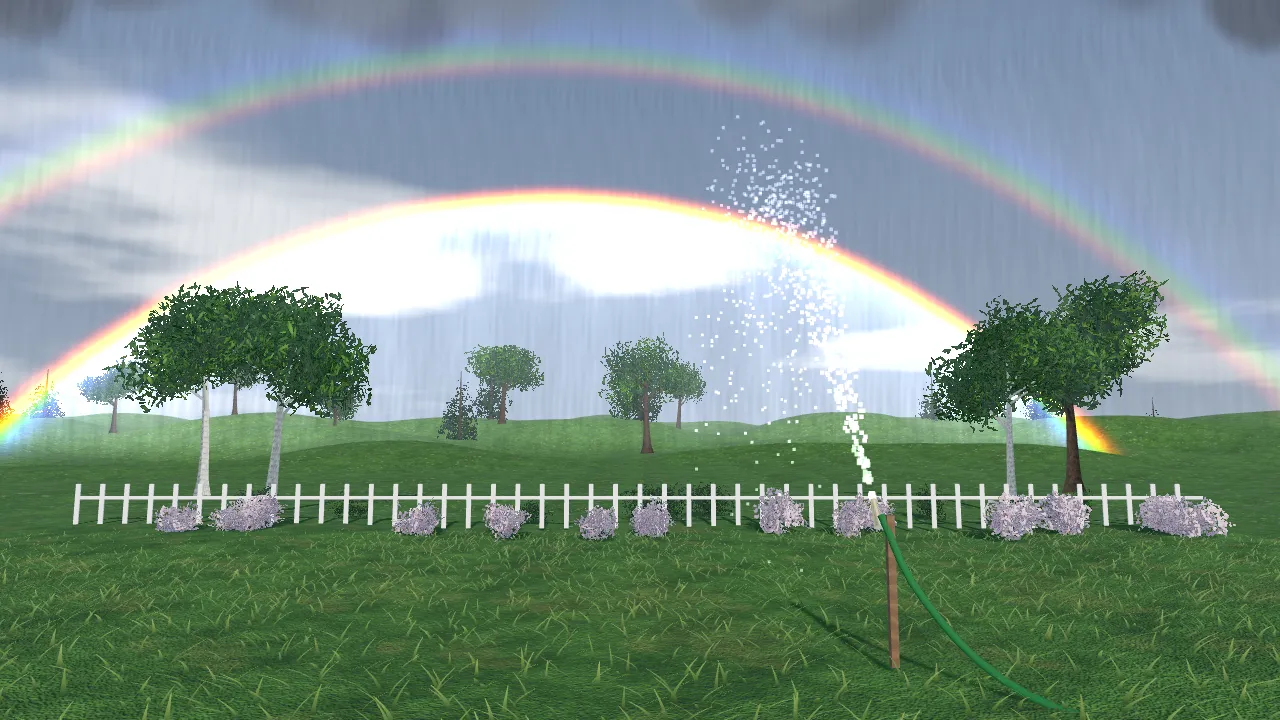
How to play
- Drag on the lawn to aim the garden hose and look for colours in its spray. Drag low on the lawn for a flat spray.
- Drag the rainbow in the sky up or down. The sun behind you moves the opposite way, so a lower bow means a higher sun.
- Turn on Show the 42° and 51° angles in Lab to see the circles the bows sit on.
- Try the three Challenges, or change the drop size in Lab to see how fog makes a white fogbow.
Challenges
- Aim the hose so a little rainbow shines in its spray
- Lower the sun until the rainbow stands as a tall half circle
- Raise the sun above 42°, then find the rainbow again in the hose’s spray
Try this
- Raise the sun above 42°. The primary bow sinks below the horizon and disappears.
- Look closely at the secondary bow: its colours run the other way, with red on the inside.
- Switch the drop size to fog. The colours smear together into a broad, white fogbow.
Fun facts
- A rainbow is a circle centred on the antisolar point, the spot directly opposite the Sun, where the shadow of your head falls.
- The primary bow sits about 42° from the antisolar point. The secondary bow, at about 51°, has its colours in reverse order.
- The darker sky between the two bows is called Alexander’s band, after Alexander of Aphrodisias, who described it around AD 200.
- No two people see exactly the same rainbow: each eye receives light from its own set of drops.
Why the rainbow is always 42° away
A rainbow is sunlight that has been bent, reflected and bent again by countless round drops of water. A ray entering a drop slows down and bends (refraction), bounces once off the back of the drop, and bends again on the way out. Depending on where it enters, it can come back out at many different angles. But near one particular angle the exiting rays bunch up: whatever the entry point, they leave at no less than about 138° from their original direction. Seen from where you stand, that bright edge lies about 42° from the point directly opposite the Sun. Every drop that sits on that 42° circle sends you a flash of bright light, and together they draw the bow.
Why there are colours
Water bends violet light slightly more than red light, a property called dispersion. So the bright edge falls at about 42.4° for red and about 40.6° for violet, and the colours separate into bands with red on the outside. The sky inside the bow looks brighter, because it is lit by all the rays that left at smaller angles.
The secondary bow and the dark band
Some light reflects twice inside the drop before leaving. Those rays bunch up at about 51° from the antisolar point, making a fainter secondary bow with its colours reversed. Between the two bows, neither kind of ray can reach your eye, so that strip of sky is darker: Alexander’s band. Look for all three in the shower beyond the garden.
Sun height and drop size
Because the bow is a circle around the antisolar point, it sinks as the Sun rises. With the Sun higher than 42°, the whole primary bow lies below the horizon, which is why rainbows are evening and morning sights. Very small drops spread the light by diffraction, blurring the colours together; in fog the bow becomes a broad white arc.
For the curious
Snell’s law, sin i = n sin r, links the entry angle i to the angle r inside the drop. With one internal reflection the ray is turned through D = 180° + 2i − 4r, which is smallest when cos² i = (n² − 1)/3. For water, n ≈ 1.333, giving D ≈ 138°, or 42° from the antisolar point. This simulation traces 5,000 rays through a drop for each of 31 wavelengths, weights them with Fresnel’s reflection formulas for both polarisations, and converts the light to colour with the CIE colour-matching functions. Drops in the hose spray are coloured by their own angle to your eye.
Questions people ask
Why is a rainbow curved?
Because it is part of a circle. Every drop that sends you rainbow light lies 42° from the point directly opposite the Sun, and all the points at a fixed angle around a centre form a circle. The ground usually hides the lower part.
Why can’t you reach the end of a rainbow?
A rainbow is not an object in one place. It is a direction: light reaches your eyes from whichever drops happen to sit at 42° from the antisolar point. When you move, a different set of drops makes your rainbow, so it moves with you.
What is a double rainbow?
The second, fainter bow outside the main one comes from light that reflects twice inside each drop. It sits about 51° from the antisolar point and its colours are reversed, with red on the inside.