Pongal: The Pot That Boils Over
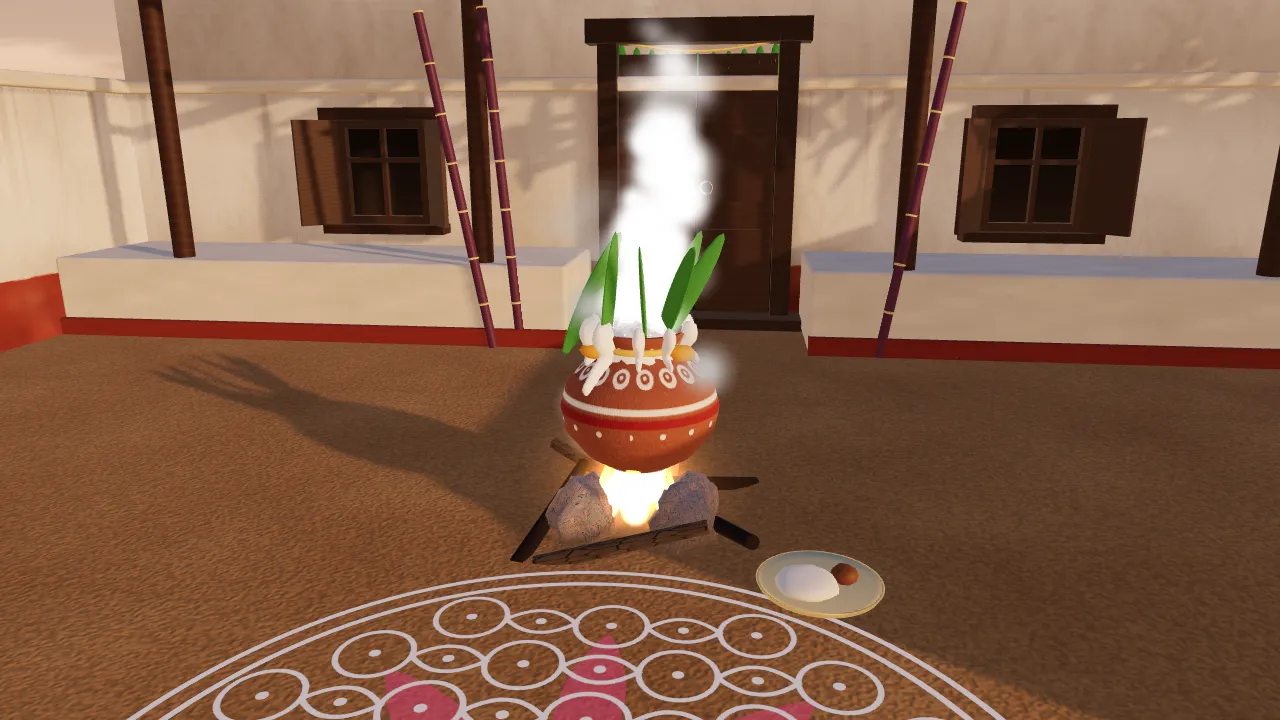
Tend the fire under a decorated pot until the milk boils over.
How to play
- Tap the fire under the pot to push in more firewood and heat the milk faster.
- Watch the temperature climb. Time runs faster while the milk heats, then slows to real time as it boils and the foam climbs the neck.
- When the foam spills over the rim, everyone calls out “Pongalo Pongal!” Then tap the brass plate to stir in the rice and jaggery.
- Open Lab to change the fire and the amount of milk, or try water instead.
Challenges
- Feed the fire until the milk in the pot comes to the boil
- Keep the fire going until the pot boils over: Pongalo Pongal!
- Once it has boiled over, tap the plate to stir in rice and jaggery
Try this
- Fill the pot with water instead of milk. It boils at the same temperature but never foams over, because water has no proteins to hold its bubbles together.
- Double the amount of milk and watch the time to boil roughly double: the heat needed is mass × specific heat × temperature rise.
- Turn the fire right down until the time-to-boil readout says never. The pot then loses heat as fast as the fire supplies it.
Fun facts
- Thai Pongal is a harvest festival celebrated by Tamil people in mid-January, at the start of the Tamil month of Thai.
- The word pongal means “boiling over”, and the overflowing pot is a sign of abundance for the year ahead.
- The festival runs over four days: Bhogi, Thai Pongal, Mattu Pongal and Kaanum Pongal.
- The visible “steam” above a pot is really a cloud of tiny water droplets. Water vapour itself is invisible.
Why milk boils over (and water does not)
Pongal is a harvest festival celebrated by Tamil people in India, Sri Lanka and around the world. On the main day, Thai Pongal, families cook fresh rice in milk in a decorated pot outdoors, often with a turmeric plant tied around its neck, sugarcane nearby and a kolam drawn in rice flour at the entrance. As the milk boils over, people call out “Pongalo Pongal!”, and the overflowing pot is a joyful sign of plenty. The dish is offered with thanks to the Sun for the harvest, and the next day, Mattu Pongal, honours the cattle that help farmers. Customs vary between families and regions.
Heating the pot
To warm a liquid you must supply heat Q = m·c·ΔT, its mass times its specific heat times the temperature rise. Milk’s specific heat is about 3.9 kJ per kilogram per degree, so bringing 2.5 litres from 30 °C to 100 °C takes roughly 700 kJ, plus more to warm the pot itself. A wood fire might deliver one or two kilowatts into the pot. Some heat always leaks away into the air, more as the pot gets hotter, so the last few degrees take the longest. In the scene, time runs faster while the milk heats, and heating takes about ten minutes in all.
Boiling
At about 100 °C, at sea level, extra heat no longer raises the temperature. It turns water into steam instead, at a rate set by the latent heat of vaporisation, about 2,260 kJ per kilogram. One kilogram of steam fills well over a cubic metre, so even a modest fire produces a great volume of bubbles.
Why milk foams
In plain water, steam bubbles rise and burst at the surface straight away. Milk is different. Its proteins (whey proteins and casein) and fat gather on the surface of each bubble, making the film strong and elastic, and a skin forms on top. The bubbles cannot burst quickly, so steam is trapped as foam. The foam piles up faster than it collapses, climbs the neck of the pot and spills over the rim. Turn the fire down and the foam sinks back, which is why cooks lower the heat or stir to stop milk boiling over.
For the curious
The model solves (m·c + Cpot)·dT/dt = P − hA·(T − Tair) while heating, then converts the spare power into steam at ṁ = (P − losses)/Lv. The foam height H grows as dH/dt = β·(steam volume flux)/A − H/τ, with β ≈ 0.22 for milk, β = 0 for water and a collapse time τ of 30 s. When H exceeds the gap to the rim, the excess spills down the outside of the pot.
Questions people ask
Why does milk boil over but water doesn’t?
Milk contains proteins and fat that coat steam bubbles and form a skin, so the bubbles cannot burst easily and pile up as foam. The foam rises and spills over the pot. Water has no such film, so its bubbles burst at the surface and it simply boils.
What is Pongal?
Pongal is a Tamil harvest festival held in mid-January. Families cook rice in milk in a decorated pot until it boils over, a sign of abundance, and give thanks to the Sun for the harvest. The festival runs over four days.
Why is steam from a pot white?
The white cloud is not steam itself, which is invisible water vapour. As the hot vapour meets cooler air it condenses into countless tiny droplets, and those scatter light and look white, just like a cloud.