Glowing Plankton Waves
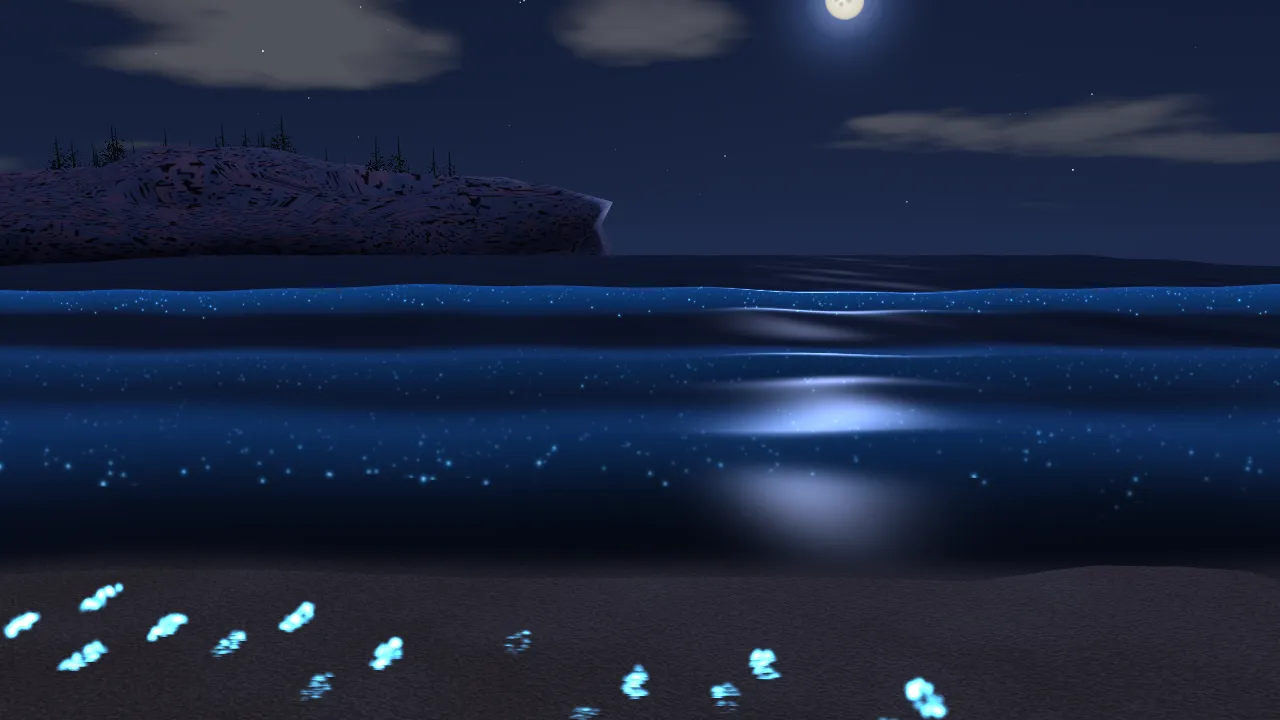
Stir a night sea full of plankton and make the waves glow blue.
How to play
- Press and drag through the shallows to stir the water with your hand: every cell you disturb flashes blue.
- Tap the wet sand near the water to leave glowing footprints.
- Tap the open sea beyond the breakers to send in a big wave, and see where it breaks.
- Open Lab to change the wave height or the amount of plankton.
Challenges
- Stir the shallows hard enough to light 40 cells at once
- Send in a big wave from the open sea and see where it breaks
- Stir one patch again straight away and find its light used up
Try this
- Stir the same patch of water again and again. It glows less each time, because each cell needs a few seconds to recharge before it can flash brightly again.
- Raise the wave height and watch the readout: bigger waves break in deeper water, farther from the beach, and are moving faster when they do.
- Switch to “A light sprinkle” of plankton. The same waves now glow faintly, as they do at the start or end of a bloom.
Fun facts
- Glowing waves are often caused by blooms of single-celled plankton called dinoflagellates, such as Lingulodinium polyedra off southern California and Noctiluca scintillans, sometimes called sea sparkle.
- Each cell flashes when the water around it is sheared, for example by a breaking wave, a swimming fish or a footstep in wet sand.
- The flashes are blue, the colour of light that travels farthest through seawater.
- In Lingulodinium, the glow follows a daily body clock, so the cells light up much more brightly at night than during the day.
Why the surf glows and the waves break
On some nights the sea seems to light up from within. Every breaking wave turns electric blue, and footsteps in the wet sand sparkle. The light comes from vast numbers of microscopic dinoflagellates, single-celled plankton that can make light through a chemical reaction, the enzyme luciferase acting on a molecule called luciferin. In daylight a dense bloom may tint the water reddish brown. At night, any disturbance makes it shine.
A flash triggered by shear
A dinoflagellate flashes when the water around it is stretched and sheared, which deforms the cell’s outer membrane and sets off the light-producing reaction in tiny compartments inside the cell. A single flash lasts only a fraction of a second, and afterwards the cell needs time to recover. That is why water you have just stirred glows less brightly the second time. One idea is that the flash works like a burglar alarm: by lighting up anything that disturbs it, such as a small grazing animal, it attracts that animal’s own predators.
Why waves slow down, grow and break
In shallow water, a wave’s speed depends mainly on the depth: c = √(g·d), where g is the acceleration due to gravity and d the depth. As a wave runs into the shallows its front slows first, and the wave bunches up and grows taller, an effect called shoaling. Eventually the wave becomes too steep to hold its shape, and it breaks when its height reaches roughly 0.78 times the water depth. The churning water inside a breaker is full of shear, which is why the glow traces the breaking crests so sharply.
For the curious
Each wave starts in deeper water and moves at √(g·d) for the local depth, on a beach that slopes at about 1 in 18. Before breaking, its height follows Green’s law, H ∝ d−1/4. It breaks once H ≥ 0.78 d, then continues as a foaming bore whose height is limited by the depth as it runs up the beach. There are 8,000 plankton cells, each with a flash level and a charge. Shear from a breaker or your hand raises the flash in proportion to the remaining charge, and uses some of it up. Flashes fade with a time constant of 0.16 seconds and the charge recovers over several seconds.
Questions people ask
What makes ocean waves glow blue at night?
Usually blooms of bioluminescent dinoflagellates, single-celled plankton that flash when the water around them is disturbed. Breaking waves, swimmers and footsteps in wet sand all create enough shear to make them light up.
Why do waves break when they reach the shore?
In shallow water a wave’s speed depends on the depth, so a wave slows down as the water shallows and grows taller. When its height reaches roughly 0.78 times the depth, it can no longer hold its shape and it breaks.
Is it safe to swim in glowing water?
The glow itself is harmless, but some plankton blooms can affect water quality or irritate skin, and a few kinds produce toxins. Check local advice about the bloom before swimming, and enjoy it from the beach if in doubt.