Planetary Gear Set
Hold the ring, sun or carrier, drive another, and change the gear ratio.
How to play
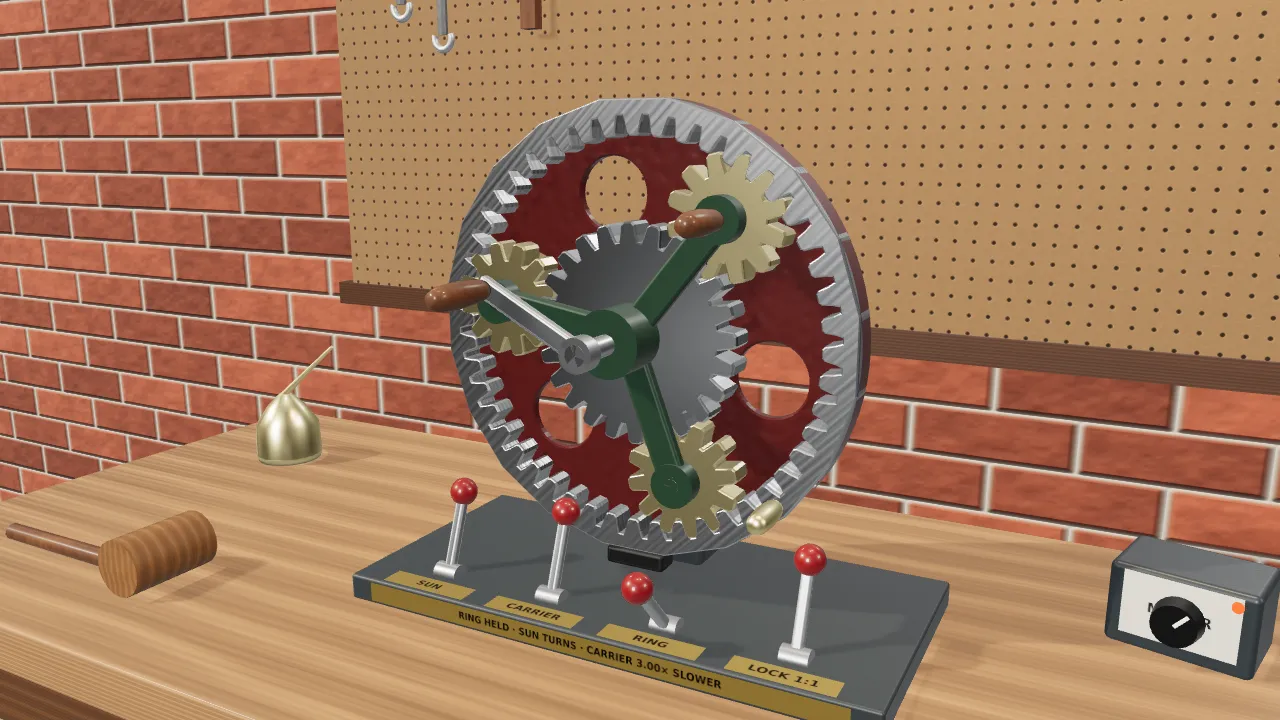
- Grab a handle and turn it: the crank on the sun shaft, the wooden grip on the green carrier, or the brass peg on the ring. The part you turn is the input.
- Tap a brake lever on the stand (SUN, CARRIER or RING) to hold that part still. The third part is the output.
- Tap LOCK to lock the sun and carrier together, so the whole set turns as one block.
- The brass plate and the readouts give the ratio. Turn the motor dial to drive the input with a motor.
Challenges
- Hold the ring, turn the sun and drive the carrier once all the way round
- Make the output turn backwards while you turn the input forwards
- Find a setting where the output spins faster than your hand
Try this
- Hold the ring and drive the sun. The carrier turns three times more slowly, in the same direction.
- Hold the carrier and drive the sun. The planets spin in place and the ring turns backwards, twice as slowly.
- Lock two parts together. The whole set turns as one block at 1 : 1, as in direct drive.
Fun facts
- In a planetary set the ring needs as many teeth as the sun plus two planets: here 24 + 2 × 12 = 48.
- Planets can be spaced evenly only when the sun and ring teeth add up to a multiple of the number of planets.
- Many automatic car gearboxes use planetary gear sets to provide several gear ratios.
One gear set, many ratios
A planetary (or epicyclic) gear set has four kinds of part: a sun gear in the middle, planet gears around it, a ring gear with teeth on the inside, and a carrier that holds the planets’ axles. Hold one of the sun, ring or carrier still, drive another, and the third becomes the output. Each choice gives a different ratio from the same compact set of gears.
Willis’s equation
The rule that governs every combination is named after the engineer Robert Willis: (ωsun − ωcarrier)·Zsun = −(ωring − ωcarrier)·Zring, where Z is a number of teeth and ω a rotation speed. The trick is to look from the carrier’s point of view. Seen from the carrier, the planets just spin on fixed axles, so the sun and ring act like an ordinary pair of gears turning in opposite directions.
The three classic set-ups
Here Zsun = 24 and Zring = 48. Hold the ring and drive the sun: the carrier turns at 24/(24 + 48) = 1/3 of the input speed, a strong reduction. Hold the sun and drive the carrier: the ring turns 1.5 times faster, an overdrive. Hold the carrier and drive the sun: the ring turns backwards at half the speed, a reverse gear. Lock any two parts together and everything turns as one.
Why engineers love them
The load is shared between several planets, so the set is compact and strong, and the input and output shafts are in line with each other. Automatic gearboxes switch between ratios by clutching and braking different members, without unmeshing any gears. Bicycle hub gears, electric screwdrivers and wind turbine gearboxes use the same idea.
For the curious
For the teeth to mesh, the ring must have Zring = Zsun + 2·Zplanet = 24 + 2 × 12 = 48, and three planets fit evenly because (24 + 48)/3 = 24 is a whole number. In the simulation each planet’s angle comes from its exact mesh with the sun, and the ring’s from its mesh with a planet, so the teeth interleave for every combination you choose.
Questions people ask
How does a planetary gear set work?
A central sun gear meshes with planet gears that sit on a carrier and also mesh with an outer ring gear. Holding one of the three still and driving another makes the third turn at a ratio set by the tooth counts.
What is the gear ratio of a planetary gear set?
It depends on which part is held. With the ring held and the sun driving the carrier, the reduction is 1 + Z_ring/Z_sun. With the sun held and the carrier driving the ring, the ring turns (1 + Z_sun/Z_ring) times faster. With the carrier held, the ring turns backwards.
Why are planetary gears used in automatic transmissions?
One compact set can give several ratios, including reverse, just by holding or locking different members with clutches and brakes. The gears stay in mesh all the time, so shifts are smooth.