Pepper and Soap
Touch peppered water with a soapy finger and send the pepper flying.
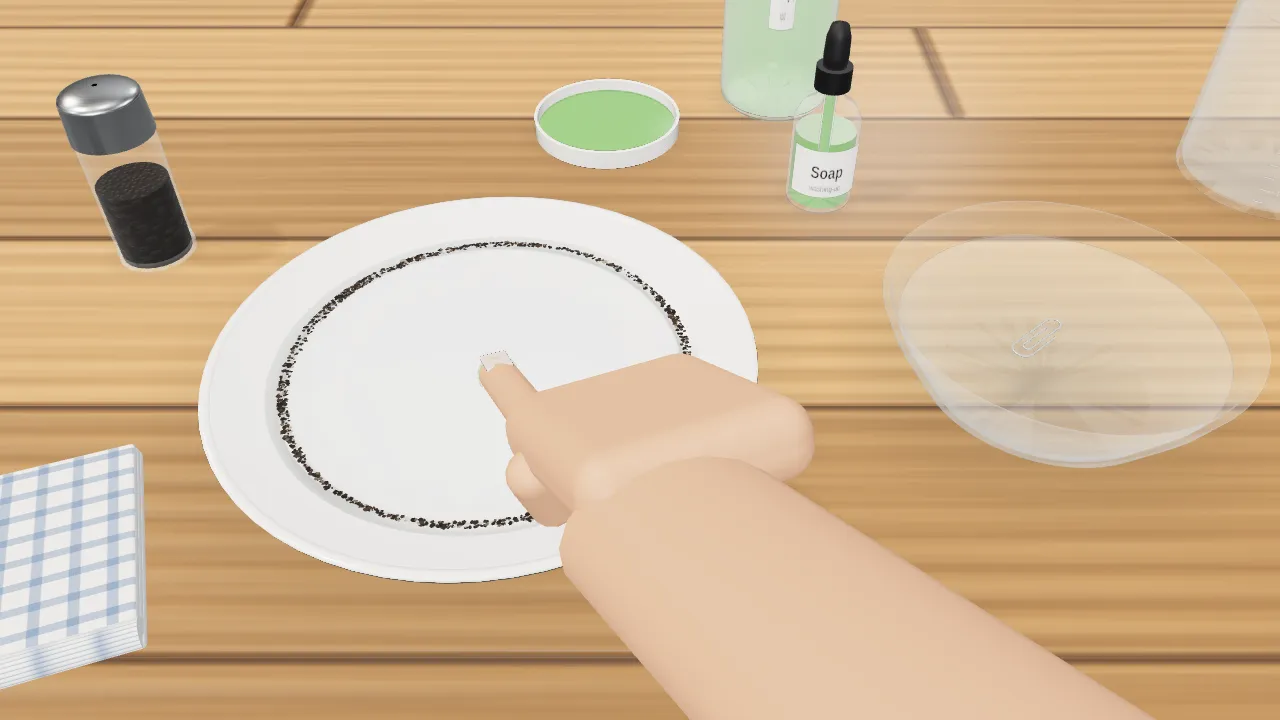
How to play
- Press on the water to touch it with your finger. A dry finger hardly moves the pepper, though a few flakes cling to your skin.
- Touch the green saucer to coat your fingertip in washing-up liquid, then touch the pepper again. Wipe your finger on the tea towel to clean it.
- Drag the paper clip over the glass bowl, hold it still just above the water and let go. Drag the dropper over the bowl to add a drop of soap.
- Drag the pepper shaker over the plate and shake it to and fro for more pepper. Tap the jug for fresh water; Lab has slow motion.
Challenges
- Clear a hole in the pepper with a soapy finger
- Float a paper clip on the water
- Sink a floating paper clip with one drop of soap
Try this
- Touch the soapy finger near the edge of the plate instead of the middle. The pepper piles up on the far side.
- Touch the same water with soap a second time. Almost nothing happens: the surface is already as weak as soap can make it.
- Drop the paper clip in quickly and it sinks, even in clean water. Lowered gently, the same clip stays afloat.
Fun facts
- At room temperature, water’s surface tension is about 72 millinewtons per metre, higher than almost any other common liquid.
- Flow driven by differences in surface tension is called the Marangoni effect, after the Italian physicist Carlo Marangoni, who studied it in the 1860s.
- Pond skaters walk on water by spreading their weight over long, water-repellent legs that dimple the surface without breaking it.
- A steel paper clip is about eight times as dense as water, yet surface tension can hold one up.
A skin on the water, and what soap does to it
A molecule inside a glass of water is tugged equally in every direction by its neighbours. At the surface there is nothing above to pull back, so the surface molecules are drawn sideways and inward, and the surface behaves like a stretched elastic skin. Its surface tension is about 72 millinewtons per metre at room temperature: strong enough to hold up specks of water-repellent ground pepper, and even a steel paper clip if you lay it down gently.
Why a soapy finger scatters the pepper
Washing-up liquid is made of surfactant molecules. One end likes water and the other avoids it, so they crowd onto the surface and weaken it. Where your soapy finger touches, the surface tension drops to around 30 mN/m. Everywhere else the surface is still pulling at full strength, so the top layer of water is tugged away from the soapy spot in all directions. Flow driven by a difference in surface tension is called the Marangoni effect. The pepper floats on that moving layer and rides outward with it: it isn’t repelled by the soap, it is carried away.
A dry finger does almost nothing, because it doesn’t change the surface tension. And once soap has spread over the dish, a second touch hardly moves anything: there is no strong, clean surface left to do the pulling. Soap works as a layer just one molecule thick, so a fingertip carries far more than enough for a whole plate.
Floating steel
A paper clip is about eight times denser than water, so by rights it should sink. Resting on the surface, though, it presses a shallow dimple into it, and the curved surface along each side of the wire pulls upward like a trampoline. Laid down gently, the clip is held up mostly by surface tension rather than buoyancy. Dropped in quickly, it punches through before the dimple can take its weight. Add soap and the weakened surface can no longer hold it; soap also helps water wet the steel, and the clip sinks.
Safety
This one is kitchen-safe. Keep washing-up liquid out of eyes and pepper away from noses, and see our disclaimer before trying experiments at home.
For the curious
Surface tension γ is a force per unit length. Along a floating wire of length L, the water can pull up with at most about F ≈ 2γL, one contact line on each side. For a paper clip with L ≈ 0.11 m that is 2 × 0.072 × 0.11 ≈ 0.016 N, about three times its weight of roughly 0.005 N. In the simulation a soapy touch starts a front that spreads as r ∝ t3/4, a scaling found for surfactant spreading on deep water, pushing the pepper ahead of it until the flakes pack against the rim of the plate.
Questions people ask
Why does pepper move away from soap?
Soap lowers the surface tension where it touches the water. The clean surface around it pulls harder, so the surface layer of water flows outward and carries the floating pepper with it. This is the Marangoni effect.
Why doesn’t it work a second time?
After the first touch, soap spreads over the whole surface and lowers its tension everywhere. With no strong, clean surface left to do the pulling, nothing drives the flow. Fresh water brings the trick back.
How do you float a paper clip on water?
Lay it flat on the surface very gently, for example by lowering it on a fork or a scrap of tissue paper that then sinks away. Surface tension holds it up in a shallow dimple. If it goes in edge first or too fast, it breaks through and sinks.