Emperor Penguin Huddle
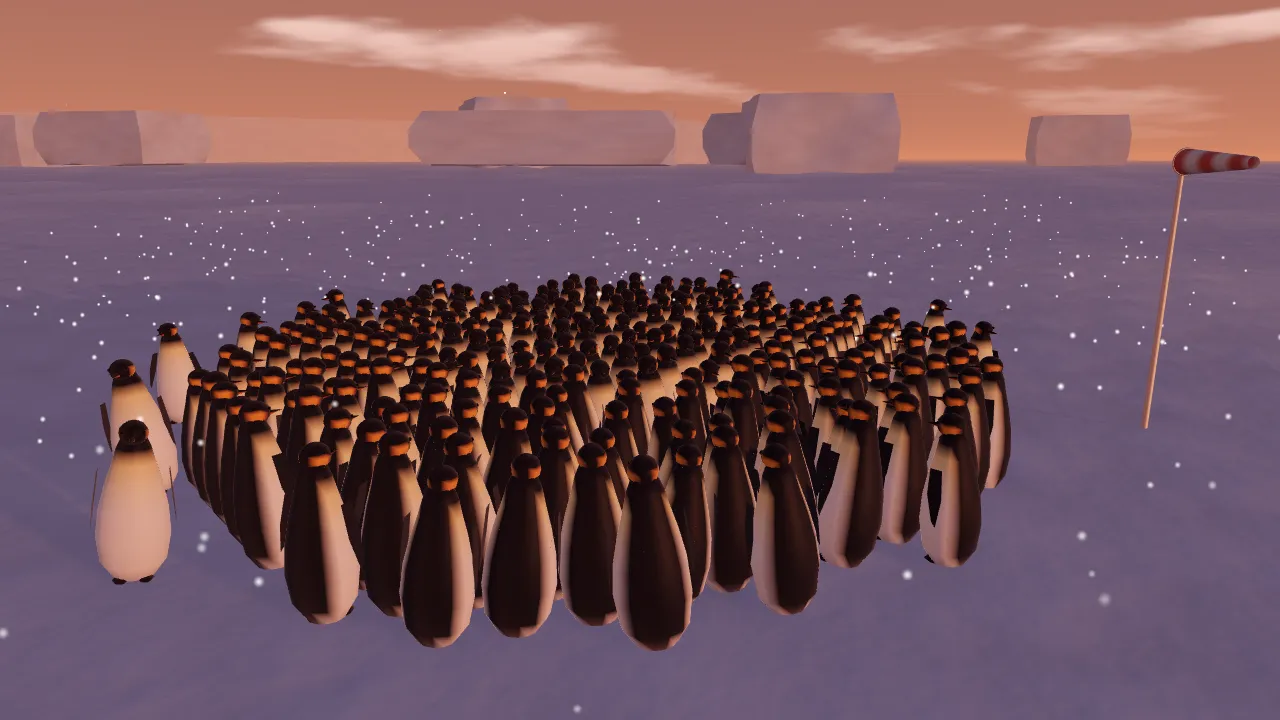
Carry emperor penguins, turn the wind and see the huddle share warmth.
How to play
- Drag a penguin to pick it up and carry it. Set it down on the windy edge and watch it chill, then walk round to shelter.
- Tap any penguin to feel how warm it is: the snug ones are deep inside the huddle.
- Grab the windsock and swing it round to turn the wind. The huddle reshapes and slowly drifts away from the new wind.
- Try the three Challenges, or open Lab for the air temperature, wind speed, a blizzard gust and the thermal camera.
Challenges
- Find a penguin that’s snug and warm in the middle of the huddle
- Carry a penguin to the windy edge and watch it walk round to shelter
- Swing the windsock to turn the wind and see the huddle drift a metre away
Try this
- With the thermal camera on, compare the windward side with the sheltered side. The coldest birds, in blue and purple, are almost all on the side facing the wind.
- Drop the wind to 0. The wind-chill readout rises toward the air temperature, fewer penguins feel cold, and the walking slows down.
- Watch the “Huddle has crept downwind” readout for a minute. As cold birds keep moving to the lee side, the whole huddle shuffles slowly downwind.
Fun facts
- Emperor penguins are the largest of all penguins, and they breed on the sea ice during the Antarctic winter.
- The male keeps the single egg warm on his feet, under a fold of feathered skin called a brood pouch, for about two months while the female feeds at sea.
- Researchers filming huddles found that the penguins make small, coordinated steps every so often, and that these steps travel through the huddle as waves.
- Emperor penguins have dense, overlapping feathers and a thick layer of fat that help keep their body heat in.
Sharing warmth in the coldest place on Earth
Emperor penguins do the hardest part of raising a chick in the dark Antarctic winter. While the females are away feeding at sea, the males stand on the sea ice for weeks, each balancing an egg on his feet, without eating. Out in the open, wind strips heat from a body very quickly. Their answer is to stand together.
Why huddling works
Heat leaks out through every surface that faces the cold air. A penguin in the middle of a tight huddle is surrounded by warm neighbours, so it loses very little heat. A penguin on the edge has cold air on one side, and if that side faces the wind it loses heat fast, because moving air carries heat away far better than still air. In this simulation, each penguin checks eight directions around it. Every gap with no neighbour lets heat escape, and gaps facing into the wind count about three times as much.
Taking turns at the edge
No penguin can stay on the windward edge for ever. When one gets too cold, it leaves and walks round the outside of the huddle to the sheltered side, where it tucks in behind the others. Mathematicians have shown that this simple rule, in which the coldest penguins move to the most sheltered spots, is enough to keep the huddle constantly turning over, so that everyone gets time in the warm middle. Because new arrivals always join the downwind side, the whole huddle slowly creeps downwind, which is just what the readout shows.
Waves through the crowd
A tight huddle can’t shuffle all at once. Filming has shown that penguins in a huddle take tiny steps together every so often, and these steps ripple through the crowd as travelling waves. You can see the same waves here: a front of small steps sweeps through every so often, nudging the huddle along.
For the curious
The wind-chill readout uses the formula adopted by weather services in Canada and the United States in 2001, WCT = 13.12 + 0.6215T − 11.37V0.16 + 0.3965TV0.16, with the air temperature T in °C and the wind speed V in km/h. Each penguin’s warmth changes at a rate proportional to (0.5 − 1.6 × e × L), where e is its weighted exposure from 0 to 1 and L = (37 − WCT) / 60 is the cooling power of the air. A penguin with warmth below 0.28 that is exposed on the edge walks to the lee side. Penguins push each other apart if they come closer than 42 cm, and the thermal camera colours each bird from purple (cold) through red to yellow (warm). The colours show the model’s warmth, not real measured temperatures.
Questions people ask
Why do emperor penguins huddle together?
To save heat. Each penguin in a huddle is sheltered by its neighbours, so it loses far less heat to the wind and cold than a penguin standing alone. This lets the males survive weeks of winter on the ice while they incubate their eggs without eating.
How warm is it inside a penguin huddle?
Much warmer than outside. Measurements inside huddles have found temperatures above freezing even when the air outside is far colder, and penguins in the middle sometimes need to move toward the edge to cool off.
Do penguins take turns in the middle of the huddle?
In effect, yes. Penguins on the cold windward edge move round to the sheltered side, which pushes others toward the middle. Over time, birds cycle between the edge and the warm interior, and the whole huddle drifts slowly downwind.