Pendulum Clock Escapement
Swing a brass pendulum, wind the weight and regulate a real clock.
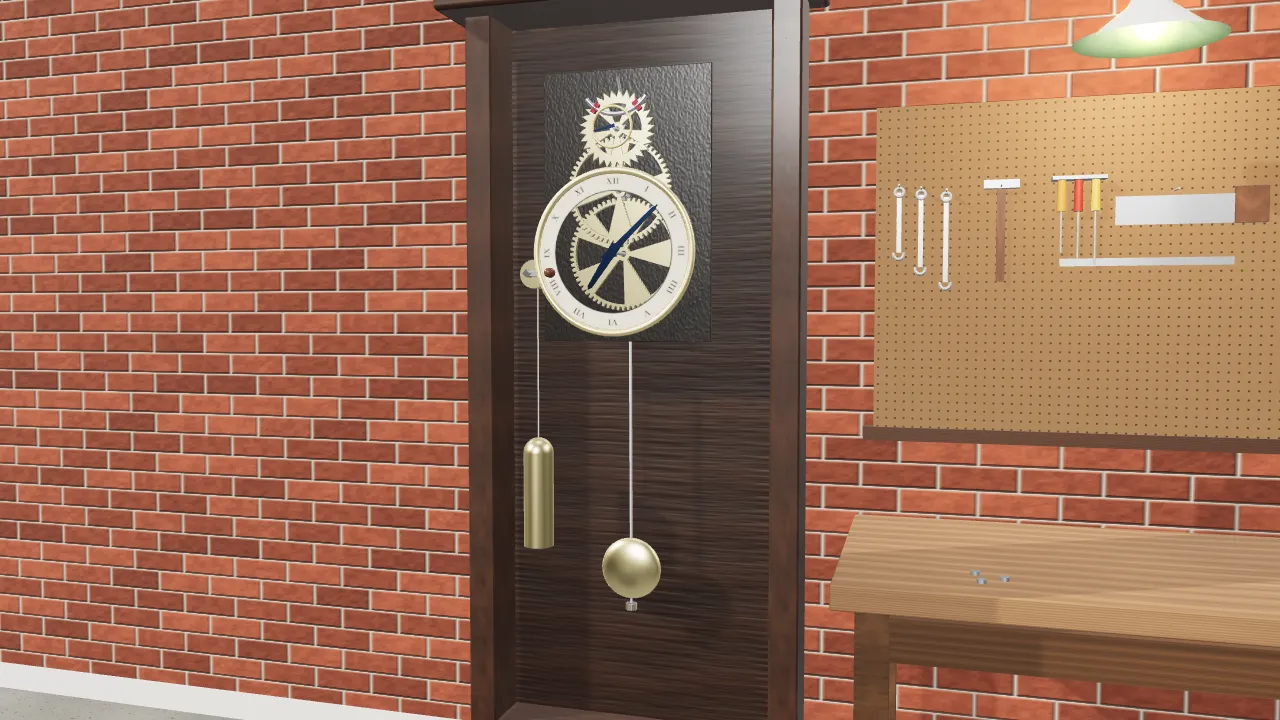
How to play
- Drag the brass bob sideways and let go. Every swing lets the escape wheel slip half a tooth: tick, then tock.
- Turn the knurled rating nut under the bob to raise or lower it. Each turn changes the length by 5 mm.
- Watch the Clock readout and adjust until the clock keeps time. A longer pendulum swings more slowly.
- Turn the little crank on the barrel to wind the weight up. When it runs down, the clock stops.
Challenges
- Give the pendulum a swing and set the clock ticking
- Wind the weight right up to the top with the crank
- Turn the rating nut until the clock keeps time to within 30 seconds a day
Try this
- Shorten the pendulum to 0.25 m. The period halves, so the clock runs twice as fast.
- Switch gravity to the Moon. The same clock would lose most of every day.
- Lower the driving weight to 0.3 kg. The swing shrinks, but the period hardly changes.
Fun facts
- Christiaan Huygens built the first pendulum clock in 1656, making clocks dramatically more accurate.
- A seconds pendulum, which takes one second for each swing from side to side, is about 99.4 cm long.
- The period of a pendulum depends on its length and on gravity, not on the mass of its bob.
- The anchor escapement appeared in England around 1670 and made long pendulums with small swings practical.
How an escapement turns a swing into time
A clock needs two things: something that repeats at a steady rate, and a way to count the repeats. The pendulum does the first. The escapement and gear train do the second, and the escapement also gives the pendulum the tiny pushes it needs to keep going.
The steady swing
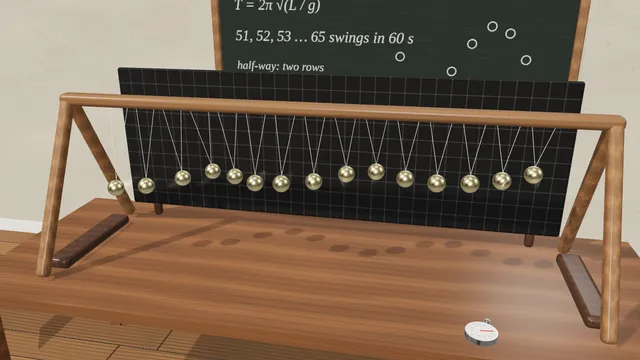
For small swings a pendulum’s period is T = 2π√(L/g), where L is its length and g the strength of gravity. Mass doesn’t appear at all. With L = 0.994 m on Earth, T is 2.00 s: one second each way, which is why this is called a seconds pendulum. Lengthen it and it slows down; take it to the Moon and it slows a lot.
The escapement
The anchor rocks with the pendulum, and its two pallets dip in and out of the teeth of the escape wheel. The falling weight is always trying to turn the wheel, but the pallets hold it. Each time the pendulum swings out past a few degrees, one pallet lifts, the wheel slips forward half a tooth and the next tooth lands on the other pallet. That is the tick. On the way back through the middle, the tooth slides along the pallet and gives it a little push, putting back the energy that friction and air took. So the weight keeps the pendulum going, and the pendulum lets the weight down one half-tooth at a time.
Counting the swings
The escape wheel has 30 teeth and advances one tooth per period, so with a 2 s pendulum it turns once a minute and can carry a seconds hand. The gears multiply the count down: the centre wheel’s 64 teeth drive an 8-leaf pinion, and the third wheel’s 60 teeth drive another, so the escape wheel turns 60 times for every turn of the minute hand.
Why big swings are slightly slow
The formula is exact only for tiny swings. Larger swings take a little longer, roughly by a factor of (1 + θ₀²/16), where θ₀ is the amplitude in radians. In this clock a swing of about ±3.7° makes it lose a little over 20 seconds a day. Clockmakers keep swings small and steady for exactly this reason.
For the curious
The simulation integrates θ″ = −(g/L)·sin θ − b·θ′ + impulse 1200 times a second. The impulse is applied only after a tick has released a tooth, and only while the pendulum passes through the middle of its swing, so if the swing becomes too small to unlock the wheel, the clock really does stop.
Questions people ask
How does a pendulum clock keep time?
The pendulum swings with a very steady period that depends only on its length and gravity. An escapement lets the gear train advance a fixed amount for each swing, and gives the pendulum a small push each time to keep it going.
Why does a pendulum clock tick?
Each tick is a tooth of the escape wheel dropping onto a pallet of the anchor after the other pallet releases it. The two pallets alternate, which gives the familiar tick-tock.
How long is the pendulum of a grandfather clock?
A longcase clock that beats seconds has a pendulum about one metre long, close to 99.4 cm, because a pendulum of that length takes one second for each swing.