Penalty Shootout
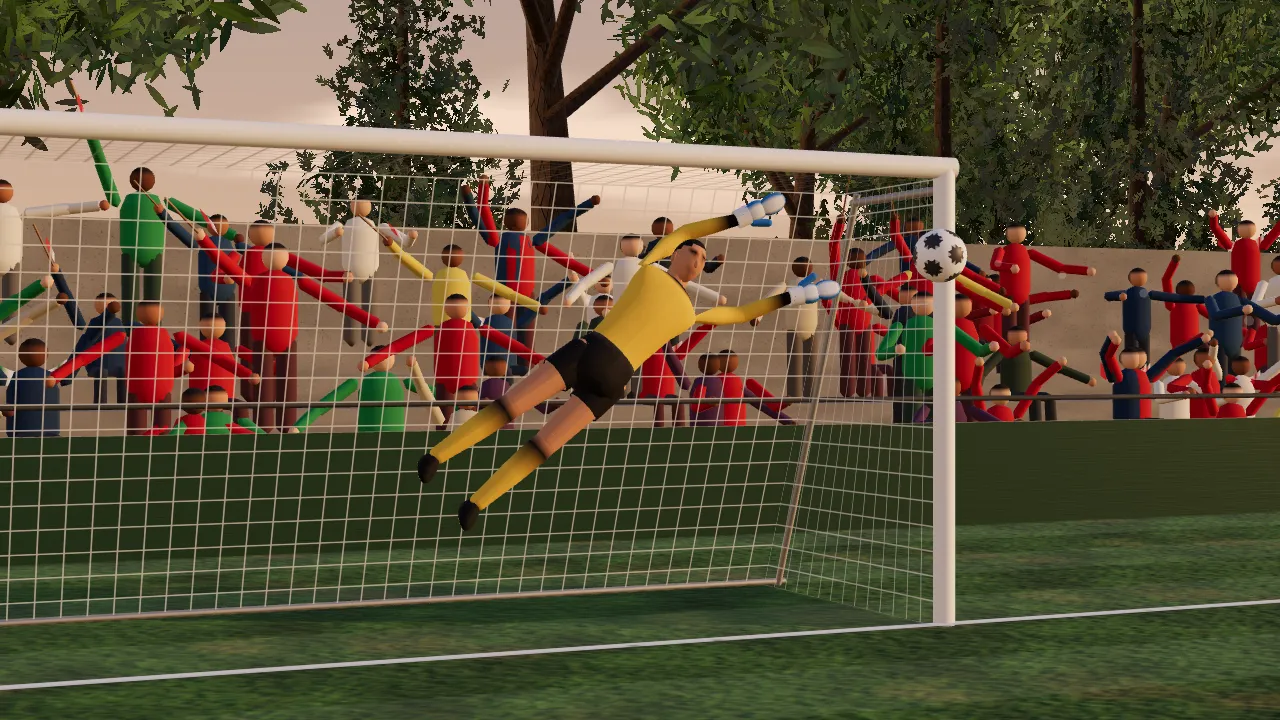
Swipe to shoot, curve the ball and win a shootout against the keeper.
On Amazon.in. As an Amazon Associate I earn from qualifying purchases.
How to play
- Swipe from the ball toward the goal and lift your finger: the ball heads for the spot your swipe points at. A longer swipe aims higher, and a faster swipe hits harder.
- Curve your swipe to put side spin on the ball. The spin bends it in the air, so a curled shot starts wide of the keeper and swings back inside the post.
- When the computer shoots, tap the left, centre or right of the goal to choose your dive before the kick.
- Each side takes five kicks, then sudden death if the score is level. In the Lab you can make the keeper easier or harder, or play under floodlights.
Challenges
- Score in a top corner, high and close to a post
- Bend a curling shot past the keeper and into the net
- Win a penalty shootout against the computer
Try this
- Swipe the same line twice, once straight and once with a curve. The curled shot leaves your foot pointing wide and swings back toward the line you swiped.
- Hit a few very hard shots and a few gentle ones at the same corner. The hard ones beat the keeper more often but stray more, which is the real trade-off a penalty taker makes.
- Shoot to the same side several times in a row. The keeper notices and starts diving that way, so mix up your corners.
Fun facts
- The penalty mark is 11 m from the goal line, and the goal is 7.32 m wide and 2.44 m high (8 yards by 8 feet), measured between the inside edges of the posts and up to the underside of the crossbar.
- A size 5 match ball has a circumference of 68 to 70 cm and weighs 410 to 450 g at the start of a match.
- At the moment of the kick, the goalkeeper must have at least part of one foot touching, or level with, the goal line.
- In a shootout each team takes five kicks, and it ends early if one team can no longer catch up. If the teams are still level after five, the kicks go on in pairs until one team scores and the other misses.
Spin, drag and a third of a second: the physics of a penalty
A penalty is a race between a ball and a person. A firm kick at about 25 metres per second covers the 11 metres to the goal line in under half a second. A human needs a few tenths of a second just to see where the ball is going and start moving, and a diving keeper needs about as long again to reach a corner. That is why keepers so often choose a side before the ball is struck, and why a well-placed kick into a corner is so hard to save.
Drag on a football
Air pushes back on a moving ball with a force that grows with the square of its speed. A football is unusual: at the speeds of a real shot the thin layer of air around it becomes turbulent, clings to the ball for longer, and leaves a smaller wake behind it. This drag crisis lowers the drag coefficient a long way, to roughly 0.2 to 0.3, so a hard kick keeps most of its speed all the way to the net. Here the ball carries a drag coefficient of 0.25 and loses about 2 metres per second on the way.
The Magnus effect
Strike the ball off-centre with the inside of the foot and it leaves spinning. A spinning ball drags the air around with it: on one side the surface moves with the oncoming air, on the other against it. The air is deflected to one side, and by Newton’s third law the ball is pushed the other way. A ball spinning anticlockwise seen from above curves to the left. The sideways force grows with the spin and with the square of the speed, and because the push lasts the whole flight, the ball bends along a curve rather than turning a corner.
Why a curled shot fools the keeper
Keepers read the line of the ball off the foot. A curled shot starts on one line and ends on another: aimed outside the post, it bends back inside. In this game the kick is worked out with the same spin and drag the ball flies with, so a curved swipe sends the ball out wide first and lets the spin bring it back onto your line. A spin of a few revolutions per second is enough to bend a penalty by more than half a metre.
For the curious
The ball (mass m, cross-section A) feels gravity, drag and Magnus lift: m·dv/dt = m·g − ½ρCDA·|v|·v + ½ρCLA·|v|²·(ω̂ × v̂). The lift coefficient CL rises with the spin parameter S = rω/|v|; here CL ≈ S, capped at 0.32. Over a flight of length d the sideways bend is about Δy = ½·a·t² with a = ρCLA·v²/(2m) and t = d/v, which gives Δy ≈ ρCLA·d²/(4m): for a fixed lift coefficient the bend does not depend on how hard you hit it. With ρ = 1.2 kg/m³, A = 0.038 m², m = 0.43 kg, d = 11 m and CL = 0.2, Δy ≈ 0.6 m.
Questions people ask
Why does a spinning football curve?
A spinning ball drags air around with it, so the air flowing past is deflected to one side and pushes the ball the other way. This is the Magnus effect. The faster the spin and the faster the ball, the stronger the sideways push.
Why do goalkeepers dive before the ball is kicked?
A hard penalty reaches the goal in under half a second. Seeing the ball, deciding and diving to a corner takes about that long, so a keeper who waits to see the ball is usually too late for a shot near the post. Guessing early, or reading the taker’s run-up, gives a chance.
How does a penalty shootout work?
Each team takes five kicks, alternating, and the shootout stops as soon as one team cannot catch up. If the score is still level after five each, the teams keep taking one kick each until one scores and the other misses.