Parade Balloons
Steer giant helium parade balloons down a city avenue against the wind.
How to play
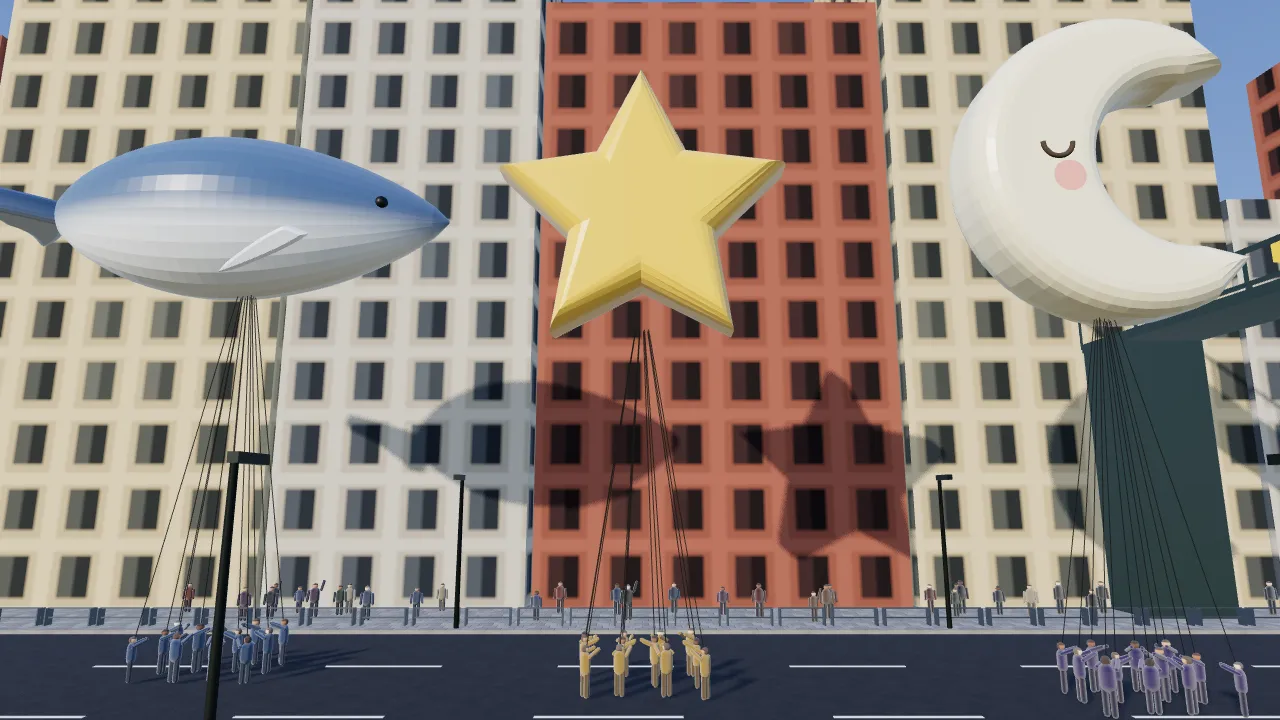
- Drag a team of handlers along the avenue. Their balloon follows on its lines, swaying a little behind them.
- Drag a balloon down to pull its lines in, or up to let them out. Each balloon must come down low to fit under the footbridge.
- Every so often a gust sweeps across the avenue. Pull the lines in before it arrives: on short lines the balloon barely swings.
- Walk all three past the reviewing stand. Try the three Challenges, or send a gust from Lab.
Challenges
- Steer the whale under the footbridge
- Hold a balloon steady through a gust, swinging less than 4.5 m
- Walk all three balloons past the reviewing stand
Try this
- Watch the line tension readout as a gust arrives. The lines must hold both the lift and the push of the wind, so the tension rises.
- Let the whale’s lines all the way out, then pull them in during a gust. The lean angle stays about the same, but the swing shrinks with the line length.
- Compare the star and the whale in a gust. The star has a big flat face for its lift, so the wind pushes it much further over.
Fun facts
- Many cities hold parades with giant helium balloons. One of the best known is held on Thanksgiving Day in the United States.
- Helium is about seven times less dense than air, so every cubic metre of it can lift roughly one kilogram.
- Giant parade balloons are steered by teams of handlers holding lines, and organisers keep them low, or leave them out, when the wind is too strong.
- Helium does not burn, which is why it replaced hydrogen for balloons that fly near people.
Lift, wind and the lines that hold a parade balloon
A morning parade with giant balloons is a favourite tradition in many cities, often on a public holiday such as Thanksgiving in the United States. Floating whales, stars and characters drift above the crowds, each one walked down the street by its own team of handlers. Keeping them there is a lesson in buoyancy, drag and tension.
Why the balloons want to rise
Air pushes up on everything in it with a force equal to the weight of the air the object displaces: Archimedes’ principle. A cubic metre of air weighs about 1.2 kilograms, but a cubic metre of helium only about 0.17 kilograms, so each cubic metre of helium brings about a kilogram of upward pull. A giant balloon holds hundreds of cubic metres. After the weight of its coated fabric, a whale like the one here still wants to rise with a force like the weight of 160 kilograms, and the handlers’ lines hold it down.
What the wind does
Wind pushes on the balloon with a drag force that grows with the square of the wind speed, and with the area facing the wind. The balloon settles where the lines pull back against both lift and drag together, so it leans downwind. In a steady wind the lean angle depends only on the ratio of drag to lift, not on the length of the lines. But the distance the balloon swings sideways is the line length times the sine of that angle: long lines mean a big swing, short lines a small one. That is why handlers bring balloons down low when the wind picks up.
Gusts and tension
A gust can double or treble the wind for a few seconds. Drag rises with the square of the speed, so a gust three times the breeze pushes about nine times as hard, and the lines feel the extra load as tension. A balloon with a big flat face and modest lift, like the star, is pushed over much further than a big, streamlined one like the whale.
For the curious
The net lift is B = (ρair − ρHe)·V·g − m·g and the drag is D = ½·ρ·Cd·A·v². With taut lines of length L, the balance of forces gives a lean tan θ = D / B, a sideways swing s = L·sin θ and a line tension T = √(B² + D²). The simulation moves each balloon with these forces, the added mass of the air it pushes aside and an inextensible tether to its handlers, and lets it bump against the footbridge if its top is higher than the gap.
Questions people ask
How do giant parade balloons float?
They are filled with helium, which is much less dense than air. The air around pushes up with a force equal to the weight of the air the balloon displaces, which is more than the weight of the helium and the fabric together.
Why are parade balloons flown low in the wind?
Wind pushes a tethered balloon over to an angle that depends on drag and lift. The sideways swing is the line length times the sine of that angle, so shorter lines keep the balloon closer to its handlers and away from lamp posts and crowds.
How much can a cubic metre of helium lift?
About one kilogram at sea level and room temperature: the difference between the density of air, about 1.2 kg/m³, and of helium, about 0.17 kg/m³, minus the weight of the balloon itself.