Office Paper Toss
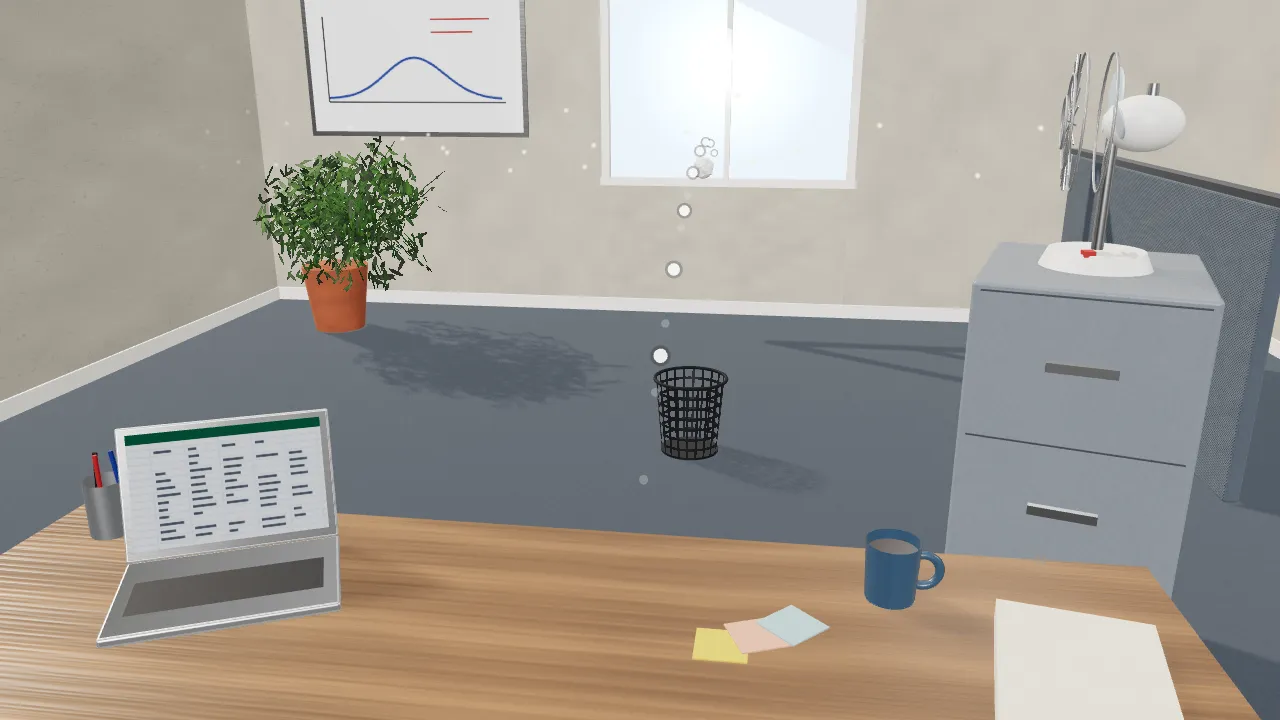
Toss crumpled paper into the bin while a desk fan blows it off course.
How to play
- Drag back from anywhere and let go to toss. Pull further for a longer throw.
- Drag slightly left or right to aim the other way, like a slingshot.
- The dotted arc shows where the paper would fly in still air. When the fan is on, aim off to let the breeze carry it in.
- Tap the desk fan’s base to change its speed, tap the knob on top to make it swing, or drag its head to turn it.
- Each round has five sheets and the fan gets stronger every round, until you set it yourself. Try the three Challenges.
Challenges
- Toss a paper ball into the bin
- Sink one with the fan on high
- Score while the fan swings from side to side
Try this
- With the fan on high, aim straight at the bin and watch where the paper lands. Then aim off by the same distance the other way.
- Turn off Air resistance in Lab. Without air the fan can’t push anything, and the paper flies like a stone.
- Tap the knob on top of the fan to make it swing, and time your throws for the moments when it looks away.
Fun facts
- A sheet of A4 office paper weighs about 5 grams: A4 is one-sixteenth of a square metre and standard copy paper is 80 grams per square metre.
- On the Moon in 1971, Apollo 15 astronaut David Scott dropped a hammer and a falcon feather together. With no air to slow the feather, they landed at the same moment.
- A fan’s breeze fades quickly with distance because the moving air drags the still air around it along, sharing its momentum with more and more air.
Why a paper ball is so easy to blow off course
Gravity pulls on every gram of the paper ball, but air resistance only cares about its size and speed. A crumpled sheet is big for its weight, which makes it unusually sensitive to air. That is the whole secret of this game, and it explains why a gentle desk fan that would never move a tennis ball can carry your throw right past the bin.
Drag compared with weight
Air pushes back on a moving ball with a force of F = ½ρCdAv², where ρ is the density of air (about 1.2 kg/m³), A is the ball’s cross-section, Cd is a shape factor and v is the speed through the air. The ball in this game weighs 5 grams and is about 7 cm across. Its terminal velocity, the speed at which drag would balance its weight, is only about 6 m/s, close to the speed of your throw. So from the moment it leaves your hand, drag is almost as strong as gravity. A tennis ball, which is about the same size, weighs more than ten times as much and would have to fall at roughly 20 m/s or more before drag caught up.
Wind is just air moving sideways
Drag depends on the ball’s speed relative to the air. When the paper crosses the fan’s jet, the air is moving sideways, so drag gains a sideways part and pushes the ball along with the breeze. The lighter the ball for its size, the bigger the push. In this office, a ball thrown straight at the bin drifts a few centimetres with the fan on low, enough to clip the rim, and clean past the bin on medium or high.
The fan’s jet
Air leaving a fan forms a jet. As it travels, it mixes with the still air around it and drags it along, so the jet widens and slows. Here the speed along the middle of the jet falls as U = U₀ / (1 + x / 1.2 m), where x is the distance from the fan, and it fades towards the edges like a bell curve whose width grows with distance. The jet crosses your throw near the top of the arc. A push there has the rest of the flight to carry the paper sideways, which is why it matters so much.
Aiming off
The dotted line shows the path the paper would follow in still air. With the fan on, the real path bends away from it, and the difference is exactly the wind’s effect. Good players aim upwind by that amount. When the fan swings side to side, the push depends on when you throw, so patience pays.
For the curious
Each step computes the air velocity w at the ball’s position and the relative velocity v − w, then adds gravity and drag: a = g − (ρCdA / 2m)·|v − w|·(v − w), with Cd = 0.62 for a lumpy paper ball. The motion is integrated 240 times a second. The bin is an open cylinder with a wire rim, and balls that come to rest inside become obstacles, so a full bin really does fill up.
Questions people ask
Why does a crumpled paper ball curve in the wind?
Because it is very light for its size. Air resistance depends on size and speed relative to the air, while weight depends on mass. Moving air pushes sideways on the paper with a force that is large compared with its weight, so the breeze changes its path a lot.
Does a tighter paper ball fly further?
Usually, yes. Crumpling the sheet more tightly keeps the same weight in a smaller ball, so air resistance slows it less and the wind pushes it less.
How do you get better at paper toss?
Use a high, soft arc so the ball drops into the bin rather than skidding across the rim, keep your throws consistent, and aim upwind when a fan or air vent is blowing.