Paper Chromatography
Dot black inks on paper, let water climb it and see the colours split.
How to play
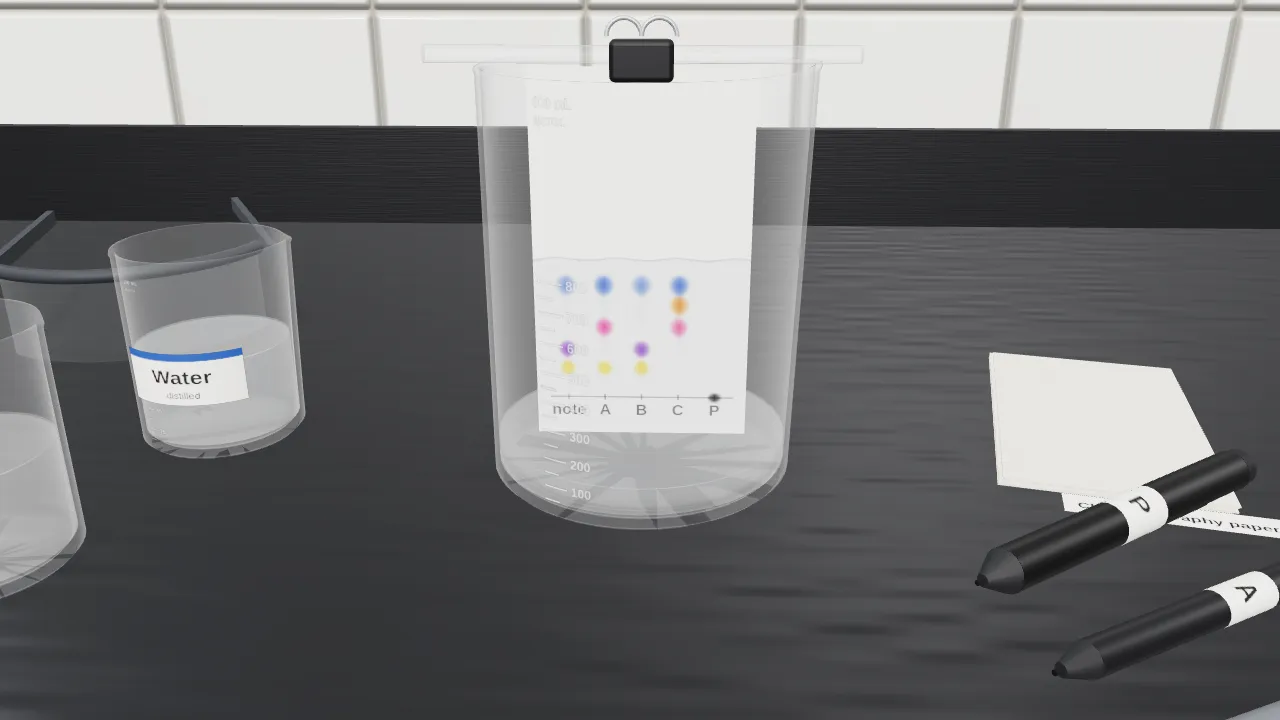
- Drag a pen onto the pencil line on the paper to put a dot of ink at a tick; hold it there for a darker dot. The note can be dotted the same way.
- Tip the water or ethanol beaker over the big beaker to pour in a centimetre or so of solvent. Keep the level below the pencil line.
- Drag the paper over the big beaker and let go to hang it. The solvent climbs, and the dyes travel with it at different speeds.
- Drag the paper out to stop the run (the front is marked in pencil), then tap a coloured spot to measure its Rf. Tap the paper stack for a fresh sheet.
Challenges
- Separate a black ink into three dyes
- Take the paper out and measure a dye’s Rf
- Find which pen wrote the note
Try this
- Run the permanent marker (P) in water: it stays put on the line. Then try it in ethanol, which dissolves its dye.
- Run the same inks in ethanol instead of water. The dyes come out in a different order, because each one prefers each solvent differently.
- Pour so much solvent that it covers the pencil line, and watch the dots bleed into the pool instead of climbing.
Fun facts
- An Rf value is always between 0 and 1, because a dye can never travel further than the solvent carrying it.
- The starting line is drawn in pencil because graphite doesn’t dissolve and run like ink.
- Chromatography was pioneered in the early 1900s by the botanist Mikhail Tsvet to separate plant pigments; its name means “colour writing”.
- Archer Martin and Richard Synge won the 1952 Nobel Prize in Chemistry for inventing partition chromatography.
Racing dyes up a strip of paper
Chromatography separates a mixture by letting a moving liquid carry it past something that holds it back. In paper chromatography the paper is the stationary phase and a solvent such as water or ethanol is the mobile phase. Put a dot of ink just above the bottom of the paper, dip the bottom edge in the solvent, and capillary action draws the solvent up through the tiny gaps between the cellulose fibres, through the dot and beyond.
Why the colours separate
Each dye in the ink is constantly shared between the moving solvent and the paper, which holds a thin film of water bound to its fibres. A dye that dissolves well in the solvent and clings weakly to the paper spends most of its time on the move, so it travels far. A dye that sticks to the paper lags behind. Over a few centimetres these small differences add up, and a single black dot opens into a column of separate coloured spots. Change the solvent and the balance changes too, which is why water and ethanol can put the same dyes in a different order.
The Rf value
To compare runs, chemists measure how far each spot moved relative to the solvent. The retention factor is Rf = distance moved by the dye ÷ distance moved by the solvent front, both measured from the pencil starting line. With the same paper, solvent and temperature, a given dye gives the same Rf every time, so matching colours and Rf values is good evidence that two inks contain the same dyes. That is how a note can be matched to the pen that wrote it.
Good technique
Draw the starting line in pencil, because graphite doesn’t dissolve. Keep the solvent below that line, or the dots dissolve into the pool instead of climbing. Take the paper out before the solvent reaches the top and mark the front straight away, because it is hard to see once the paper dries. A lid on the tank keeps the air inside full of solvent vapour, so the paper doesn’t dry out as the solvent climbs.
Safety
Ethanol is highly flammable and harmful if swallowed: use only small amounts, well away from flames, with an adult in charge. Water and felt-tip inks are fine on a kitchen table. Please read our disclaimer.
For the curious
Capillary rise in paper roughly follows Washburn’s law: the distance climbed grows with the square root of time, L² = D t, where D ∝ γ r cos θ ÷ 2η (surface tension γ, pore radius r, contact angle θ, viscosity η). Water’s high surface tension and low viscosity make it climb faster than ethanol, and the front slows as it rises, so the first centimetre takes far less time than the last. In this simulation each dye moves at Rf times the solvent front, and its spot spreads in proportion to the square root of the distance travelled.
Questions people ask
What is an Rf value?
The retention factor: the distance a spot travels divided by the distance the solvent front travels, both measured from the starting line. It is always between 0 and 1, and under the same conditions the same dye gives the same Rf, so it helps identify substances.
Why is the baseline drawn in pencil?
Pencil marks are graphite, which doesn’t dissolve in water or ethanol, so the line stays put. A line drawn in ink would separate and run up the paper along with the samples.
Why doesn’t permanent marker move in water?
Its dyes are chosen to dissolve in alcohol-based solvents rather than water, which is what makes them hard to wash off. In water they stay on the starting line; in ethanol they dissolve and travel up the paper.