Chemical Garden
Drop metal-salt crystals into water glass and grow coloured tubes.
How to play
- Drag the tweezers into one of the jars of salt crystals: they pick up a crystal.
- Carry it over the tank and let go (or hold still) to drop it in. It sinks slowly through the thick water glass.
- Watch hollow coloured tubes grow up from it by osmosis. The garden runs 20 times faster than real life.
- Try the three Challenges, or open Lab for crystal size, temperature and time-lapse.
Challenges
- Drop a crystal in and grow a tube 5 cm tall
- Grow tubes from three different salts
- Grow a tube all the way up to the surface
Try this
- Drop a large and then a small crystal of the same salt. The large one feeds more tubes for longer.
- Warm the tank to 35 °C and compare the growth speed with a garden at 10 °C.
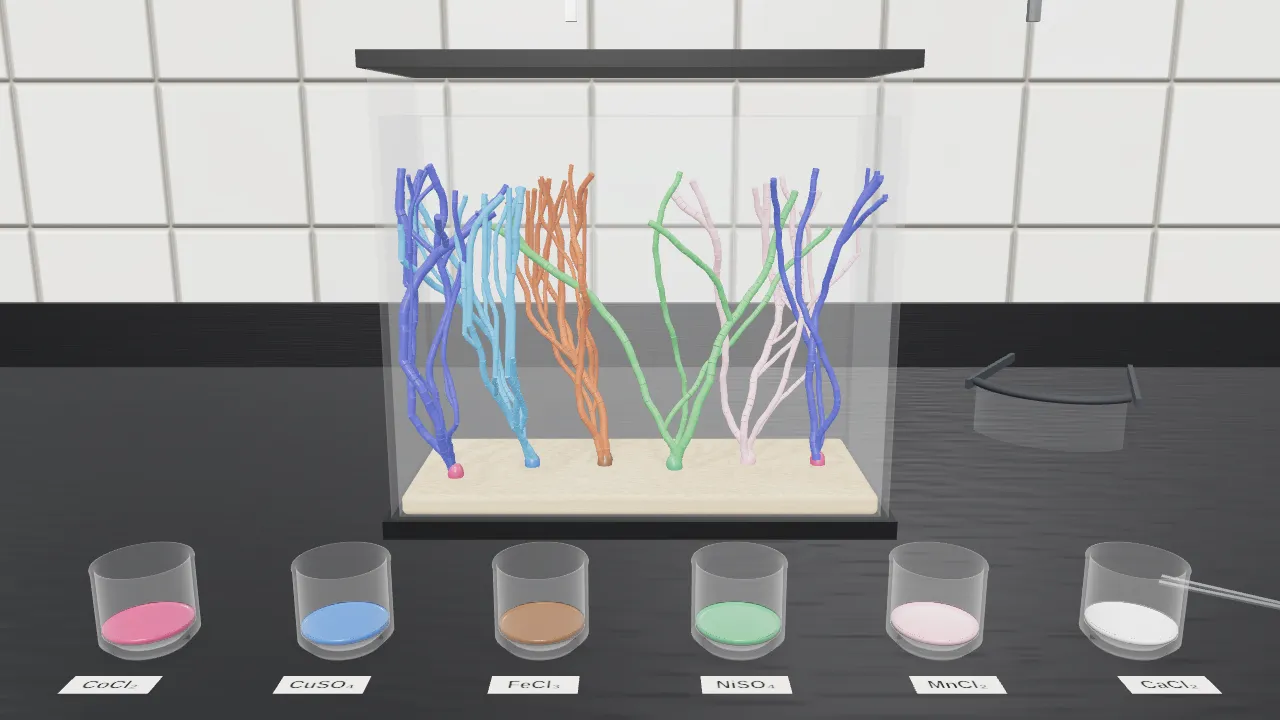
- Plant all six salts side by side. Each metal colours its tubes: blue cobalt, sky-blue copper, rusty iron, green nickel.
Fun facts
- Chemical gardens were first described by the chemist Johann Rudolf Glauber in 1646.
- The tubes are hollow: each is a thin shell of metal silicate around a column of salt solution.
- Similar self-building mineral chimneys form at some deep-sea hydrothermal vents, and some scientists study them as possible settings for the origin of life.
- Water glass is sodium silicate dissolved in water; it was once a popular way to preserve eggs.
A garden that grows by osmosis
Drop a crystal of cobalt chloride into a jar of diluted water glass (sodium silicate solution) and within minutes a deep blue stalk starts to climb, then another, twisting and branching like coral. Nothing is alive. The garden is built by chemistry and physics working together.
Step 1: a membrane forms
As the crystal starts to dissolve, its metal ions meet silicate ions in the surrounding liquid. The two react at once to form an insoluble metal silicate, a gel-like solid that coats the crystal in a thin skin. This skin is semipermeable: water molecules can pass through it, but most of the dissolved ions cannot.
Step 2: osmosis pumps water in
Inside the skin is a very concentrated solution of the metal salt. Outside, the water glass is less concentrated in dissolved particles. Water moves through a semipermeable membrane from the side with fewer dissolved particles to the side with more, a process called osmosis. So water floods in, and the pressure inside the skin rises.
Step 3: burst, rise, repeat
Eventually the skin ruptures, usually near the top. A jet of metal-salt solution escapes, and because it is less dense than the water glass around it, it rises. Wherever it touches fresh silicate, new membrane forms around it, so the jet builds itself a hollow tube. The tip keeps bursting and resealing, and the tube grows upwards in fits and starts, wandering and sometimes splitting. Growth slows as the crystal is used up.
Why the colours
Each metal gives its silicate a characteristic colour: cobalt gives blue to purple tubes, copper pale blue, iron(III) rusty orange-brown, nickel green and manganese a pale pink. Calcium gives white.
For the curious: osmotic pressure
For dilute solutions the osmotic pressure follows van ’t Hoff’s law, Π = icRT, where c is the concentration, i the number of ions each unit splits into, R the gas constant and T the absolute temperature. For 1 mol/L of cobalt chloride (i = 3) at 20 °C that is about 7 MPa, roughly 70 times atmospheric pressure, in the ideal case. Real concentrated solutions deviate from the ideal law, but the pressures involved are large, which is why the membranes keep bursting. In the simulation each tube tip climbs at a speed that decays as its crystal dissolves, v = v₀e−t/τ, scaled by a mild temperature factor, with a little random wandering and an occasional branch. The growth speeds are typical rather than measured.
Safety
Water glass is strongly alkaline and irritates skin and eyes. Cobalt and nickel salts are toxic and can cause allergic reactions, and cobalt chloride is classed as a possible carcinogen. Use gloves and goggles, work with an adult and dispose of the solutions properly. Please read our disclaimer.
Questions people ask
How does a chemical garden grow?
A metal-salt crystal forms a thin semipermeable membrane of metal silicate where it touches the water glass. Water rushes in by osmosis, the membrane bursts, and the escaping salt solution rises and coats itself in new membrane, building a hollow tube upwards.
What chemicals are used in a chemical garden?
A solution of sodium silicate (water glass) and crystals of metal salts such as cobalt(II) chloride, copper(II) sulfate, iron(III) chloride, nickel(II) sulfate, manganese(II) chloride or calcium chloride.
Is a chemical garden alive?
No. It only looks like plants or coral. The growth is driven by precipitation, osmosis and buoyancy, and it stops when the crystals have dissolved.