Optics Bench
Slide a candle, lens and screen to focus an upside-down flame.
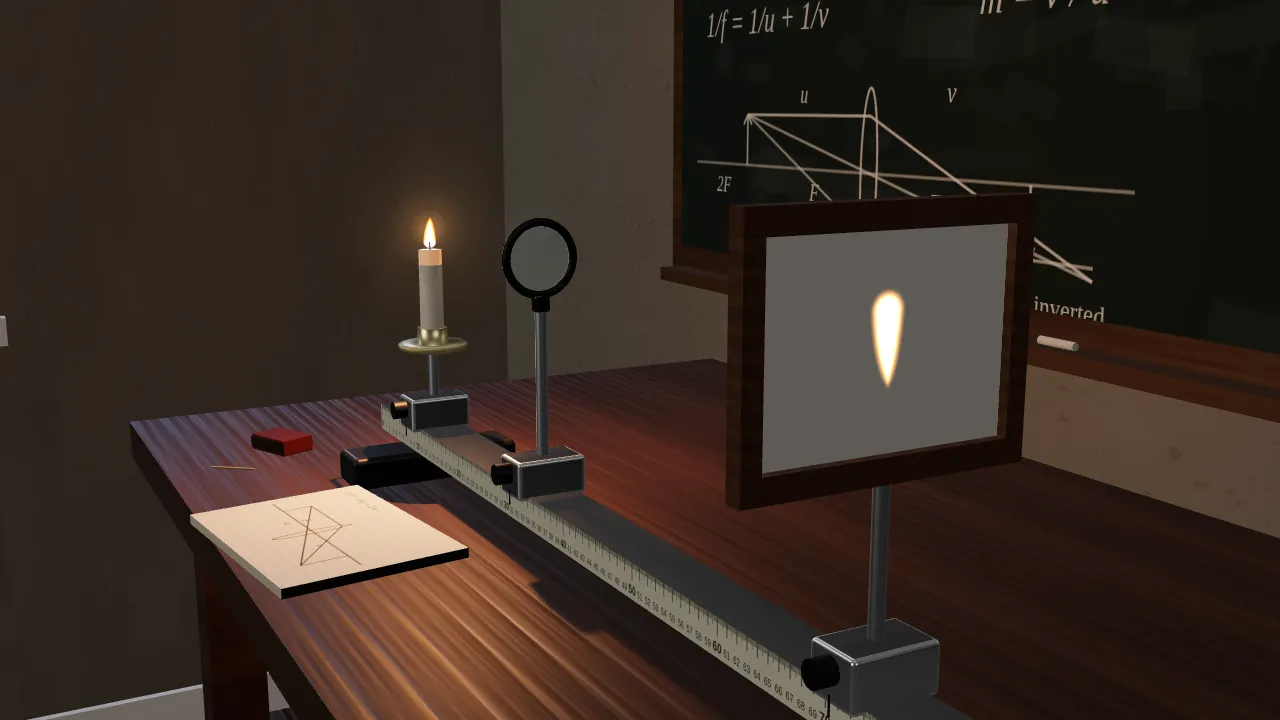
How to play
- Drag the candle, the lens or the screen along the rail. The scale on the rail shows where each one stands.
- At just the right distance a sharp, upside-down flame appears on the paper screen. Move the screen and the image blurs into a soft glow.
- Tap a lens in the wooden case to swap it into the holder, and tap the flame to make it flicker.
- Try the three Challenges, or open Lab to draw three rays and mark the focal points.
Challenges
- Focus a sharp image of the flame on the screen
- Make a sharp image twice as tall as the flame
- Find the focal length: make a sharp image exactly the size of the flame
Try this
- Move the candle closer to the lens and refocus. The sharp image forms further away and grows larger, but it gets dimmer, because its light is spread over a bigger picture.
- Bring the candle inside the focal length. No image forms on the screen at all, because the light leaves the lens spreading out.
- Swap in lens A, the most strongly curved one. It bends light more sharply, so everything comes to a focus closer to the lens.
Fun facts
- A convex lens makes a real image the same size as the object when both are two focal lengths from the lens, which gives a quick way to measure a lens.
- Your eye works like this bench: the cornea and lens throw a real, upside-down image onto the retina, and the brain makes sense of it the right way up.
- Opticians give lens strength in dioptres, one divided by the focal length in metres, so a lens with a focal length of 20 cm is a +5 dioptre lens.
- Convex lenses that focus sunlight to a hot spot, called burning glasses, have been used to start fires since ancient times.
How a convex lens forms an image: focal length and the lens equation
A convex lens is thicker in the middle than at the edges. Light passing through it is bent, or refracted, at each curved surface, and the shape of the lens tips every ray towards the middle. Rays that arrive parallel to the lens’s axis all cross at one point, the focal point, and its distance from the lens is the focal length, f.
From a flame to an image
Every point of the candle flame sends light out in all directions. The part that reaches the lens is bent and brought together again at a single point on the far side. Do that for every point of the flame and you get an image, a picture made of light that you can catch on a screen. Rays from the top of the flame end up at the bottom and rays from the left end up on the right, so the image is upside down and back to front. It is called a real image because the light really does meet there.
The lens equation
Where the image forms depends on how far the candle is from the lens. With the candle distance u and the image distance v, a thin lens obeys 1/f = 1/u + 1/v. Bring the candle closer and the image moves further away; push the candle back and the image comes in towards the focal point. The magnification, how many times taller the image is than the flame, is v/u. When the candle is two focal lengths away, the image forms two focal lengths away on the other side and is exactly the same size, a handy way to measure an unknown lens.
Why the image blurs
Light from one point of the flame fills the whole lens and narrows to a point at the image distance. If the screen stands closer or further away than that, it cuts the cone of light before or after its tip, and each point becomes a small disc. The discs overlap and the picture goes soft. A wide lens makes wide cones, so its focus is more critical, which is why a camera with a wide aperture has a shallow depth of field.
Brighter and dimmer
The lens can only pass on the light that falls on it, and it spreads that light over the image. A bigger image covers a larger area, so it looks dimmer even though moving the candle closer lets the lens gather a little more light. If the candle is inside the focal length, the lens cannot bring the light together at all. It leaves spreading, nothing forms on the screen, and looking through the lens you would see an upright, magnified candle instead: the lens has become a magnifying glass.
For the curious
The simulation uses the thin-lens equation 1/f = 1/u + 1/v, with distances measured from the lens and real distances positive. For a screen at distance s, each point of the flame becomes a blur disc of diameter D·|s − v|/v, where D = 50 mm is the lens diameter, centred where the ray through the middle of the lens lands, at a scale of −s/u. The lenses are biconvex glass with a refractive index of about 1.5, so by the lensmaker’s equation, 1/f = (n − 1)(2/R), each face has a radius of curvature R equal to f. The light collected grows as D²/u² and is shared over the image’s area, so a sharp image’s brightness goes as D²/v².
Questions people ask
Why is the image upside down?
Light travels in straight lines, so rays from the top of the flame cross the axis on their way through the lens and land at the bottom of the image, while rays from the bottom land at the top. A single convex lens always makes a real image that is upside down and back to front.
How do you find the focal length of a convex lens?
Focus something far away, such as a tree seen through a window, onto a sheet of paper and measure from the lens to the paper. Or move a candle until its sharp image is exactly the same size: the candle is then two focal lengths away, so halve the distance. With a real candle, keep the flame well away from the paper and never leave it burning unattended (see our disclaimer).
Why does the image get dimmer as it gets bigger?
The lens can only pass on the light that falls on it. A bigger image spreads that light over a larger area, so each part of the screen gets less. For a sharp image, the brightness falls with the square of the image’s distance from the lens.