Magnet Field Lines
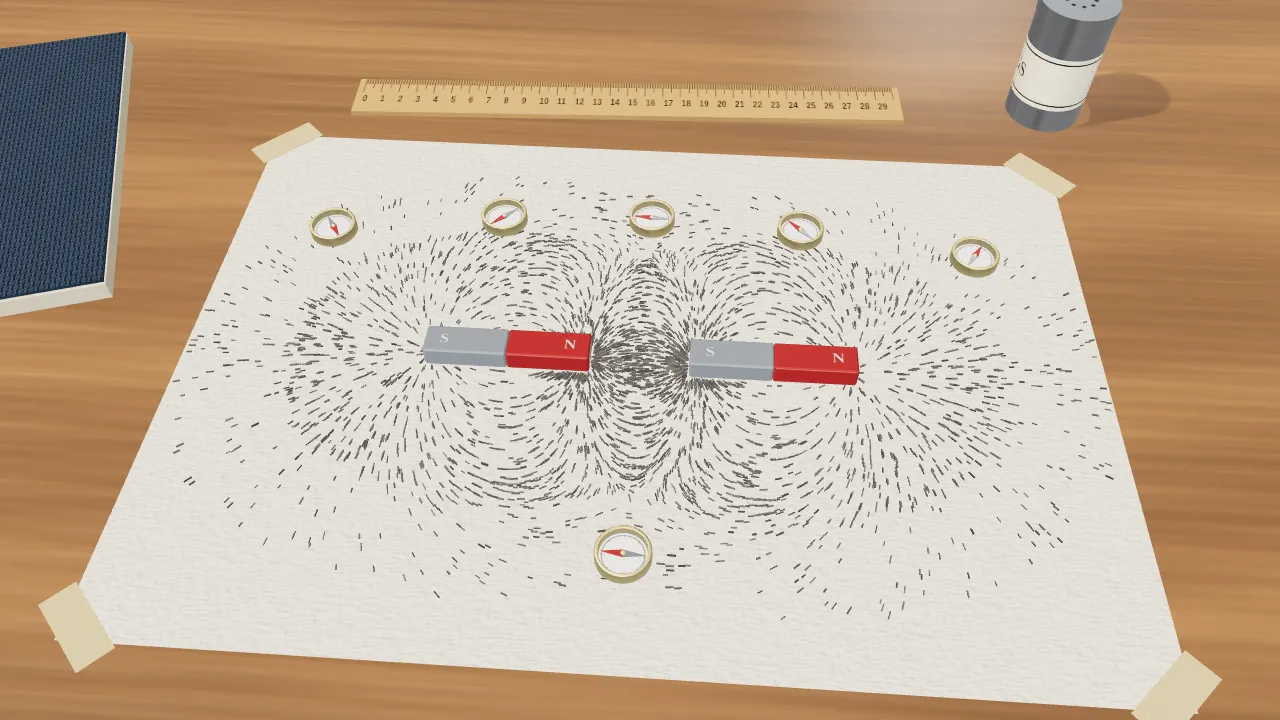
Sprinkle iron filings round magnets and plot the field with compasses.
How to play
- Tap the paper to sprinkle iron filings from the shaker, or drag the shaker across the paper. Tap the desk to knock the filings into line.
- Drag a magnet by its middle to slide it, or by one end to swing it round. Tap a magnet to turn it end for end.
- Drag the little brass compasses around the magnets. The red end of each needle points along the field.
- Try the three Challenges, or open Lab to brush the paper clean or show the calculated field lines.
Challenges
- Face a north pole towards a south pole and sprinkle filings across the gap
- Point two like poles at each other and find the neutral point with a compass
- Plot a field line: a chain of five compasses from a north pole to a south pole
Try this
- Tap one magnet to turn it end for end. The filings between the magnets stop bridging the gap and swerve away from each other instead.
- Slide a compass slowly away from a magnet. Close up it points along the magnet’s field; far away it swings round to point north, pulled by the Earth.
- Turn on the calculated field lines in Lab and compare them with the filings. The chains of iron follow the same curves.
Fun facts
- Iron filings show a magnet’s field because every grain of iron becomes a tiny magnet itself while it sits in the field, and turns to lie along it.
- The north pole of a compass needle is pulled towards the Earth’s magnetic pole in the Arctic, so that pole is, magnetically speaking, a south pole.
- At the Earth’s surface the magnetic field is roughly 25 to 65 microtesla, hundreds of times weaker than the field near the end of a bar magnet.
- Michael Faraday called the curves traced out by iron filings lines of force, an idea that grew into the modern picture of fields.
Magnetic field lines: how iron filings map an invisible field
A magnet changes the space around it. At every point nearby there is a magnetic field with a strength and a direction, and anything magnetic placed there feels it. You can’t see the field, but iron filings and compasses can, and they draw it for you.
Why the filings line up
Iron is a soft magnetic material. Put a grain of iron in a field and it becomes a little magnet itself, with its own north and south ends pointing along the field. The field then twists the grain until it lies along the field, as long as the twist is strong enough to beat friction on the paper. Tapping the paper makes the grains hop, so friction lets go for a moment and they can move.
The grains also pull on each other. Two magnetised grains lying end to end attract, while two lying side by side push apart. So the filings join into chains along the field with gaps between them, and those chains are the lines you see. Near the poles, where the field is strongest, the grains crowd together and the lines bunch up.
North, south and the shape of the field
By convention, field lines leave a magnet’s north pole, curve round through the space outside and enter its south pole. They never cross, because the field can only point one way at any spot. Face a north pole towards a south pole and the lines leap straight across the gap: that is the attraction you feel between them. Point two north poles at each other and the lines turn away from each other instead. Half-way between, the two fields cancel exactly. At this neutral point a compass feels only the Earth’s much weaker field.
Plotting with compasses
A compass needle is a small magnet on a pivot, so its north end points along the field wherever you put it. Place a compass near a pole, mark where its needle points, move the compass to that mark and repeat: the chain of positions traces one field line from north round to south. Far from the magnets, the needles swing back to point north, because there the Earth’s field is the strongest one left.
For the curious
Each bar magnet is modelled by two poles of strength q = ±120 A·m near its ends, roughly what a 75 mm Alnico bar would have. A pole gives a field B = (μ0/4π)·q·r̂/r², and the fields of all the poles add up. Two centimetres from a pole that is about 30 mT, compared with 18 µT for the horizontal part of the Earth’s field used here. A filing turns only where the field is above about 0.15 mT. Two neighbouring grains with moments m along t̂ feel a force F = (3μ0m²/4πr⁴)·[2(û·t̂)t̂ + (1 − 5(û·t̂)²)û], which attracts them end to end and repels them side by side. Each needle obeys θ″ = −ω0²·sin(θ − θB) − 2ζω0θ′, with ω0² proportional to the field strength.
Questions people ask
Why do iron filings make lines rather than an even sprinkle?
Each filing becomes a small magnet in the field. Grains lying end to end attract and grains lying side by side repel, so they gather into chains along the field with gaps between, which we see as lines.
What is a neutral point?
It is a place where the fields of two or more magnets cancel out, for example half-way between two north poles facing each other. A compass placed there feels only the Earth’s field and points north.
Why does a compass point north?
The Earth behaves roughly like a giant magnet. A compass needle is a small magnet that turns to line up with the Earth’s field, so its north-seeking end points towards the magnetic pole in the Arctic.