Splitting Water with Electricity
Split water with electricity and collect hydrogen and oxygen 2 : 1.
How to play
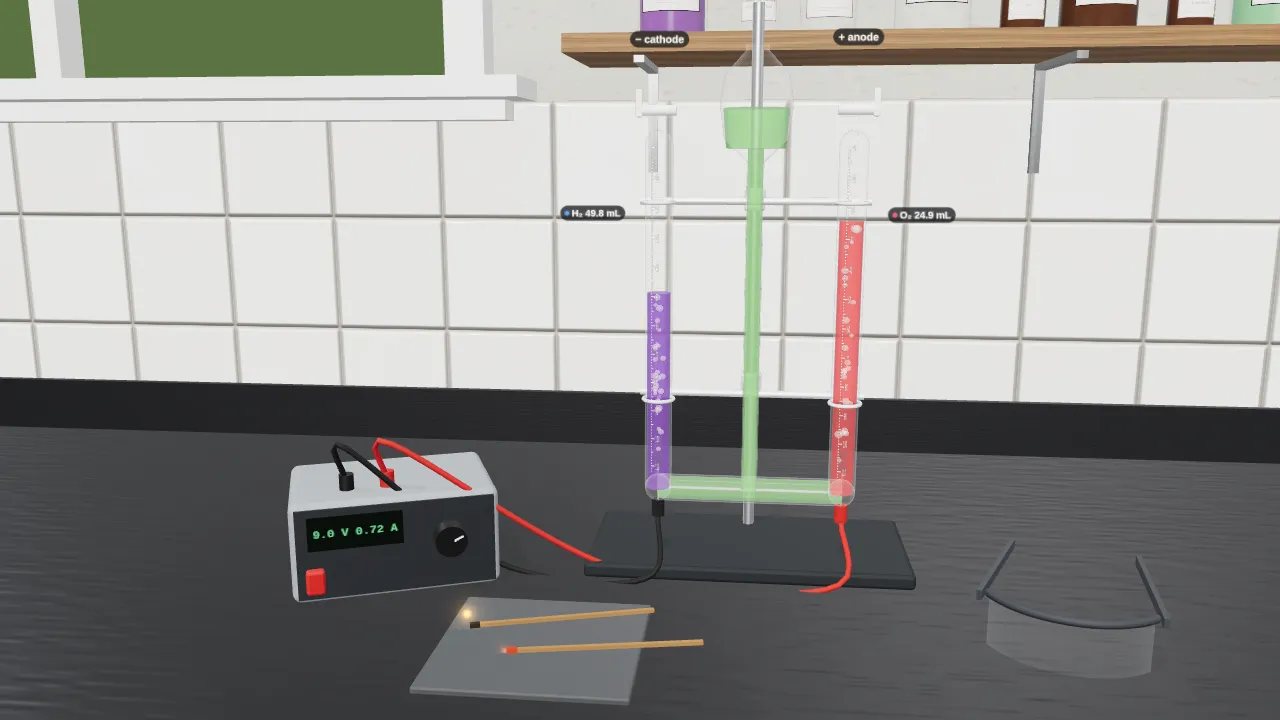
- Turn the black knob on the power pack: drag it up. Above about 2 V bubbles of hydrogen (left) and oxygen (right) start to rise.
- Press the red switch to turn the power off or on. The display shows the voltage and the current.
- Drag the lit splint to the tap on top of the hydrogen tube for a squeaky pop, and the glowing splint to the oxygen tube to relight it.
- Try the three Challenges, or open Lab to change the electrolyte and the time-lapse.
Challenges
- Turn the voltage up until bubbles stream from both electrodes
- Collect 20 mL of hydrogen in the left-hand tube
- Test both gases: a squeaky pop and a relit glowing splint
Try this
- Set 1.5 V. Nothing happens: you need to beat the decomposition voltage before any current flows.
- Switch to pure water at 12 V. Almost no current flows, because pure water has very few ions to carry charge.
- Read the ratio after a while. Whatever the current, hydrogen and oxygen stay at 2 : 1, just as H₂O suggests.
Fun facts
- Water was first split by electricity in 1800 by William Nicholson and Anthony Carlisle, only weeks after Alessandro Volta described his battery.
- Pure water conducts electricity very poorly; dissolving a salt or acid supplies the ions that carry the current.
- A “squeaky pop” from a lit splint is the classic test for hydrogen; a glowing splint bursting into flame shows oxygen.
- The Hofmann voltameter is named after the 19th-century German chemist August Wilhelm von Hofmann.
Taking water apart
Water is a very stable molecule, but electricity can pull it apart into the two gases it is made from. In a Hofmann voltameter, two glass tubes stand over platinum electrodes, joined at the bottom and filled with a solution that conducts. Switch on a direct-current supply and bubbles stream from both electrodes, collecting at the tops of the tubes.
What happens at each electrode
At the negative electrode, the cathode, water molecules gain electrons and hydrogen gas forms:
2H₂O + 2e⁻ → H₂ + 2OH⁻
At the positive electrode, the anode, water molecules lose electrons and oxygen gas forms:
2H₂O → O₂ + 4H⁺ + 4e⁻
Making one oxygen molecule takes four electrons, while one hydrogen molecule takes only two. The same current flows through both electrodes, so twice as many hydrogen molecules are made, and since equal numbers of gas molecules fill equal volumes, the hydrogen tube fills twice as fast. That 2 : 1 ratio is a direct look at the formula H₂O.
With universal indicator in the solution you can see the reactions: hydroxide ions made at the cathode turn the indicator violet, and hydrogen ions made at the anode turn it red.
Why you need a few volts
Splitting water needs energy. The minimum, set by thermodynamics, corresponds to 1.23 V. In practice the electrodes need an extra push, called overpotential, so electrolysis usually starts at nearly 2 V. Below that, almost no current flows and no gas appears. The electrolyte matters too: pure water has so few ions that it barely conducts, so a salt such as sodium sulfate, or a little acid, is added.
For the curious: Faraday’s law
Michael Faraday showed that the amount of substance made is proportional to the charge passed. One mole of electrons carries 96,485 coulombs (the Faraday constant, F). So a current I for time t makes n(H₂) = It / 2F and n(O₂) = It / 4F. One amp for an hour passes 3,600 C and makes about 0.019 mol of hydrogen, roughly 450 mL at 20 °C. The simulation uses exactly this, with gas volumes from the ideal gas law (24.05 L/mol at 20 °C and 1 atm) and a current I = (V − 1.8 V)/R, where R depends on the electrolyte.
Safety
Hydrogen and oxygen together are explosive, and electrolytes such as sulfuric acid are corrosive. Real demonstrations use a low-voltage supply, small volumes and a supervising teacher. Never electrolyse salt water at home: it can release chlorine. Please read our disclaimer.
Questions people ask
Why do you get twice as much hydrogen as oxygen in electrolysis?
Each oxygen molecule needs four electrons to form but each hydrogen molecule only two. The same current flows through both electrodes, so twice as many hydrogen molecules are made, and they take up twice the volume.
What voltage is needed to split water?
The theoretical minimum is 1.23 volts, but real electrodes need extra voltage (overpotential), so electrolysis of water usually starts at around 1.8 to 2 volts.
Why add salt or acid to water for electrolysis?
Pure water contains very few ions, so it conducts electricity poorly. Dissolving a salt such as sodium sulfate, or a little acid, provides ions that carry the current.