Circuit Builder
Plug leads between a battery, lamps and switches to light them up.
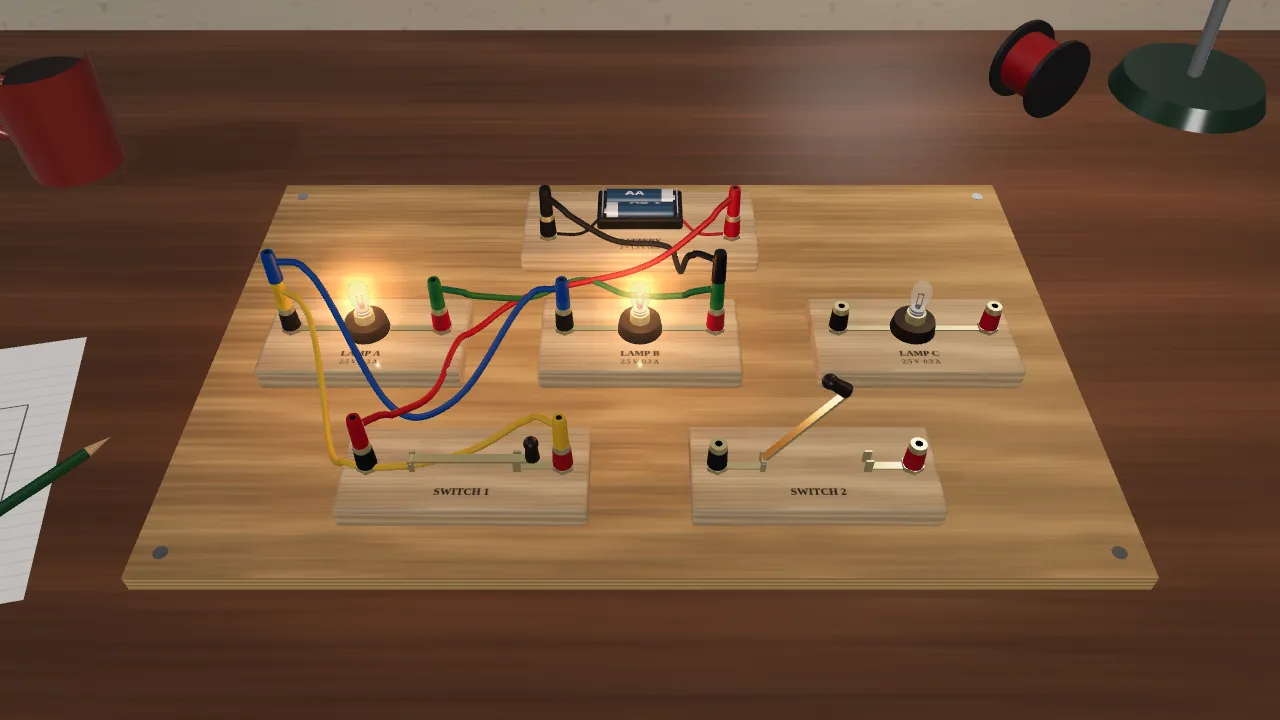
How to play
- Drag from one brass terminal to another to plug in a lead. Plugs stack, so several leads can share a terminal.
- Make a complete loop from the battery’s + terminal, through a lamp and back to −, and the lamp lights.
- Tap a switch to open or close it, tap a lamp to unscrew it, and tap a lead to unplug it.
- Try the three Challenges, or open Lab to show the current as moving dots.
Challenges
- Light a lamp: make a complete loop from the battery, through a lamp and back
- Light two lamps in parallel, so they shine equally brightly
- Wire one switch so it turns two lamps on and off together
Try this
- Wire lamps A and B in series, then tap one to unscrew it. The other goes out too, because the current has only one path.
- Now wire them in parallel and unscrew one. The other stays as bright as before, just like the lights in a house.
- Turn on the moving dots in Lab and watch the current split where leads meet: the two branches add up to the current in the lead back to the battery.
Fun facts
- Georg Ohm published the law that now carries his name in 1827, in a book about circuits powered by galvanic cells.
- Gustav Kirchhoff set out his two circuit laws in 1845, while he was still a student.
- A glowing tungsten filament has many times the resistance it has when cold, which is why a lamp takes a brief surge of current at the moment it is switched on.
- The electrons in a wire drift along at well under a millimetre per second, yet a lamp lights almost at once, because the push travels round the circuit at a large fraction of the speed of light.
Electric circuits: series, parallel and Kirchhoff’s laws
An electric circuit is a closed loop that lets charge flow out of one terminal of a battery, through leads and lamps, and back into the other terminal. Break the loop anywhere and the flow stops everywhere at once. On this board every brass post is a junction where leads can meet, and the simulation works out the current in every lead from two simple rules first written down by Gustav Kirchhoff.
Voltage, current and resistance
The battery’s voltage is the energy it gives each unit of charge: here two 1.5 V cells in series make 3 V. The current is how much charge passes each second, measured in amps. Every part of a circuit resists the flow a little, a lead hardly at all and a lamp filament a lot. For a simple resistor, Ohm’s law says the current is the voltage divided by the resistance.
Kirchhoff’s two laws
Charge is never created or lost at a junction, so the currents flowing into any junction add up to the currents flowing out. That is Kirchhoff’s current law. Energy is conserved too, so around any closed loop the voltage the battery provides is used up by the parts in that loop: the voltage law. Together they fix the voltage at every post and the current in every lead.
Series and parallel
Wire two lamps one after the other, in series, and the same current passes through both, but they must share the battery’s 3 V. Each gets about half, and because a lamp’s light output rises very steeply with voltage, both glow a dim orange. Unscrew one and the loop is broken, so the other goes out too. Wire them side by side, in parallel, and each lamp gets the full voltage and shines as brightly as a lamp on its own. The battery now supplies the current for both, and the two branch currents add up in the lead back to the battery. A switch in the shared part of the circuit controls both lamps; a switch in one branch controls only its own lamp. Homes are wired in parallel for exactly these reasons.
Why a lamp is not a simple resistor
A lamp’s filament is a tiny coil of tungsten wire that glows because it is white hot. Hot tungsten resists the current far more than cold tungsten, so the filament’s resistance climbs as the voltage across it rises. Its colour changes too: a lamp at half its rated voltage runs cooler, glows orange and gives out only about a tenth of its normal light.
For the curious
The simulation uses nodal analysis. Each post is a node with an unknown voltage. Each lead (0.03 Ω), closed switch and lamp is a conductance G = 1/R between two nodes, and the battery is a source of E = 3.0 V with an internal resistance of 0.36 Ω. Kirchhoff’s current law at every node gives a set of linear equations, G·V = I, solved by Gaussian elimination. The lamps are rated 2.5 V, 0.3 A, and their resistance follows R = Rrated·(V/2.5 V)0.4, so the equations are solved again with updated resistances until they agree. Light output follows the lamp makers’ rule Φ ∝ V3.4, and the filament temperature T ≈ 2750 K·(P/0.75 W)1/4 sets the colour of its glow.
Questions people ask
Why are two bulbs in series dimmer than two in parallel?
In series the two lamps share the battery’s voltage, so each gets about half. A filament lamp’s light output rises roughly with the 3.4th power of the voltage, so half the voltage gives only about a tenth of the light. In parallel each lamp gets the full voltage.
Why does unscrewing one bulb turn the others off in a series circuit?
A series circuit has only one path for the current. Removing a lamp breaks that path, so the current stops everywhere in the loop. In a parallel circuit each lamp has its own path, so the others stay lit.
What is a short circuit?
A short circuit is a path with almost no resistance between a battery’s terminals. A large current rushes through it instead of through the lamps, draining the battery and heating the wires. Real batteries can get dangerously hot this way, so never short-circuit one, and never experiment with mains electricity. Please read our disclaimer.