Chua’s Circuit Double Scroll
Tune a chaotic circuit with a knob and drop probes on its scope trace.
How to play
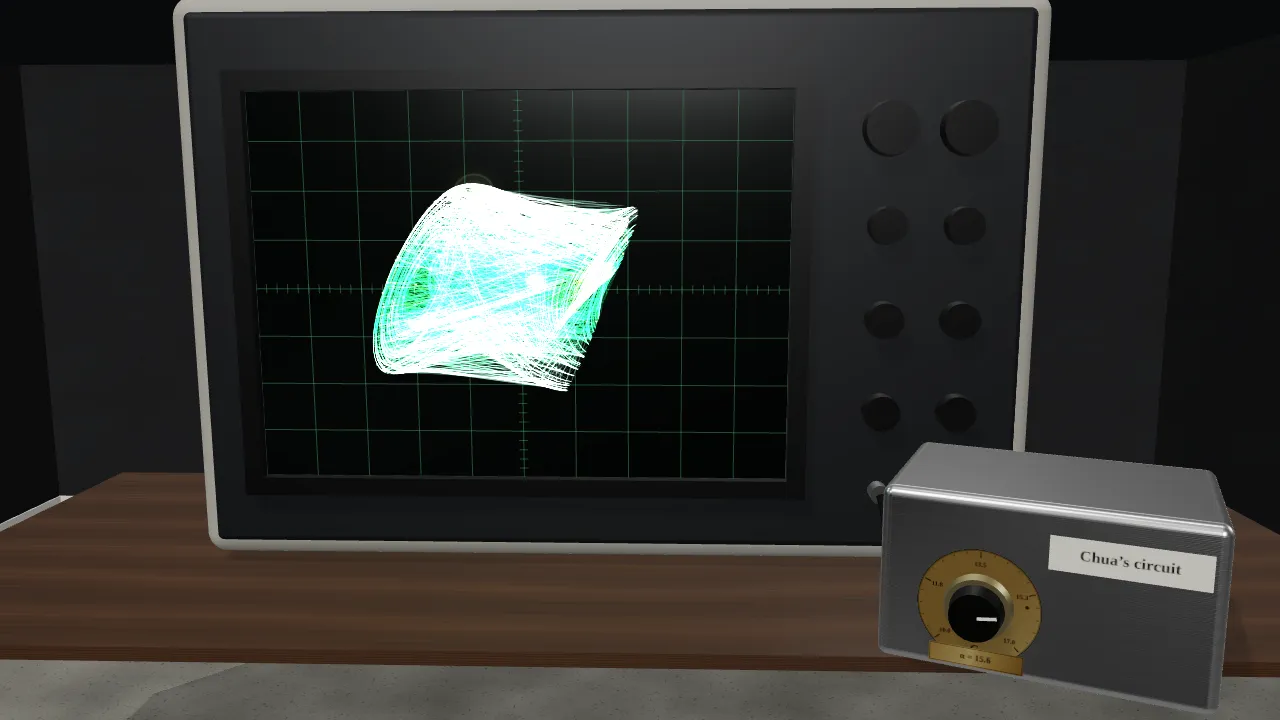
- The oscilloscope shows the circuit’s two capacitor voltages, x across and y up. Tap the screen to drop a cloud of probes there.
- Drag the bright spot to a new place and let go: its neighbours soon go their separate ways.
- Turn the C₁ knob on the circuit box by dragging it up or down. C₁ sets α, the ratio of the two capacitors: lower α and the double scroll shrinks to one.
- Watch “Jumps between scrolls”. Try the three Challenges, or open Lab for α, β and the presets.
Challenges
- Tap the screen beside the trace and watch the probes get pulled onto the double scroll
- Turn the knob down to about α = 14 and the trace keeps to one scroll
- Turn it further, to about α = 12.5, and the chaos becomes one simple loop
Try this
- Choose α = 14. The traces stay on one side, circling a single scroll, and the jump counter falls to zero.
- Choose α = 12.5. The chaos is gone and the circuit settles into a steady, repeating oscillation.
- Return to the double scroll and slowly lower α until the jumps between scrolls stop.
Fun facts
- Leon Chua invented this circuit in 1983.
- It needs only five parts: two capacitors, an inductor, a resistor and a nonlinear resistor known as Chua’s diode.
- Chua’s circuit is known as the first physical system whose chaos was shown in experiments, in computer simulations and by mathematical proof.
- Leon Chua also predicted the memristor, a fourth basic circuit element, in 1971.
Chaos you can build on a bench
Many chaotic systems are abstract equations, but this one is a real circuit you can solder together. Leon Chua designed it in 1983 to be as simple as possible while still being chaotic. It has two capacitors, an inductor, a resistor and one special part, a nonlinear resistor now called Chua’s diode, whose current does not rise in proportion to the voltage across it but bends in two places.
Written in dimensionless form, with x and y the voltages across the two capacitors and z the current through the inductor, the circuit obeys:
dx/dt = α(y − x − g(x)), dy/dt = x − y + z, dz/dt = −β·y,
where g(x) = m₁x + ½(m₀ − m₁)(|x + 1| − |x − 1|) is the diode’s bent line, with slopes m₀ = −8/7 in the middle and m₁ = −5/7 outside. The negative slopes mean the diode feeds energy into the circuit instead of soaking it up.
Two scrolls
The circuit has two unstable resting states, one on each side. Near each one, the voltages spiral outwards in a widening scroll. When a spiral grows big enough, the voltage crosses into the other half of the diode’s characteristic and the motion is captured by the other scroll. When it jumps, and how many turns it makes on each side, is chaotic: the sequence never repeats. The “Jumps between scrolls” readout counts these crossings.
Turning the knob
α depends on the ratio of the two capacitors, and β on the inductor and resistor. With the classic values α = 15.6 and β = 28 you get the full double scroll. At α = 14 the motion stays on one side, a single scroll that is still chaotic. At α = 12.5 it settles into a simple repeating loop round one resting state. We checked each preset numerically, measuring the chaos rate λ each time.
On the oscilloscope
Engineers usually see this attractor by connecting the two capacitor voltages to an oscilloscope’s horizontal and vertical inputs, so the screen traces y against x, with the vertical gain turned up because y swings much less than x. This view mimics that: a dark glass screen, a graticule grid and green phosphor-coloured traces, with brighter colour for faster changes. Real circuits run at audio frequencies or faster, so the real pattern would fill the screen in a fraction of a second.
For the curious
Particles start on the attractor and are advanced with fourth-order Runge–Kutta in fixed steps of 0.005 dimensionless time units. Because the diode’s characteristic is made of straight pieces, the system is linear inside each region, which is part of what made its chaos possible to prove mathematically.
Questions people ask
What is Chua’s circuit?
A simple electronic circuit, invented by Leon Chua in 1983, made of two capacitors, an inductor, a resistor and a nonlinear resistor. Its voltages behave chaotically.
What is the double scroll attractor?
The chaotic pattern traced by Chua’s circuit: two spiralling scrolls, one around each of two unstable resting states, with unpredictable jumps between them.
Can I build Chua’s circuit at home?
Yes, it is a popular electronics project. The nonlinear resistor is usually made from operational amplifiers and resistors. Follow a trusted guide and use low-voltage supplies.