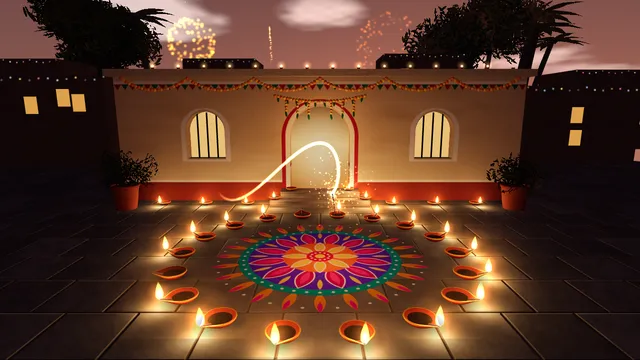
Onam Pookalam Flower Carpet
Fill the rings of a symmetric flower carpet, petal by petal.
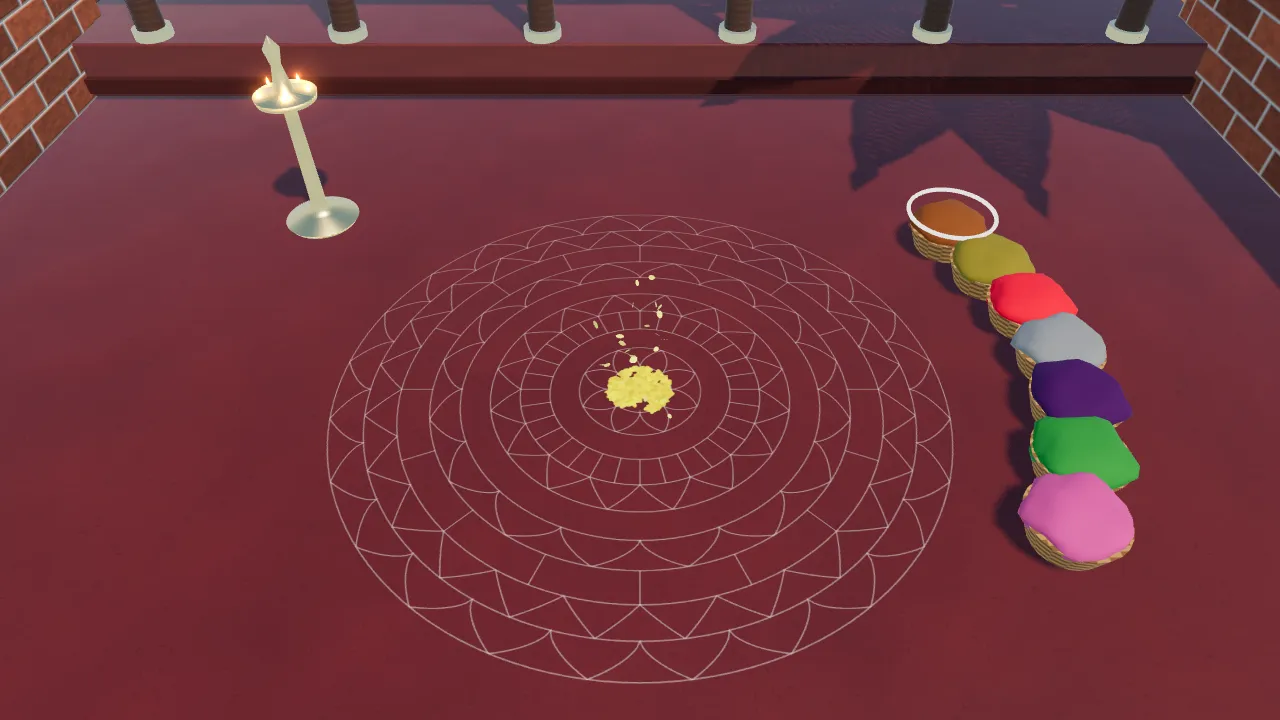
How to play
- Tap a basket to choose a flower.
- Tap any part of a ring: petals rain down onto every matching part, all the way round.
- Choose another basket and fill the next part, working outwards from the centre.
- Open Lab to change the symmetry, the day of Onam (more rings each day), or draw freely like a kaleidoscope. Fill it for me makes a whole carpet.
Challenges
- Fill the round centre of the pookalam with flowers
- Fill both parts of a patterned ring, each with a different flower
- Cover every ring of a full ten-day pookalam with your own flowers
Try this
- Switch the symmetry from 8-fold to 16-fold and fill a petal ring. Twice as many petals, each half as wide, cover the same area.
- Fill the small centre, then the outermost ring, and compare the petal count. The outer ring needs far more flowers, because a ring’s area grows with its radius.
- Turn on Draw freely and trace a squiggle. Every stroke is copied around the circle, just as a kaleidoscope copies with mirrors.
Fun facts
- Onam is the harvest festival of Kerala, celebrated in the Malayalam month of Chingam, usually in August or September.
- The festival lasts ten days, from Atham to Thiruvonam, and a pookalam traditionally grows a little bigger each day.
- Thumba, a small white wild flower, has a special place in traditional pookalams.
- Onam is also known for the Onasadya feast, served on a banana leaf, and for the vallam kali snake-boat races.
The maths of a flower carpet: symmetry and area
Onam is the great harvest festival of Kerala, celebrated by people of all communities. Over ten days, from Atham to Thiruvonam, families lay a pookalam, a carpet of flower petals, in front of their homes. It traditionally starts small on the first day and gains rings and colours as the festival goes on. Many families say Onam welcomes the legendary King Mahabali on his yearly visit to his people. There are feasts, boat races, songs and games, and pookalam designs and customs vary from place to place, with competitions for the most intricate carpets.
Rotational symmetry
A pookalam is built from rings, and each ring repeats one small motif around the centre: a petal, a triangle, a block of colour. If the motif appears N times, turning the carpet by 360°/N leaves it looking exactly the same. Mathematicians call this N-fold rotational symmetry. Most designs are also mirror-symmetric: a line through the centre splits each motif into two matching halves. Together the N rotations and N mirror lines make up the dihedral group DN, which has 2N symmetries in all. This simulation uses that fact: when you fill one part of a ring, petals fall on all of its copies at once.
Why the outer rings take so long
A ring of width w at radius r has an area of about 2πr·w. Rings of equal width therefore need more and more flowers the further out they are. In this 1.65-metre carpet the outermost ring needs about seven times as many petals as the second ring from the centre, which is why families gather flowers by the basketful.
Where the colours come from
Petal colours come from pigments that absorb some wavelengths of light and reflect the rest. The yellows and oranges of marigolds and chrysanthemums are mostly carotenoids, the same family of pigments that colours carrots. Reds, pinks and purples, as in roses, usually come from anthocyanins, and green leaves get their colour from chlorophyll.
Falling petals
Each petal you drop is light and thin, so air drag almost cancels its weight. It drifts down at well under a metre per second, gliding and tumbling as it goes, before it settles into the carpet.
For the curious
The ring motifs are defined in polar coordinates. Using the angle θ and the radial position s across a ring (0 at its inner edge, 1 at its outer edge), a petal motif fills the region |φ − ½| < ½(1 − s1.5), with φ = frac(Nmθ/2π). A zigzag fills s < 1 − |2φ − 1|. Swapping N changes every ring at once, which is why the carpet is redrawn when you change the symmetry.
Questions people ask
What is a pookalam?
A pookalam is a carpet of flower petals laid on the ground during Onam in Kerala. It is usually circular and made of concentric rings with repeating, symmetric patterns, and it traditionally grows larger on each of the ten days of the festival.
When is Onam celebrated?
Onam falls in the Malayalam month of Chingam, usually in August or September. It lasts ten days, from Atham to Thiruvonam, with the main celebrations on Thiruvonam.
What kind of symmetry does a pookalam have?
Most pookalams have rotational symmetry, where a motif repeats several times around the centre, and mirror symmetry, where each motif matches its reflection. A design with an 8-fold pattern looks the same after turning it by 45°.