Ocean Waves and Lighthouse
Sweep up a wind round a lighthouse and see long waves outrun short.
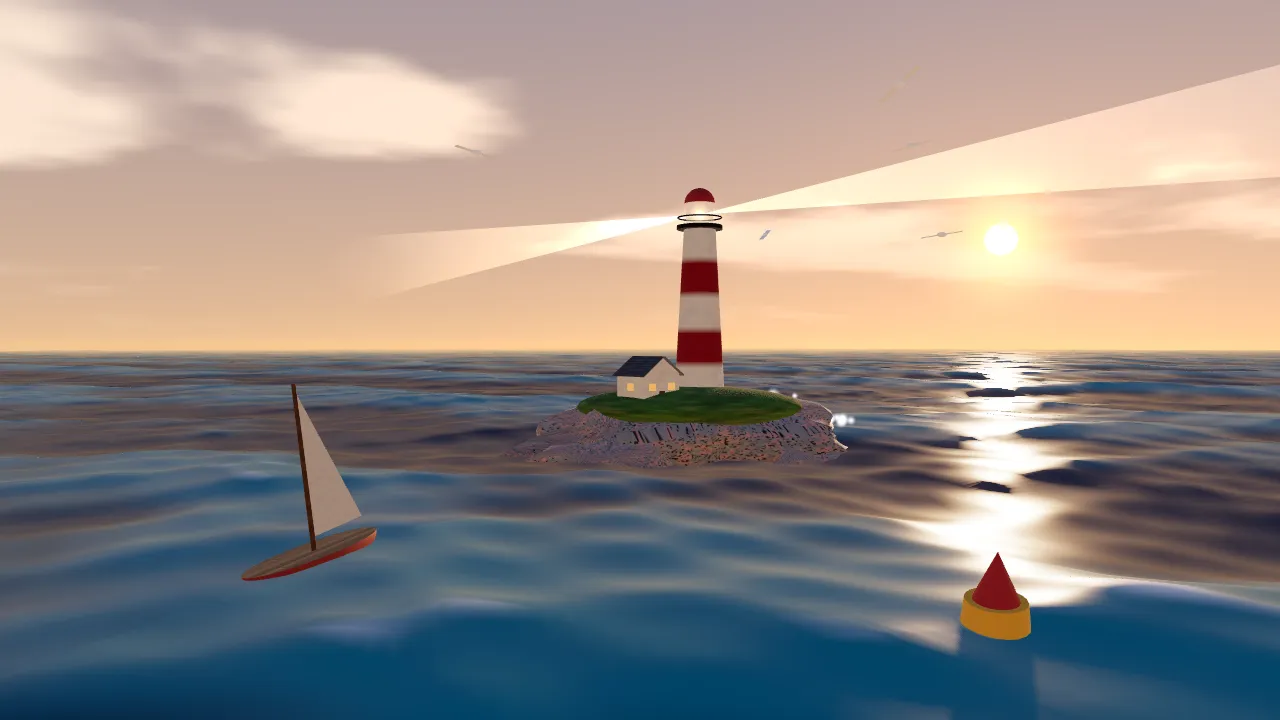
How to play
- Sweep your finger across the open sea to raise the wind. The waves grow, lengthen and run the way you swept.
- Stop and the wind slowly eases, but the long swell it built keeps rolling for a while.
- Drag the yellow buoy to a new spot and let go: it traces the loop a parcel of water makes as each wave passes.
- Try the three Challenges, or open Lab for the wind, the choppiness and sunset or night with the beam.
Challenges
- Drag the buoy to a new spot and watch it trace one full loop
- Sweep up a fresh breeze of 8 m/s, when whitecaps break out
- Keep the wind going until the waves are more than 5 metres high
Try this
- Change the period from 6 to 12 seconds. The wavelength grows four times and the speed doubles.
- Trace the buoy’s orbit. It loops round and comes back almost to where it started: the wave moves on, the water stays.
- Turn the choppiness up and watch the crests sharpen and foam while the troughs flatten out.
Fun facts
- In deep water a wave’s speed in metres per second is about 1.56 times its period in seconds.
- Wave energy travels in groups that move at half the speed of the individual crests in deep water.
- In a deep-water wave, water moves round in near-circular orbits that shrink quickly with depth.
- Swell from storms in the Southern Ocean has been tracked crossing the whole Pacific to Alaska.
Why long waves are fast waves
Waves at sea are raised by the wind. A gust pushes on the water surface, ripples grow into waves, and the longer and harder the wind blows over a long stretch of sea, the bigger and longer the waves become. Once they leave the storm behind, they travel on as smooth, regular swell.
Speed depends on period
In deep water, waves of different lengths travel at different speeds. This is called dispersion, and it follows from a simple relation between how fast a wave oscillates and how long it is. The result is neat: a wave’s speed is c = gT/2π, about 1.56 metres per second for every second of its period T, and its wavelength is λ = gT²/2π. A 10-second swell is about 156 metres long and travels at about 15.6 m/s. Long waves outrun short ones, so the swell from a distant storm arrives at the coast sorted by period, the longest first.
Groups move at half speed
Waves travel in sets, and in deep water each set moves at only half the speed of its crests. Watch a group and you will see new crests appear at its back, pass through it and fade away at the front. The energy travels with the group, not with the crests.
The water goes round in circles
As a wave passes, a floating object does not travel with it. It moves up and forward on the crest, then down and back in the trough, tracing a loop that brings it almost back to where it began. Below the surface the loops shrink quickly, so at a depth of half a wavelength the motion is only a few percent of that at the surface. Turn on the orbit trace to see the buoy draw its loop.
For the curious
The sea here is a sum of eight Gerstner waves. In this model each surface point moves in a circle as the wave passes, which gives sharp crests and wide, flat troughs like real swell. For deep water each component obeys ω² = gk, where ω is the angular frequency and k = 2π/λ. The components spread around the swell direction, from the main swell down to short wind chop. The heights are scaled so that four times the standard deviation of the surface equals the wave height you choose, the usual definition of significant wave height. Foam appears where the crests are most compressed. Near shore, in water shallower than about half a wavelength, waves slow down and steepen, which is why they break on the rocks around the lighthouse.
Questions people ask
How fast do ocean waves travel?
In deep water the speed in metres per second is about 1.56 times the period in seconds. Choppy wind waves with a 4-second period move at about 6 m/s, while a long 15-second swell travels at over 23 m/s, more than 80 km/h.
What is the difference between swell and wind waves?
Wind waves are still being driven by the local wind, so they are short, steep and irregular. Swell has left the wind that made it behind and travels on as long, smooth, regular waves, sometimes for thousands of kilometres.
Does the water travel with the wave?
Hardly at all. In deep water each bit of water moves round in a loop and returns almost to where it started. It is the shape and the energy of the wave that travel across the ocean.