Navratri Dandiya Rhythm
Strike your dandiya sticks in time with the dhol on a garba night.
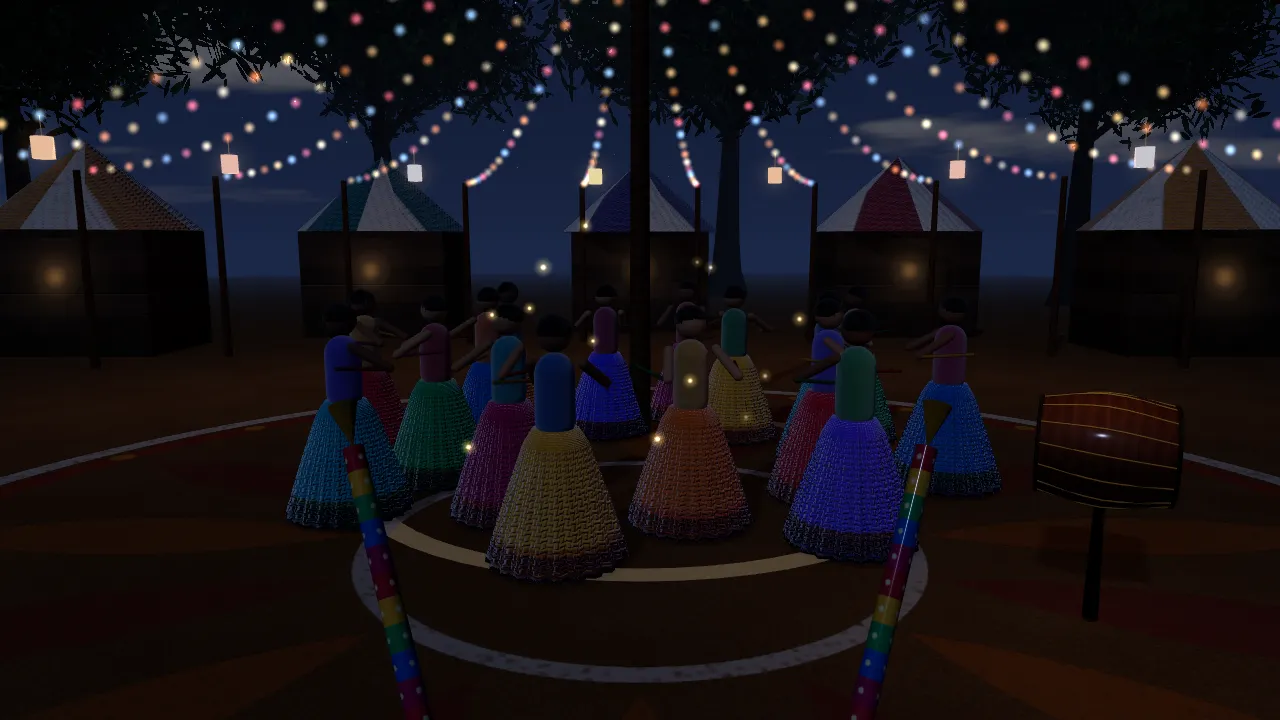
How to play
- Tap the screen, or press Space, to strike your dandiya sticks on each beat. The dancers show you when.
- Watch your timing readout: within 70 milliseconds counts as in step.
- Tap the dhol at the edge of the circle three or four times, evenly, to drum a new tempo. The dancers follow your beat.
- Open Lab to change the strike pattern, let the music speed up as the night goes on, or move away from the dhol and notice the sound arriving late.
Challenges
- Strike your sticks in step with the dhol eight times in a row
- Tap the dhol evenly to drum a new tempo for the dancers
- Drum the tempo up to 120 BPM or more, then stay in step for eight strikes
Try this
- Set your distance from the dhol to 60 m. The sound now reaches you about 0.17 s after the dancers strike, so tapping to what you hear makes you late.
- Try 70 BPM and then 140 BPM. At the faster tempo each beat lasts less than half a second, leaving much less time to correct a mistake.
- Watch your offsets over a run of taps. Many people tap slightly before the beat, a well-studied effect called negative mean asynchrony.
Fun facts
- Navratri means “nine nights”. It honours the goddess Durga in her many forms, and it is celebrated in different ways across India.
- In Gujarat, people dance garba and dandiya raas on the evenings of Navratri, often in large circles.
- In dandiya raas, dancers strike pairs of decorated wooden sticks together in rhythm, and partners keep changing as the circles move.
- Sound travels at about 343 metres per second in air at 20 °C, so it takes about a tenth of a second to cross a 34-metre dance ground.
Keeping the beat: rhythm, timing and the speed of sound
Navratri, “nine nights”, is a Hindu festival honouring the goddess Durga, celebrated in autumn in the month of Ashvin, usually in September or October. Customs differ widely across India. In Gujarat its evenings are famous for garba, a circular dance with clapping and turning steps, and dandiya raas, in which dancers in two circles strike pairs of decorated sticks together, moving on to a new partner with every few strikes. The rhythm often speeds up as the night goes on, driven by the dhol and singers. This scene captures the joy of a garba night; the dancers are simple figures, and the focus is on the beat.
Tempo and period
Music is organised around a steady pulse, the beat. The tempo in beats per minute (BPM) tells you the beat’s period: T = 60/BPM seconds. At 96 BPM a beat lasts 0.625 s. Dandiya patterns place strikes on some beats and leave others empty, and the dancers’ arms and sticks follow that pattern, which is why a circle of dancers can strike together so neatly.
How precise are you?
When people tap along to a regular beat, their timing typically scatters by a few tens of milliseconds. Curiously, many people tap slightly before the beat, typically by a few tens of milliseconds, an effect psychologists call negative mean asynchrony. One explanation is that the brain perceives the touch of your finger a little later than the sound, so tapping early makes the two feel simultaneous. This game counts a strike as in step when it lands within 70 milliseconds of the beat.
Sound is slower than light
Light from the dancers reaches you almost instantly, but sound travels at only about 343 metres per second. At a large garba ground, someone 34 metres from the speakers hears every beat a tenth of a second late, which is plenty to throw off a dancer who listens rather than watches. The Lab lets you stand further away to feel it: the figures strike on time, but the clack and the dhol arrive late.
Why sticks clack
A dandiya stick is light and stiff, so when two strike they ring very briefly at a high frequency. The short, bright click cuts through the low boom of the dhol, whose larger, looser drum heads vibrate slowly.
For the curious
The beat clock advances in eighth-note steps of length T/2. When you tap, the game finds the nearest active step in the pattern and reports the offset in milliseconds. Sounds are scheduled with a delay of d/343 s, where d is your distance from the dhol.
Questions people ask
What is dandiya raas?
Dandiya raas is a folk dance from Gujarat performed during Navratri. Dancers form two circles facing each other and strike pairs of decorated wooden sticks together in rhythm, moving on to new partners as the circles turn.
What is the difference between garba and dandiya?
Both are danced in circles during Navratri in Gujarat. Garba uses hand claps and graceful turning steps, while dandiya raas is danced with a pair of sticks that partners strike together in time with the music.
How fast does sound travel?
In air at about 20 °C, sound travels at roughly 343 metres per second, around a million times slower than light. That is why you see a distant drum being struck before you hear it.