Monsoon Rain
Turn the calendar and bring the monsoon rain in from the sea.
How to play
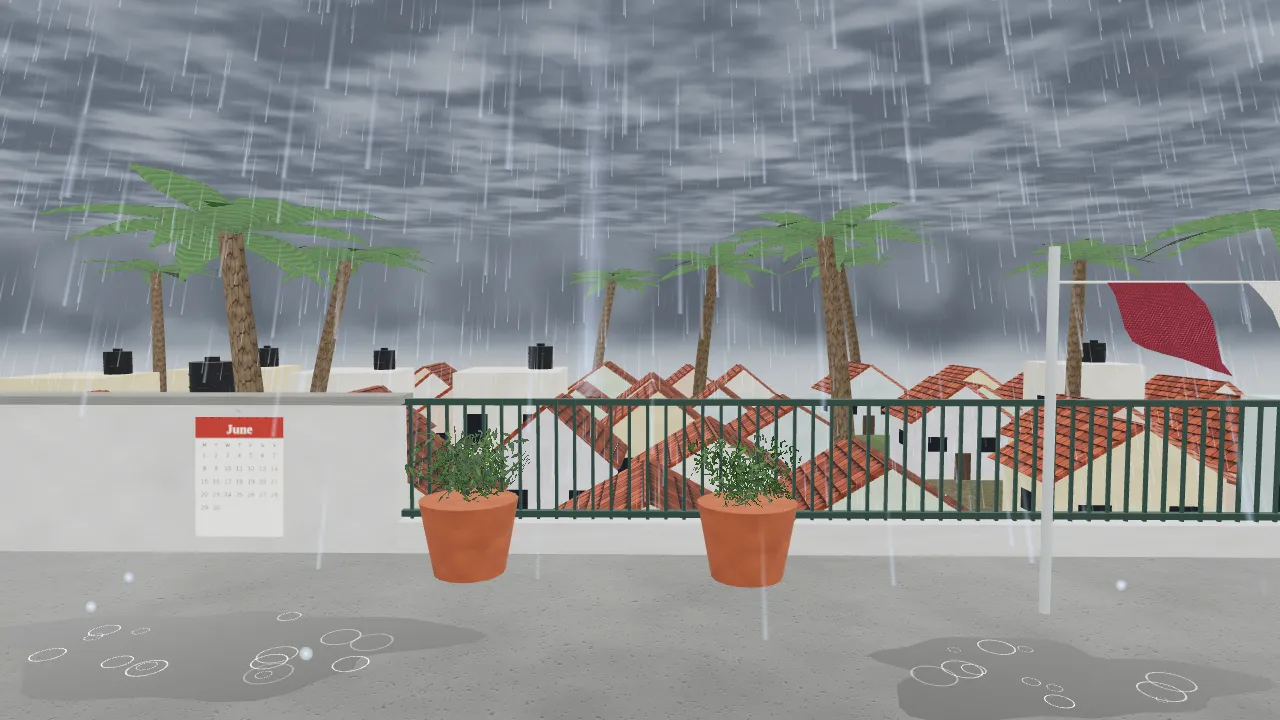
- Tap the calendar on the parapet to turn to the next month, or drag it up or down to flip through the year.
- Watch the sky and the washing line: when the land is much warmer than the sea, a wet wind blows in from the sea and the rain sets in.
- Catch the rain in the gauge on the parapet and tap it to empty it. Tap a puddle to make ripples.
- Try the three Challenges, or open Lab to switch off the heat released by condensing rain.
Challenges
- Catch 10 mm of rain in the gauge on the parapet
- Turn the calendar to winter, when the wind blows out to sea and the sky clears
- From the dry season, turn the months until the monsoon breaks with heavy rain
Try this
- Turn the calendar to December. The land is now cooler than the sea, the wind blows off the land, the clouds retreat and the washing swings the other way.
- Switch off the condensation heating in Lab during August. Without that extra lift the rain fades early, which shows how the monsoon feeds itself.
- Watch the rain readout: heavier rain comes with bigger drops, and bigger drops fall faster.
Fun facts
- The word monsoon comes from the Arabic word mawsim, meaning season.
- The Indian summer monsoon usually reaches the coast of Kerala around the start of June.
- Most of India’s rain falls during the summer monsoon, from June to September.
- Mawsynram and Cherrapunji, in the Indian state of Meghalaya, are among the wettest places on Earth.
A sea breeze the size of a continent
On a sunny day at the coast, the land warms up faster than the sea. Air over the warm land rises, the pressure there drops a little, and cooler air flows in from the sea to replace it: a sea breeze. The monsoon is the same idea on the scale of a continent and a whole season.
Why land and sea warm differently
Water needs much more energy than rock or soil to warm by the same amount, and sunlight falling on the sea is mixed down through a deep layer of water, while on land it heats only a thin layer near the surface. So in the months before the summer monsoon, the land of South Asia becomes far hotter than the Indian Ocean around it. The heated air over the land rises, and moist air is drawn in from the ocean towards the land.
From wind to rain
The wind from the sea carries enormous amounts of water vapour. When it is pushed up over hills and mountains, or rises in towering storm clouds, it cools and the vapour condenses into rain. Condensation releases heat, which warms the rising air further and strengthens the whole circulation. That is why the summer monsoon, once it starts, can bring weeks of heavy rain, which is so important for farming and water supplies across the region.
The winter reversal
In winter the pattern turns around. The land cools faster than the sea, so the pressure is higher over the land and the wind blows from the land out to sea. For most of India this is the dry season. Turn the calendar to December to see the wind reverse and the rain stop.
For the curious
The calendar sets the contrast through two heat reservoirs warmed by the same sunshine: the land answers within about half a month, the upper ocean over about three, so the sea stays warm long after the land has cooled. On top of that, rain releases heat as it condenses, which keeps the wind going once the rains have begun. This toy uses a simple scaling estimate for the wind, U ≈ 0.7 √(gHΔT/T), with a circulation depth H of 1 km and a mean temperature T of 300 K, and makes rain heavier as the onshore wind grows; it is a picture of the idea, not a forecast. The raindrops follow measured rules. The Marshall–Palmer distribution says how many drops of each size fall at a given rain rate R; its typical drop size grows slowly with R. Each drop falls at its terminal speed, approximated by v ≈ 9.65 − 10.3 e−0.6D m/s for a drop D millimetres across: about 6 m/s for a 2 mm drop. Rain is called heavy above about 7.6 mm per hour.
Questions people ask
What causes the monsoon?
In summer the land heats up much faster than the ocean. Air rises over the hot land and moist air flows in from the sea to replace it. As that moist air rises over hills and in storm clouds, it cools and its water falls as heavy rain.
Why does the monsoon reverse in winter?
In winter the land cools down faster than the sea, so the pressure becomes higher over the land and the wind blows from the land towards the sea. That air is dry, so for most of India winter is the dry season.
How fast do raindrops fall?
Small drizzle drops fall at only a few metres per second. Large raindrops of 4 to 5 millimetres reach about 9 metres per second, the speed at which air resistance balances their weight.