Mini Golf
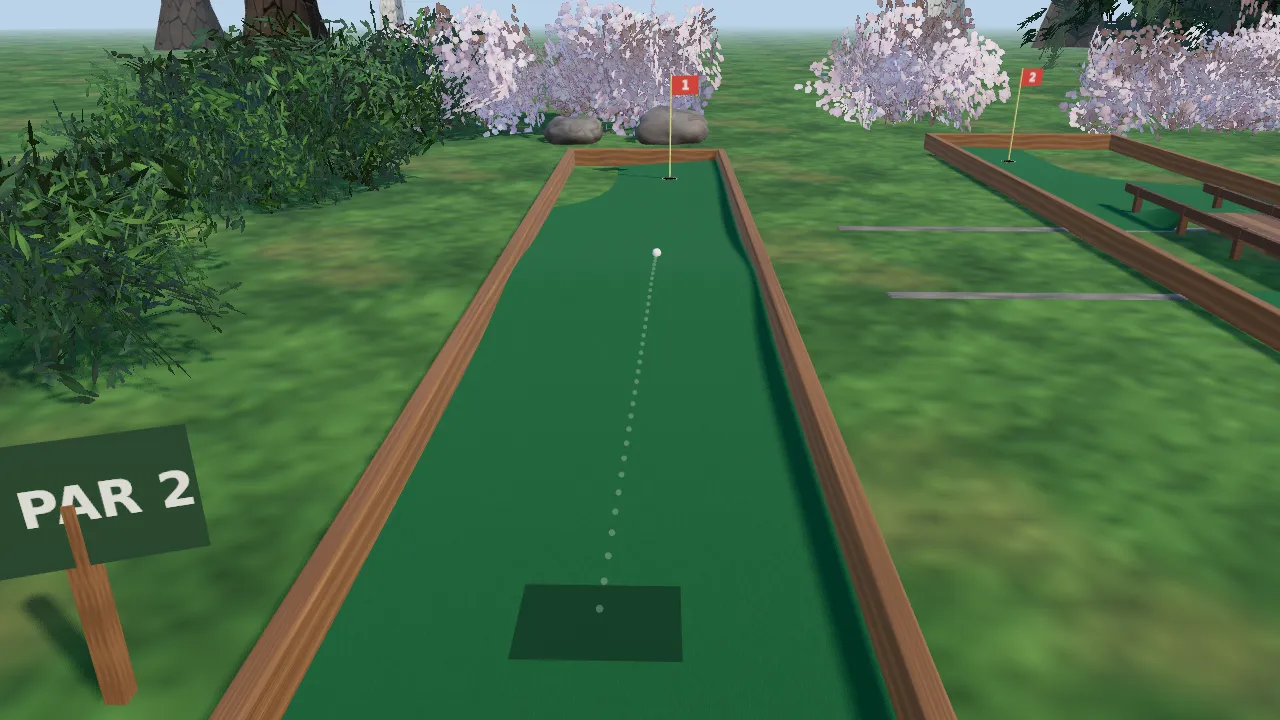
Putt round three garden holes, over a bridge and past a windmill.
How to play
- Drag back from anywhere and let go to putt. The ball rolls the opposite way to your drag, in any direction, and a longer pull hits it harder.
- The dots show the start of the roll. Watch the slopes: the ball curls downhill as it slows down.
- Bounce putts off the timber kerbs, cross the bridge without dropping into the stream, and time your putt through the windmill’s turning sails.
- Each hole has a par, and the readouts keep your score. Try the three Challenges.
Challenges
- Sink a hole in one on any of the three holes
- Finish all three holes in fewer strokes than par
- Bank a putt off a kerb and into the cup
Try this
- On the first hole, putt gently at the hump. Too slow and the ball rolls back to you; just enough and it creeps over and curls toward the cup.
- Putt hard straight at a cup and watch the ball hop over the hole. A ball that is moving too fast has no time to drop.
- Time the windmill: send the ball just after a sail sweeps past the tunnel, and it arrives as the gap opens.
Fun facts
- A regulation golf ball is at least 42.67 mm across and weighs no more than 45.93 g.
- A golf hole is 4.25 inches, or 108 mm, across: two and a half balls wide.
- Golf greens are measured with a stimpmeter, a notched bar that releases a ball onto the green. How many feet it rolls is the green’s speed.
- On a slope, a rolling ball speeds up or slows down at five sevenths of the rate of something sliding without friction, because part of its energy goes into spinning.
How slopes, friction and kerbs steer a putt
A putt looks simple: the ball just rolls. But every putt is a small physics problem with three forces at work. Gravity pulls the ball along any slope, rolling resistance from the turf slowly takes away its speed, and the kerbs bounce it back with a little less speed than it arrived with.
Rolling resistance
A rolling ball keeps pressing a tiny dent into the turf just ahead of it, so it is always climbing out of a shallow hollow. That costs energy and slows it at a nearly steady rate. On the artificial turf of this course the ball loses about 0.7 m/s every second, so a putt that leaves the putter at 2 m/s rolls a little under 3 metres on the flat. Real greens are measured in the same spirit with a stimpmeter: the further a standard roll goes, the faster the green.
Slopes and the break
On a slope, part of the ball’s weight points downhill. A rolling ball feels only five sevenths of that pull as a change in speed, because some of the energy has to go into spinning it faster or slower. A pull across the line of the putt bends its path, and the bend is strongest at the end, when the ball is slow and the slope has the most time to act. That is why putts curl most as they die toward the hole.
Dropping in
A ball falls into the cup only if it stays over the hole long enough to sink below the far edge. Rolling dead centre, it has the full 108 mm to cross and must fall by about its own radius, which takes roughly 0.065 seconds. So in this simple estimate a ball arriving faster than about 1.6 m/s hops over the hole even when it is perfectly on line, and a ball that clips the edge has much less time still.
Bank shots
A kerb works like a slightly soft mirror. The ball leaves at about the angle it arrives, but the part of its velocity into the kerb is reduced: here the kerb returns about 60 percent of it. Aim at a point on the kerb that reflects toward the cup, and hit a little firmer to make up for the speed the kerb absorbs.
For the curious
On a slope of angle θ the ball’s acceleration along its path is a = (5/7)·g·sin θ − μr·g, where μr ≈ 0.07 is the rolling resistance here, so on the flat a putt at speed v rolls d = v² / (2μrg). The 5/7 comes from the ball’s moment of inertia, I = (2/5)·m·r². A kerb returns the normal part of the velocity as v′ = −e·v with e ≈ 0.6. The ball is a 42.7 mm, 45.9 g sphere stepped 240 times a second on height-field greens, and the dotted preview runs the same model ahead of you.
Questions people ask
Why does a putt curve on a slope?
Gravity pulls the ball downhill the whole way. The slower the ball goes, the longer the slope has to act on it, so putts break most near the end as they slow toward the cup.
How hard should you hit a putt?
Hard enough to reach the hole with a little to spare, but not so hard that it hops over. As a rough guide, a ball arriving faster than about 1.5 m/s tends to skip past even when it is on line.
How do you make a bank shot in mini golf?
Use the kerb like a mirror: the ball leaves at about the same angle it arrives. Pick the point on the kerb that reflects toward the cup and putt a little firmer, because the kerb soaks up some of the speed.