Mid-Autumn Moon and Lanterns
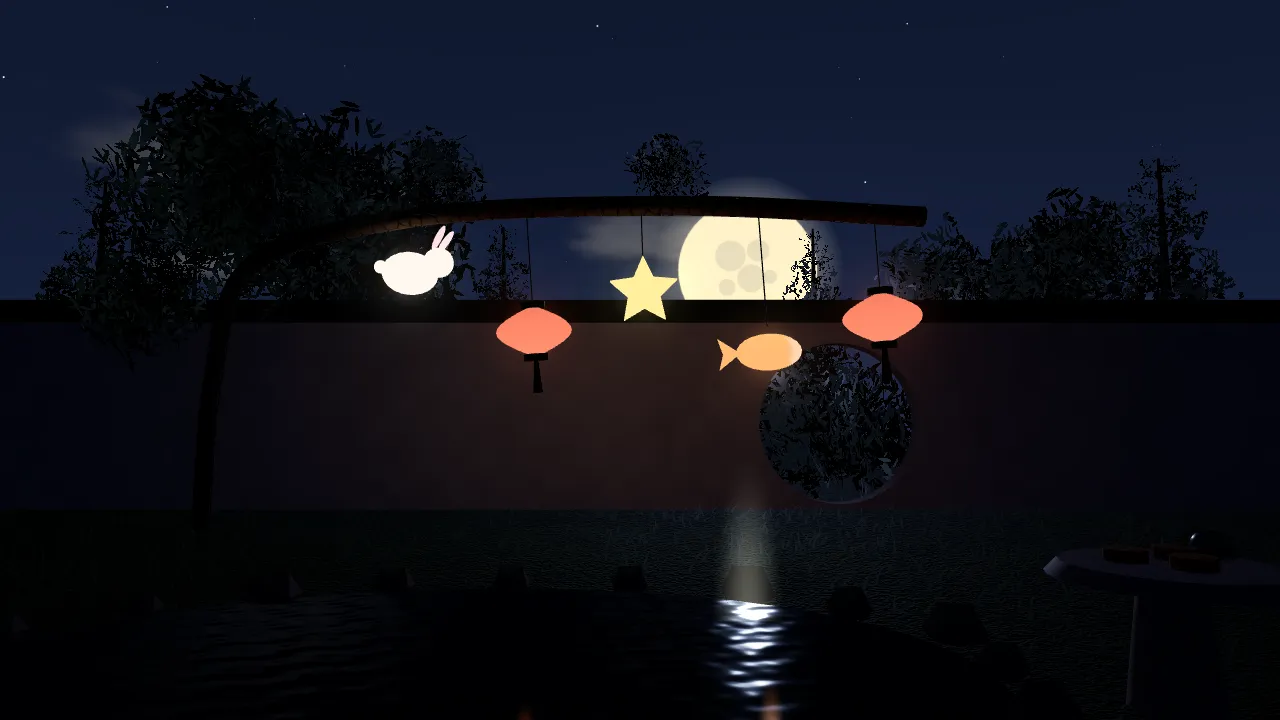
Swing shaped lanterns under the full moon and find their resonance.
How to play
- Grab one of the five lanterns on the branch (rabbit, round, star, fish and another round one), pull it aside and let go.
- Tap a swinging lantern to push it along its swing. Pushes in time with the swing build it up, like pushing a swing.
- Tap empty space for a puff of wind. Puffs in a steady rhythm pump the lantern whose own rhythm matches.
- Try the three Challenges, or switch on Regular gusts in Lab and change their period.
Challenges
- Pull a lantern aside and let it swing
- Push one lantern in time with its swing until it swings past 30°
- Tap steady puffs of wind until one lantern swings far more than the rest
Try this
- Switch on regular gusts in the Lab and set their period to about 1.7 seconds, then to about 2.5 seconds, and watch which lantern takes over. The Swinging most readout names it.
- Find the lantern with the longest string. Its natural period is the longest, so it only joins in when the gusts come slowly.
- Push one lantern by hand and count its swings for ten seconds. Divide 10 by your count to measure its period, and compare with T = 2π√(L/g).
Fun facts
- The Mid-Autumn Festival falls on the 15th day of the eighth lunar month, when the Moon is full or very nearly full.
- A pendulum’s period depends on its length and on gravity, not on its weight: a 1-metre pendulum takes about 2 seconds for a full swing on Earth.
- Mooncakes are round pastries, often filled with lotus seed or red bean paste, that are shared and given as gifts during the festival.
- Soldiers are traditionally told to break step when crossing a bridge, so that their marching cannot build up a resonant swing.
Five lanterns and one rhythm
The Mid-Autumn Festival is a harvest celebration held on the 15th day of the eighth lunar month, when the Moon is round and bright. Families gather to admire it, share mooncakes and tea, and children carry or hang lanterns in all kinds of shapes, from rabbits to stars. It is celebrated in China, Vietnam and many other places, with customs that vary from region to region. In this garden, lanterns hanging from a single branch show a striking piece of physics: resonance.
Every lantern has its own rhythm
Each lantern is a pendulum, and a pendulum’s natural period depends only on its length and on gravity: T = 2π√(L/g). The lanterns here hang on different lengths of string, measured to the middle of each lantern, so their periods range from about 1.7 seconds for the shortest to about 2.7 seconds for the longest. A lantern’s weight makes no difference, so the rabbit and the fish would keep the same time if their strings were equal.
Pushing in time
The breeze in this garden comes in regular gusts. Every gust gives every lantern a small push, but for most of them the pushes arrive at the wrong moments: sometimes helping the swing, sometimes fighting it, so their swings stay small. The lantern whose natural period matches the gust period is different. Each push arrives just as it starts to swing away, like a well-timed push on a playground swing, and its swing grows larger and larger until air drag takes away as much energy as each gust adds. This is resonance.
Resonance all around us
Resonance tunes radios and lets a singer’s voice make a glass ring. Engineers design bridges and tall buildings so that wind and footsteps don’t match their natural rhythms. The same idea is behind a classic classroom demonstration called Barton’s pendulums, in which one swinging driver sets only the pendulum of matching length into large motion.
The full moon
The festival’s moon rises around sunset, opposite the Sun, and looks especially large near the horizon. Its actual size in the sky hardly changes; the impression of a giant rising moon is an illusion of perception.
For the curious
Each lantern follows θ̈ + cθ̇ + (g/L)·sinθ = F(t)/(mL), where F(t) is the drag force of the gusts. For a periodic push at frequency ω, the steady swing is largest when ω is close to √(g/L), and the sharpness of the peak depends on the damping c.
Questions people ask
When is the Mid-Autumn Festival?
On the 15th day of the eighth month of the lunar calendar, which usually falls in September or early October, when the Moon is full or nearly full.
What is resonance?
Resonance happens when something is pushed again and again at its own natural rhythm. Each push adds to the motion, so the swing grows much larger than pushes at any other rhythm could make it.
Why are mooncakes eaten at the Mid-Autumn Festival?
Their round shape echoes the full moon and the idea of family reunion, so they are shared with family and given to friends as gifts. Fillings vary by region, from lotus seed paste to red bean and salted egg yolk.