Methane: A Perfect Tetrahedron
Pull methane’s hydrogens, hear the bonds ring and find its 109.5°.
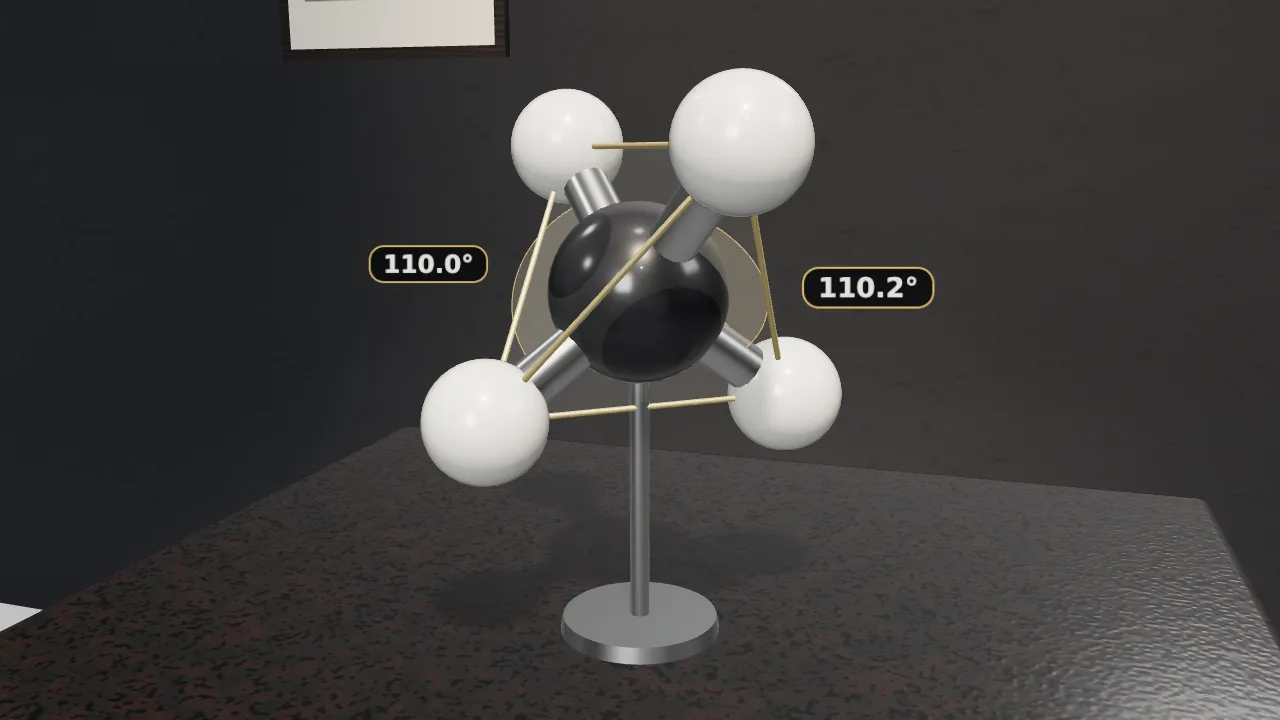
How to play
- Grab any hydrogen and pull it outwards. The C–H bond stretches, and when you let go it rings like a spring.
- Pull a hydrogen sideways to bend an H–C–H angle. Watch the brass arc: it springs back to 109.5°.
- The Last ring readout times each vibration and turns it back into a real frequency in cm⁻¹.
- Drag empty space to walk around the plinth. Open Lab for the hidden cube and the flatten slider.
Challenges
- Pull a hydrogen to stretch its C–H bond, then let it ring
- Pull a hydrogen sideways and let go, so an H–C–H angle rings
- Push two hydrogens together until the angle between them drops below 90°
Try this
- Turn on the hidden cube. Each hydrogen sits on a corner, with every other corner left empty.
- Flatten the molecule all the way. The closest H···H distance shrinks from 1.78 Å to 1.54 Å and the pair repulsion goes up.
- Look straight down one C–H bond. The other three hydrogens form a perfect triangle around it.
Fun facts
- Every H–C–H angle in methane is the same: about 109.5°, the tetrahedral angle arccos(−1/3).
- Methane is the main component of natural gas.
- Natural gas has no smell of its own; suppliers add strong-smelling sulfur compounds so that leaks can be noticed.
- Kilogram for kilogram, methane traps far more heat than carbon dioxide: roughly 30 times as much over a century.
The shape that keeps four bonds apart
Methane, CH₄, is the simplest hydrocarbon: one carbon atom bonded to four hydrogens. Carbon has four outer electrons and each hydrogen supplies one, so carbon ends up with four shared electron pairs. Drawn on paper, methane often looks like a flat cross with 90° angles. In three dimensions it is something much more elegant: a tetrahedron.
Spreading out in three dimensions
Electron pairs repel one another, so the four bonding pairs push as far apart as they can. On a flat plane the best they could do is 90°. In three dimensions they can do better: pointing towards the four corners of a regular tetrahedron puts every pair at 109.5° from every other. This is the core idea of VSEPR (valence shell electron pair repulsion) theory, and methane is its textbook example. All four bonds are identical, each about 1.09 Å long.
The hidden cube
There is a neat way to build a tetrahedron: take a cube and use every other corner. Put the carbon at the centre and the hydrogens at four alternate corners, and the bond angle is exactly arccos(−1/3), 109.47°. Switch on the cube in the Lab to see it.
Why not flat?
The flatten slider lets you test the alternative. As the molecule is squashed towards a square, two pairs of hydrogens are forced together at 90° and the closest H···H distance drops. A simple measure of how much the pairs crowd each other, adding up 1/r for all six H–H pairs, rises by about 4%. Nature picks the arrangement with the least repulsion, which is the tetrahedron.
Methane in the world
Methane is the main ingredient of natural gas, burned for heating and electricity: CH₄ + 2O₂ → CO₂ + 2H₂O. It is also made by microbes in wetlands, rice paddies and the stomachs of cattle. In the atmosphere it is a powerful greenhouse gas: it doesn’t last as long as carbon dioxide, but while it is there it absorbs far more heat per kilogram.
For the curious: hybrid orbitals and vibrations
Chemists often describe the bonding by saying carbon mixes its one 2s and three 2p orbitals into four equivalent sp³ hybrid orbitals, each pointing to a corner of the tetrahedron. Methane has four fundamental vibration frequencies; the symmetric stretch, where all four hydrogens move in and out together, is near 2917 cm⁻¹. Because it keeps the molecule perfectly symmetric, it doesn’t create a dipole and doesn’t absorb infrared. In this model the bond length and angles are measured values. The atoms are joined by springs whose stiffnesses were chosen so that the model’s four vibrations land within about 2% of methane’s measured ones (2917, 1534, 3019 and 1306 cm⁻¹), then slowed down about 40 trillion times so you can watch them. The flattened shapes are what-ifs, not real molecules.
Questions people ask
Why is methane tetrahedral?
Carbon has four bonding pairs of electrons, which repel each other. Pointing them at the corners of a tetrahedron puts them as far apart as possible in three dimensions, at 109.5° from each other.
What is the bond angle in methane?
Every H–C–H angle is about 109.5°, the tetrahedral angle. More precisely it is arccos(−1/3), or 109.47°.
Is methane polar?
No. Each C–H bond is only slightly polar, and because the four bonds point symmetrically to the corners of a tetrahedron, their effects cancel out completely.