Mars Rover Drive
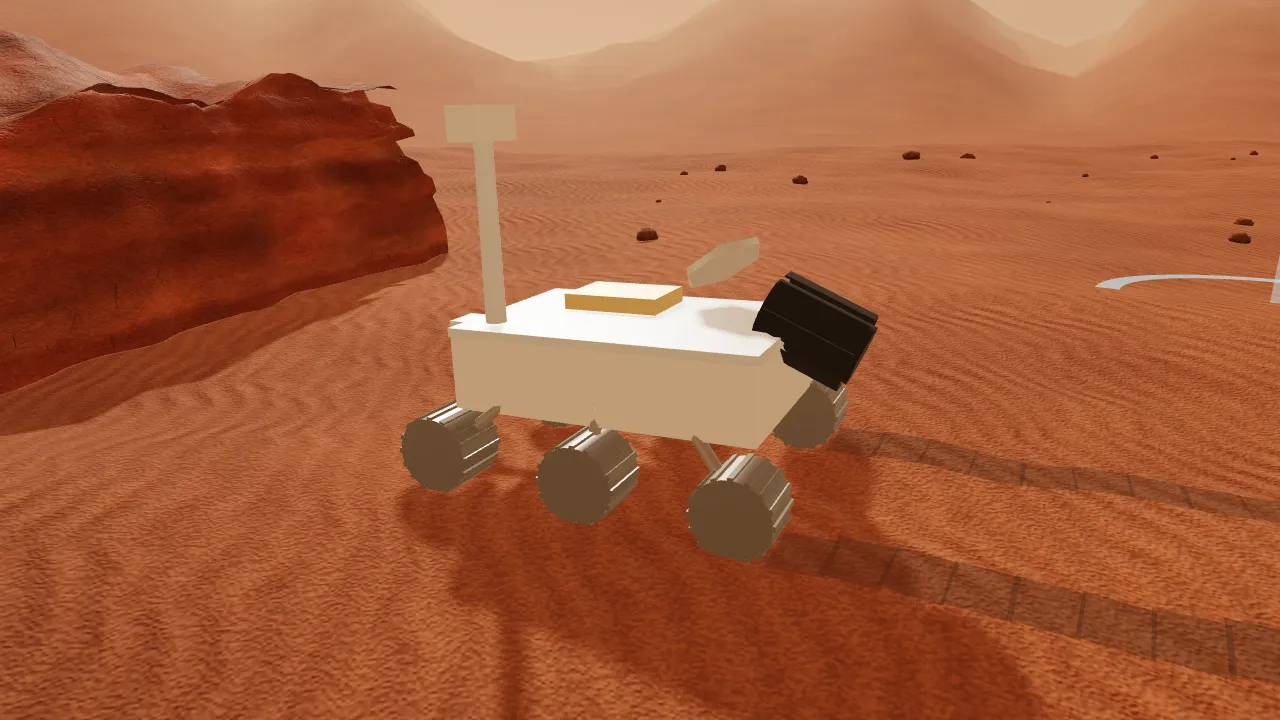
Drive a six-wheeled rover over Martian dunes and rocks to its targets.
How to play
- Press and hold on the ground: the rover turns and drives towards your finger. Let go and it stops.
- Or tap a spot to send the rover there on its own, the way real rover drivers plan a route.
- Steep sand makes the wheels slip. If the rover stalls on the dune, back off and climb at an angle.
- Drive within about 12 m of the striped rock and tap it to take a photo. Drag the sky to look around; the Lab sets the time-lapse.
Challenges
- Drive to all three glowing navigation targets
- Climb to the crest of the dark dune (steep sand slips: try zig-zagging)
- Photograph the layered rock: drive close, then tap the rock
Try this
- Drive straight at the dune’s steep side and watch the slip readout climb until the wheels just spin.
- Drive across a patch of small rocks and watch the six wheels rise and fall on their arms while the body stays nearly level.
- Look back at your wheel tracks in the dust. On Mars they stay until the wind slowly fills them in.
Fun facts
- The gravity at the surface of Mars is about 3.7 m/s², a little over a third of Earth’s.
- NASA’s Curiosity rover landed in Gale crater on 6 August 2012 (UTC) and later began climbing the layered slopes of Mount Sharp.
- Radio signals take between about 3 and 22 minutes to cross between Earth and Mars, so rovers cannot be driven live with a joystick.
- The daytime sky on Mars is often butterscotch, coloured by fine reddish dust, while its sunsets look bluish.
Driving on another planet
A Mars rover is a geologist, a laboratory and a car rolled into one, and it has to look after itself a very long way from any mechanic. Radio messages take minutes to cross between the planets, so nobody steers it live: each day its team plans a route, sends the commands, and the rover drives itself, checking the ground with its own cameras. Tapping a spot here works the same way.
Six wheels and no springs
The rover uses a rocker-bogie suspension. On each side, a rocker arm carries the front wheel and a smaller bogie carries the middle and rear wheels. A bar across the body links the two sides, so when one side climbs the body tilts by only about half as much. There are no springs: all six wheels stay pressed to the ground, sharing the load and the grip, which lets the rover roll over rocks and dips that would tip a car. Drive over the small rocks here to watch it work.
Slowly does it
A Curiosity-sized rover tops out at about 4 cm/s on flat, firm ground. Speed is not the point: a stuck or broken rover cannot be rescued. Time runs 25 times faster in this toy, otherwise crossing the map would take most of an afternoon.
Sand is the enemy
Loose sand gives way under the wheels. As a slope steepens the wheels turn faster than the rover moves, the slip grows, and eventually they just dig in. NASA’s Spirit rover became stuck in soft ground in 2009 and never drove out. Dunes have a gentle windward side and a steep slip face near the angle at which sand avalanches, about 30°. Climbing at an angle meets a gentler slope than climbing straight up, which is why drivers zig-zag.
Reading the rocks
Flat-lying layers in rock are a history book. Each bed was once mud or sand laid down by water or wind, and the oldest lie at the bottom. Curiosity found that layers in Gale crater formed in an ancient lake, evidence that Mars once had water that stayed liquid for a long time.
For the curious
Slip ratio: s = 1 − vactual/vwheels. On a slope of angle β, a path at angle α to the steepest line climbs a gentler slope β′ with tan β′ = tan β · cos α: on a 23° face, a path 50° off the fall line climbs only about 15°. The pull of gravity down a slope is g·sin β, with g = 3.71 m/s² on Mars.
Questions people ask
Why do Mars rovers drive so slowly?
For safety and to save power. A stuck or broken rover cannot be rescued, so rovers creep along, stop to look and check each move with their cameras. Their top speed on flat ground is only about 4 cm/s.
What is a rocker-bogie suspension?
A linkage without springs. On each side a rocker carries the front wheel and a bogie carries the middle and rear wheels, and a bar across the body links the two sides, so all six wheels stay on the ground and the body tilts only half as much as the terrain.
Why is the Martian sky that colour?
Fine reddish dust hangs in the thin air and scatters sunlight, giving the daytime sky a butterscotch tint. Near the setting Sun the dust scatters blue light forwards, so Martian sunsets look blue.