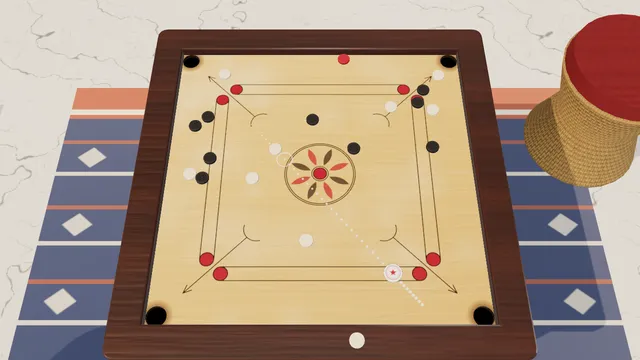
Marbles (Kanche)
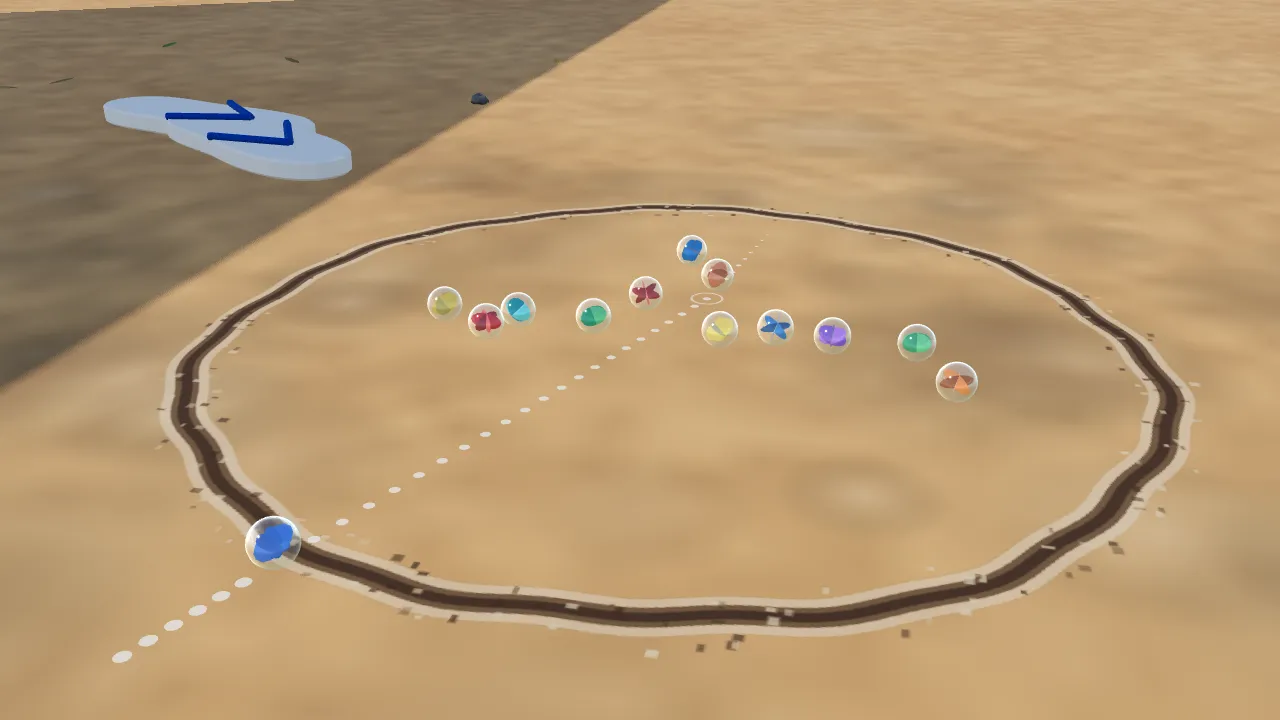
Flick a glass marble to knock the others out of the ring.
On Amazon.in. As an Amazon Associate I earn from qualifying purchases.
How to play
- Pull back on your shooter marble and let go: it shoots the opposite way, faster the further you pull.
- Slide your shooter along the edge of the ring first, or tap the edge, to choose where you shoot from.
- Marbles you knock out of the ring are yours, and you shoot again from where your shooter stopped. Miss, and it is the computer’s turn. When the ring is empty, whoever has more marbles wins.
- In Lab, switch to Into the hole: five marbles each from a line, and whoever gets more into the hole wins. You can also make the computer easier.
Challenges
- Knock a marble out of the ring
- Knock two marbles out of the ring with one shot
- Win a ring against the computer
Try this
- Shoot hard, dead centre, at a marble close to your shooter. Your shooter stops almost dead and the other marble races away: equal masses swap their speeds.
- Now make the same full hit from much further away. By then your shooter is rolling rather than sliding, and its spin carries it on after the hit.
- In the hole game, send a fast marble straight over the hole. A slow one drops in, but a fast one jumps the far edge before it has fallen far enough to be caught.
Fun facts
- Small stone balls from about 2500 BCE, identified by archaeologists as marbles, were found near Mohenjo-daro, a city of the Indus Valley Civilisation.
- In India the game is called kanche. Marbles are set in a circle and players flick their own marble to knock them out; every marble knocked out belongs to the player who hit it.
- Before a game of kanche, players often flick a marble toward a small hole from behind a line, and whoever gets closest goes first.
- In a cat’s eye marble, streams of coloured glass are injected into clear glass while it is made, which gives the coloured vanes inside.
Why marbles slide, then roll, then click
A flicked marble does two different things on its way across the ground. First it slides, then it rolls. That change, and what happens when two glass marbles meet, is most of the skill in kanche.
From sliding to rolling
A knuckle flick sends the marble off fast but hardly spinning. Its bottom point scrapes across the earth, and sliding friction pushes back on it. That push does two jobs at once: it slows the marble down and, because it acts at the bottom, it makes the marble spin faster. Once the spin matches the speed, the bottom point is momentarily still, the sliding stops and the marble rolls. For a solid ball shot without spin this always happens at 5/7 of the starting speed, however rough the ground is. Rough ground only makes it happen sooner. After that only rolling resistance slows it, which on packed earth is a few percent of its weight.
Equal masses swap their speeds
Glass marbles are hard and almost perfectly bouncy, and all the marbles here have the same mass. When one hits another full on, the push between them acts along the line of their centres, and for equal masses the speeds along that line are simply exchanged. A shooter that is still sliding therefore stops dead and the target leaves at its speed. If the hit is a glancing one, the two marbles go off at roughly a right angle to each other.
Why the shooter follows through
A rolling shooter carries spin as well as speed. The collision takes the speed but not the spin, so a moment after the hit friction grips again and the spinning shooter creeps forward. That is why a long shot often leaves your shooter close behind the marble it hit, still inside the ring for your next turn.
Catching a hole
A marble falls into a hole only if it drops far enough before it reaches the far rim. A slow marble has plenty of time to fall; a fast one skims across and jumps out. The safest shot arrives at the hole gently.
For the curious
Sliding friction gives a deceleration a = μg and a spin-up dω/dt = 5μg/(2r) for a solid sphere (moment of inertia I = 2/5·mr²). Sliding ends when v = ωr, after a distance 12v₀²/(49μg), at v = 5v₀/7. A head-on hit between equal masses with restitution e leaves the target at (1 + e)/2 of the shooter’s speed and the shooter at (1 − e)/2; with e = 0.92 that is 96 percent and 4 percent. A rolling shooter that stops after a full hit picks up 2/7 of its old speed from its spin. Here μ = 0.35 and the rolling resistance coefficient is 0.045.
Questions people ask
Why does my shooter stop dead when it hits a marble straight on?
Because both marbles have the same mass. In a head-on hit the push between them acts along the line of their centres, and equal masses simply swap their speeds along that line. If your shooter was still sliding, it is left with almost nothing.
Why does a flicked marble start rolling on its own?
Friction from the ground acts at the bottom of the marble. It slows the marble and at the same time spins it up, until the spin exactly matches the speed. From then on the marble rolls, at five sevenths of the speed it started with.
How big is a marble?
Sizes vary, but toy marbles usually measure from about 0.5 to 3.5 cm across. The glass marbles in this game are 19 mm across and weigh about 9 g.