Carrom
Flick the striker, pocket your coins and cover the red queen.
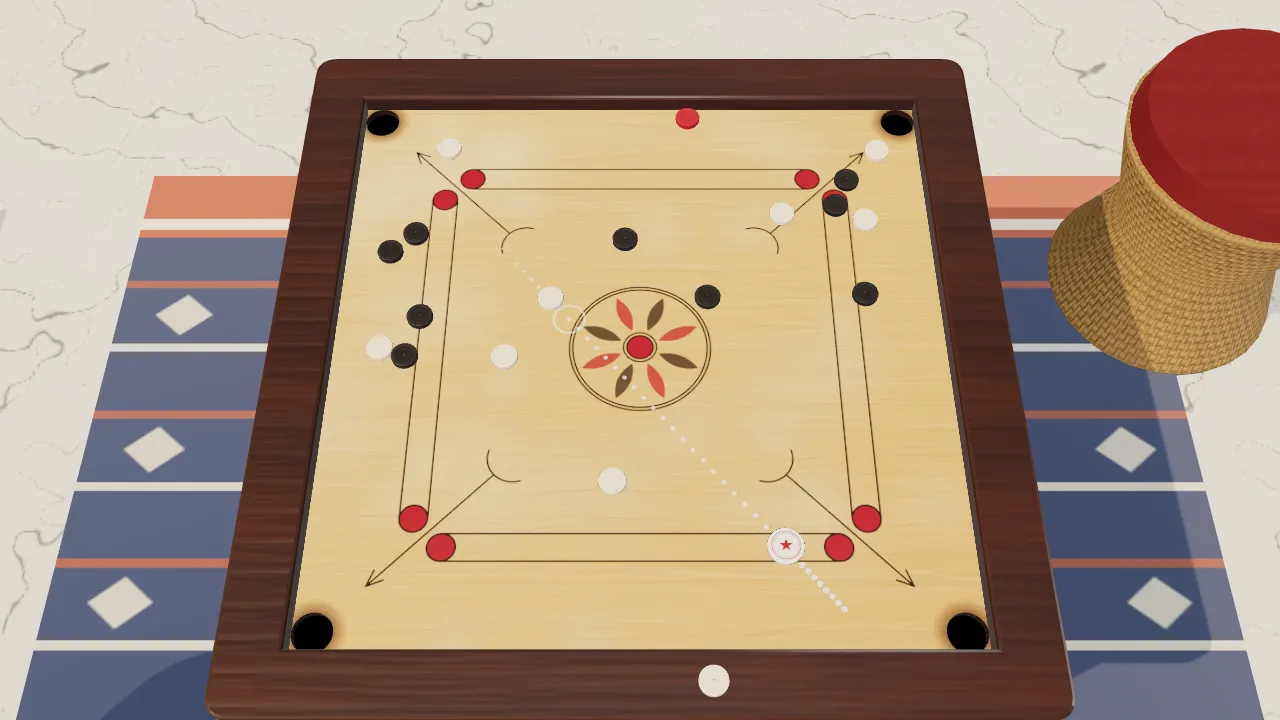
How to play
- Slide the striker sideways along your baseline to place it. Then pull back from it and let go: it shoots the opposite way, harder the further you pull.
- You play white. Pocket one of your coins and you strike again. Pocket the striker and it is a foul: one of your pocketed coins goes back to the centre.
- Pocket the red queen, then cover it by pocketing one of your own coins in the same strike or the next one. If you don’t, the queen goes back to the centre.
- Clear all nine of your coins first to win the board. You score a point for each coin your opponent still has on the board, plus 3 for a queen you covered.
- In Lab, play the computer (easy or normal) or a friend on the same phone (the view turns to whoever strikes), and change how much powder is on the board.
Challenges
- Pocket one of your own coins to earn another strike
- Pocket the red queen and cover it with one of your coins
- Win a board against the computer
Try this
- Strike a lone coin dead centre and watch the striker: being heavier, it keeps sliding forward after the hit at about half its speed instead of stopping.
- Set the powder slider to 0.06, then to 0.30, and play the same gentle strike each time. Less friction lets the pieces glide much further for the same flick.
- Bank a coin off the frame into a pocket. The rebound comes off flatter than it went in, because the wood takes away part of the speed straight into it.
Fun facts
- Carrom comes from India and is played all over South Asia, at home, in clubs and in cafés. A set has 19 pieces: nine white, nine black and the red queen.
- Under International Carrom Federation rules the square playing surface measures between 73.5 and 74 cm along each side, and every pocket has a net underneath.
- Tournament carrom men are 3.02 to 3.18 cm across and weigh 5.0 to 5.5 g. The striker is larger and heavier, usually about 4.1 cm across and 15 g.
- Players dust the board with a fine powder, most often boric acid powder, so that the pieces slide easily.
The physics of a carrom strike
Every carrom strike is a short story told by three pieces of physics: sliding friction that slows the pieces down, collisions that pass momentum from one piece to the next, and rebounds off the wooden frame. The game in this page simulates each of them with real sizes and masses.
Friction and the powder
A sliding coin feels a friction force of about μ times its weight, where μ is the coefficient of sliding friction. That force hardly depends on speed, so the coin slows at a steady rate of μ·g and stops after a distance of v²/(2μg). Double the speed of a flick and the coin slides four times as far. Powder lowers μ, which is why a well-powdered board feels fast and lively. The Lab slider lets you try a sticky board or a very slippery one.
Why the striker is heavier
When the striker hits a coin squarely, momentum is shared between them. Because the striker is almost three times as heavy as a coin, a head-on hit sends the coin away faster than the striker arrived, while the striker carries on forward at roughly half its speed. That is great for clearing a path, but it is also why the striker so often follows a coin into the pocket: a foul.
Cut shots and the ghost striker
Two smooth discs push on each other only along the line joining their centres at the moment of contact. So a coin always leaves along that line, whatever angle the striker came in at. To send a coin to a pocket, aim the striker at the spot just behind the coin, on the far side from the pocket: the "ghost" position. The ring in the aiming guide shows exactly where the striker will touch. A little friction between the pieces makes a thin cut drag the coin slightly sideways, an effect players call throw.
Bouncing off the frame
The frame gives back only part of the speed aimed straight into it, here about 60 percent, while the speed along the frame is barely touched. The rebound therefore comes off at a flatter angle than it went in. Rubbing against the wood also sets the piece spinning, which you can see in the slow-motion setting.
For the curious
Stopping distance: d = v² / (2μg). A collision is an impulse along the line of centres, J = (1 + e)·vn / (1/m₁ + 1/m₂), where e is the coefficient of restitution and vn the closing speed. For a head-on hit of a striker of mass M on a coin of mass m at rest: vcoin = (1 + e)·M/(M + m)·v and vstriker = (M − e·m)/(M + m)·v. With M = 15 g, m = 5.5 g and e = 0.82 the coin leaves at 1.33 v and the striker keeps 0.51 v. The simulation takes small time steps so that no piece moves more than 4 mm between collision checks.
Questions people ask
What does covering the queen mean in carrom?
After you pocket the red queen you must also pocket one of your own coins, either in the same strike or in your very next one. That is called covering the queen. If you fail, the queen goes back to the centre of the board.
Why do people put powder on a carrom board?
Fine powder, most often boric acid powder, makes the varnished playing surface slippery so the pieces slide easily. With less friction a gentle flick carries much further, as you can try with the powder slider in Lab.
What happens if the striker goes into a pocket?
It is a foul. Your turn ends and one of the coins you have already pocketed goes back to the centre. Tournament rules use the same kind of penalty: the player who sinks the striker returns one piece and loses the turn.