Jansen Linkage Walker
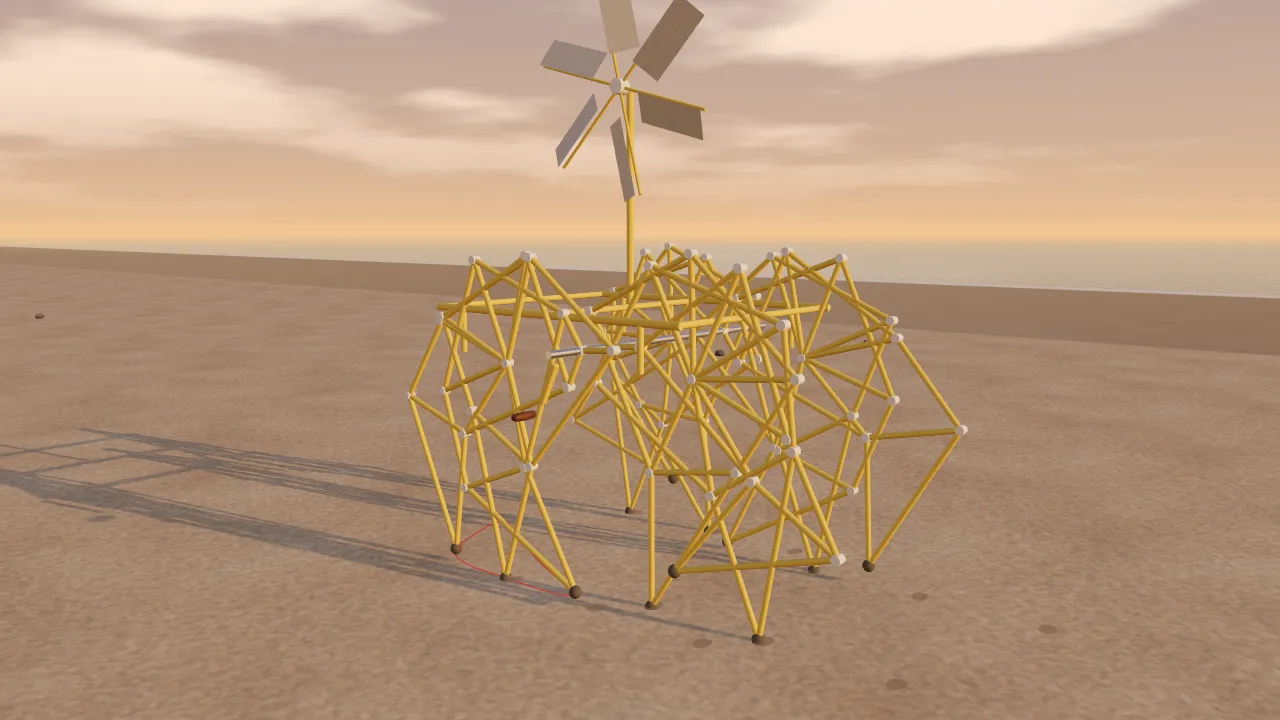
Crank or wind-walk a twelve-legged walker along a beach.
How to play
- Grab the wooden crank handle on the axle and turn it. The twelve legs walk the machine along the sand.
- Swipe across the sky to make a breeze. The wind wheel on the mast turns the crankshaft through its gears, as Jansen’s beach beasts walk on the wind.
- Drag the knee joint of the nearest front leg to stretch or shrink bar j, and watch the stride, the lift and the body bob change.
- Turn on Show the foot path in Lab to see the shape each foot traces, or press Back to the holy numbers.
Challenges
- Crank the walker three metres along the beach by hand
- Swipe up a breeze and let the wind walk it two metres
- Stretch bar j to make the ride bumpy, then find the length that is smoothest again
Try this
- Show the foot path and look at its bottom edge. It is almost perfectly flat, so the body barely bobs.
- Drag the knee to make bar j a few centimetres longer, then shorter. The flat part shrinks and the walk gets bumpy.
- Watch the feet: at any moment several are on the sand, which is what keeps the walker steady.
Fun facts
- The Dutch artist Theo Jansen has been building wind-powered beach creatures that walk on their own since 1990.
- Jansen’s walkers are built largely from yellow plastic electrical conduit tubing.
- Jansen found his leg proportions, which he calls the “holy numbers”, with the help of a computer evolution program.
How a turning crank becomes a gliding walk
Wheels need a road. Legs can cross sand, but they usually make a body rise and fall with every step. Theo Jansen’s leg linkage does something remarkable: one turning crank drives a foot along a path with a long, flat bottom, so the body glides along almost level. This machine uses his proportions, credited to Theo Jansen, scaled so that a leg is about a metre tall.
Eleven bars and one crank
Each leg is a planar linkage of eleven bars connected by pin joints. Only two points are fixed to the body, the crank axle and one pivot. The crank turns in a circle, and every other joint is forced to follow because the bars can’t change length. Knowing the positions of two joints and the lengths of the bars to a third, the third joint must sit where two circles meet. Solving those circle intersections one after another gives the position of every joint, all the way down to the foot.
The foot path
With Jansen’s numbers, the foot traces a rounded D shape. Along the bottom the foot moves backwards in a nearly straight line, and that is the moment it is on the ground pushing the walker forward. Then it lifts, swings forward through the air and comes down again. In this model the flat part is about 60 cm long and the foot lifts about 22 cm, so each crank turn moves the walker forward by about one stride. The body bobs by only about 3 mm; make bar j two centimetres longer or shorter and it bobs about three times as much, while the stride shrinks.
Why so many legs
Each foot is on the ground for roughly half the cycle. By putting legs at three different crank angles on each side, and mirroring them, this walker always has several feet down at once. Mirrored legs push in the same direction because they are driven at mirrored crank angles. Jansen’s beach beasts use the same trick with many more legs.
For the curious
The holy numbers (in cm) are a = 38, b = 41.5, c = 39.3, d = 40.1, e = 55.8, f = 39.4, g = 36.7, h = 65.7, i = 49, j = 50, k = 61.9, l = 7.8 and m = 15, where m is the crank radius and a and l place the fixed pivot. The body moves by exactly the backward sweep of the lowest foot each frame, so grounded feet don’t slide, just as with a real walker.
Questions people ask
What is a Jansen linkage?
It is an eleven-bar leg mechanism invented by the artist Theo Jansen. A single rotating crank drives the foot along a path with a long flat bottom, giving a smooth walking motion.
What are Theo Jansen’s holy numbers?
They are the thirteen lengths that define his leg linkage, found with the help of a computer program that simulated evolution. They give the foot its flat-bottomed path.
How do Theo Jansen’s walking sculptures move?
His beach creatures are moved by the wind. The wind turns crankshafts, and the linkage turns that rotation into walking. Here a swipe of wind turns a small wind wheel geared to the crankshaft, or you can turn the crank by hand.