Lantern Festival (Yuanxiao)
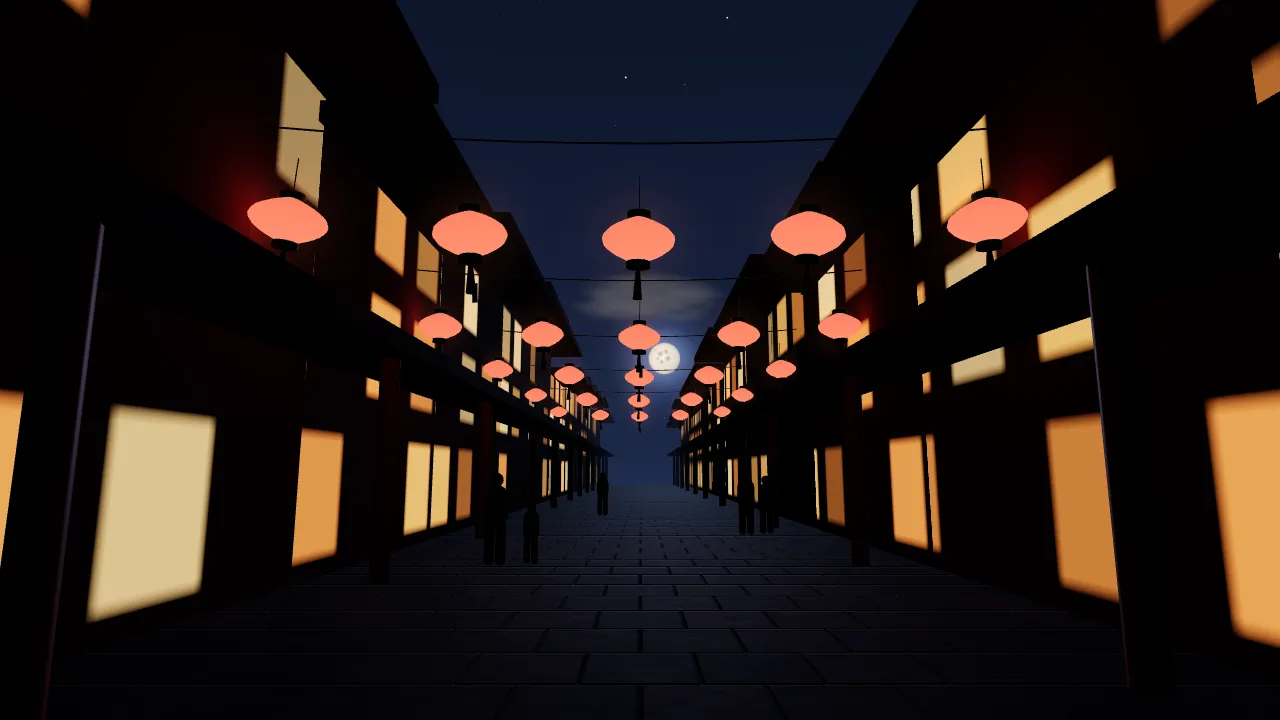
Pull red lanterns on a rope and see the swing pass along the row.
How to play
- Grab a red lantern, pull it aside and let go. The rope passes its swing along the row to its neighbours.
- Tap a lantern to give it a gentle push in the direction it is already swinging.
- Lanterns with a paper slip carry a riddle: tap one to read it, and tap again for the answer.
- Try the three Challenges, or change the rope coupling and the breeze in Lab.
Challenges
- Pull a lantern well aside and let it go
- Find and read three lantern riddles
- Swing one lantern until its swing reaches the far end of its rope
Try this
- Push one lantern hard, then watch: its swing dies down as its neighbours start to swing, and later it comes back. Energy is flowing to and fro.
- Turn the rope coupling up in the Lab and pull a lantern again. The swing passes along faster, because each lantern tugs harder on its neighbours.
- Check the Energy passed along readout a few seconds after a push to see how much of the swing has moved to the other lanterns.
Fun facts
- The Lantern Festival falls on the 15th day of the first month of the lunar calendar, the first full moon of the new year.
- Guessing riddles written on lanterns is a traditional Lantern Festival game.
- Sweet glutinous rice balls, called tangyuan or yuanxiao, are a traditional food at the festival.
- Two identical pendulums joined by a slack cord will hand their swing back and forth, a slow rhythm that physicists call beats.
Lanterns that pass their swing along
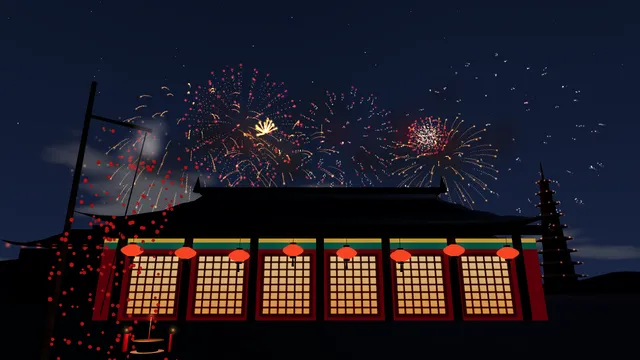
The Lantern Festival closes the Lunar New Year celebrations on the 15th day of the first lunar month, under the year’s first full moon. Streets and parks fill with lantern displays, families share sweet rice balls called tangyuan or yuanxiao, and many people try to solve riddles written on slips of paper hanging from the lanterns. Customs differ across regions and communities. This street of red lanterns adds a quiet piece of physics: lanterns that share a rope also share their motion.
Each lantern is a pendulum
A lantern on a cord swings like a pendulum. Its natural rhythm depends only on the length from the hook to its middle and on gravity: here every lantern hangs about a metre down and takes roughly two seconds for each full swing. Air drag slowly takes energy away, so a swing left alone gradually fades.
Joined by a rope
These lanterns don’t hang from a rigid beam but from a rope stretched across the street. When one lantern swings, its cord tugs the rope sideways a little, and the rope tugs on the neighbouring cords. Physicists call this coupling. Each small tug arrives in step with the neighbour’s own rhythm, because all the lanterns have the same natural period, so the neighbour’s swing grows while the first one’s shrinks. After a while the motion flows back again. This slow exchange is called beats.
Stiff or slack
How fast the energy moves depends on how strongly the lanterns are coupled. A slack rope moves easily and lets the lanterns influence each other strongly, so the swing passes along quickly. A tight rope barely moves, so the exchange is slow. Try both with the Lab’s rope stiffness slider.
Riddles under the lanterns
Lantern riddles are a centuries-old pastime, often clever plays on Chinese characters. The riddles in this scene are simple ones in English, in the same spirit: read one, think, then tap again for the answer.
For the curious
Each lantern obeys θ̈ = −(g/L)·sinθ + (ẍ/L)·cosθ − cθ̇, where x is the sideways movement of its attachment point. The rope points obey m·ẍᵢ = −k(2xᵢ − xᵢ₋₁ − xᵢ₊₁) − mlg·sinθᵢ, so the rope’s stiffness k sets the coupling. For two weakly coupled identical pendulums, energy swaps between them with a period that gets longer as the coupling gets weaker.
Questions people ask
When is the Lantern Festival?
It falls on the 15th day of the first month of the lunar calendar, the first full moon after Lunar New Year, usually in February or early March.
What are lantern riddles?
Riddles written on paper and hung on lanterns for visitors to solve. Guessing them is a traditional Lantern Festival game, and many are clever plays on Chinese characters.
Why does one swinging lantern make its neighbours swing?
They hang from the same rope. Each swing tugs the rope a little, and because the lanterns share the same natural rhythm, those small tugs build up their neighbours’ swings, passing the energy along.