Kite Festival (Makar Sankranti)
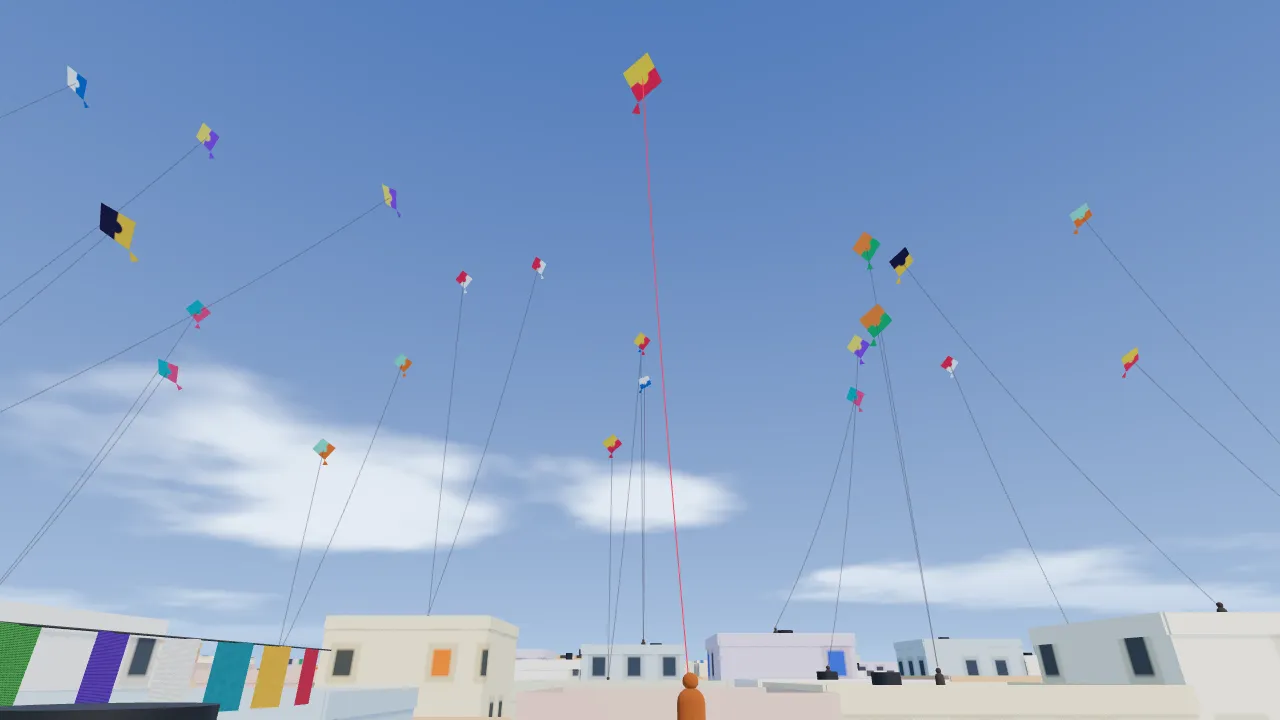
Fly a patang over sunny rooftops among dozens of kites.
How to play
- Drag across the sky: your kite, the one on the red line, turns its nose to follow your finger.
- Flick down quickly to tug the line and make the kite dart forwards.
- Fly it across the middle of the sky for speed; at the edges it runs out of wind and slows.
- Try the three Challenges, or open Lab for the wind, the line length and the kite’s size.
Challenges
- Steer your kite across the sky until it flies faster than the wind
- Fly a full loop: turn your kite’s nose right round once
- Fly your kite to the edge of the wind window, where it runs out of power
Try this
- Steer your kite sideways across the middle of the sky and watch the airspeed readout: it can fly faster than the wind itself.
- Fly it out to the far edge of the sky. It slows down, the line slackens and it starts to sink: you have reached the edge of the wind window.
- Double the wind speed and watch the line tension. It roughly quadruples, because aerodynamic forces grow with the square of speed.
Fun facts
- Makar Sankranti follows the solar calendar, which is why it falls on or around 14 January almost every year, unlike most Hindu festivals, which follow the Moon.
- In Gujarat the festival is called Uttarayan, and families spend the day flying kites from their rooftops.
- A kite flying across the wind can move faster than the wind itself, because its lift pulls it sideways as well as up.
- Glass-coated “manja” string injures birds and people every year and has been banned in many parts of India.
How a kite flies faster than the wind
Makar Sankranti marks the Sun’s entry into Makara (Capricorn) in the sidereal zodiac, and it is traditionally linked with the Sun’s northward journey, Uttarayan. It is celebrated across India under many names and with many customs, including Pongal in Tamil Nadu and Magh Bihu in Assam. In Gujarat, where it is called Uttarayan, the sky fills with kites flown from crowded rooftops, and people share sweets made with sesame seeds and jaggery. Customs vary from region to region and family to family.
Lift and drag
A kite is a sail held at an angle to the wind by its bridle. Air flowing past the tilted sail is deflected downwards and backwards, and the sail feels an equal and opposite push: partly upwards and sideways, called lift, and partly downwind, called drag. Both grow with the square of the airspeed. The line holds the kite against the drag, and the kite settles where the forces balance.
The wind window
On a tight line, a kite can only move over the surface of an imaginary dome around you, called the wind window. In the middle of the window, straight downwind, the wind pushes almost along the line, and a kite flying across it builds up speed: its lift pulls it sideways, the extra speed makes more lift, and it can end up several times faster than the wind. Towards the edges, less of the wind pushes along the line, the kite slows and, at the edge itself, it hovers or sinks. In this scene your kite’s airspeed is close to its lift-to-drag ratio times the part of the wind blowing along the line.
Steering
Indian fighter kites, patangs, have no long tail, so they are agile and a little unstable. Flyers steer them by tugging the line, which makes the kite dart in whichever direction its nose points, and by letting the line go slack to make it turn. Here you turn the kite’s nose with a sideways drag and tug with a downward one.
Fly kindly
Glass-coated manja is used in kite fights to cut rival lines, but it also cuts birds, animals and people. Plain cotton string is safer for everyone, and the kites in this scene never fight.
For the curious
Line tension is roughly T ≈ ½ρAC(w² + v²), where A is the sail area, C a force coefficient of about 0.8, w the wind along the line and v the kite’s airspeed. Its crosswind speed is about v ≈ E·w·cosθ, where E is the lift-to-drag ratio and θ the angle from the centre of the window; the edge of the window is where tanθ = E.
Questions people ask
Why are kites flown on Makar Sankranti?
Kite flying is a much-loved way of celebrating the festival, especially in Gujarat, where it is called Uttarayan. The festival falls in mid-January, when skies are often clear and breezy.
How can a kite fly faster than the wind?
When a kite flies across the wind, its lift pulls it sideways. The faster it goes, the more lift it makes, so it can reach several times the wind speed, like a sailing boat on a beam reach.
Why is manja dangerous?
Manja is kite string coated with glass or other sharp materials to cut other kites’ lines. It also cuts birds, animals and people, especially motorcyclists, so plain cotton string is a much safer choice.