Jellyfish Bloom
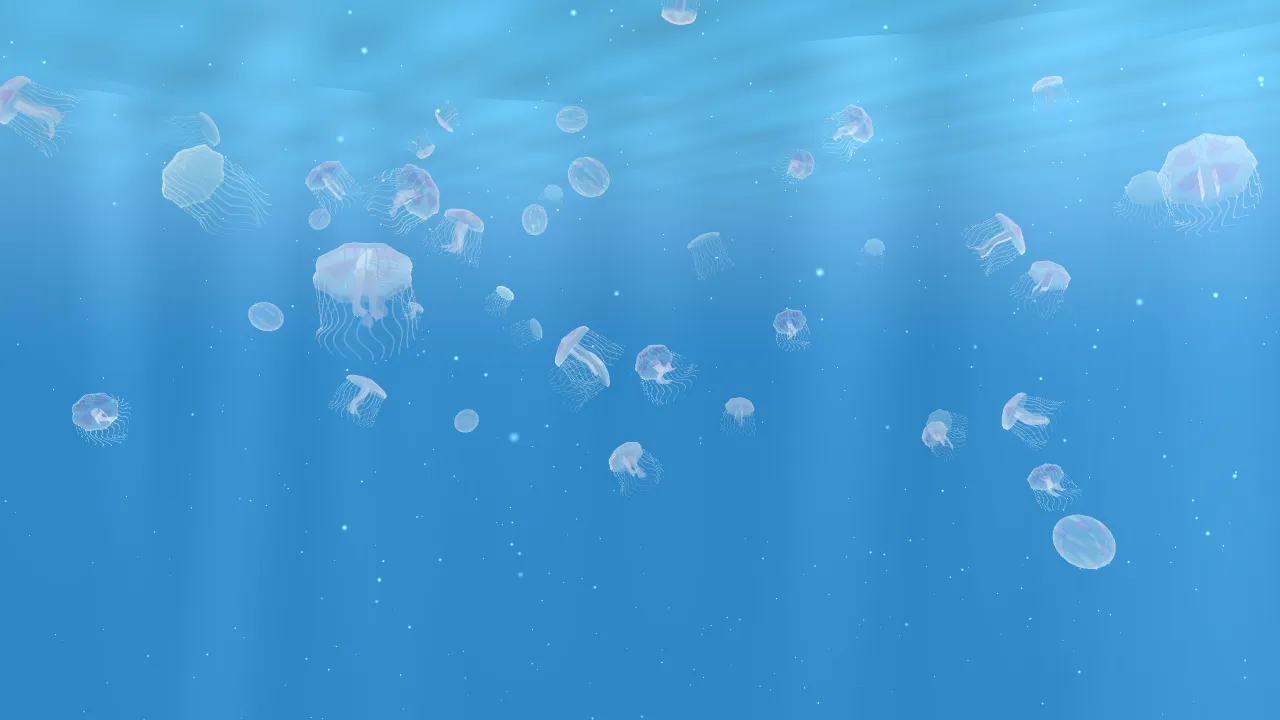
Startle and push pulsing jellyfish, and make a crystal jelly glow.
How to play
- Tap a jellyfish to startle it: it pulses fast to get away. The clearest ones are crystal jellies, and they flash green.
- Press and drag through the water to push a current. Jellies are drifters, so a gentle sweep carries them along.
- Look for comb jellies, the oval ones with shimmering rows: they row with beating combs instead of pulsing a bell.
- Open Lab to choose the bloom, change the pulse rate or the current, or turn the lights out.
Challenges
- Tap a jellyfish and startle it into a burst of fast pulses
- Sweep a current through the bloom that pushes eight jellies at once
- Find a crystal jelly and make it flash green
Try this
- Choose crystal jellies in the Lab, turn the lights out, and tap a few. The green ring around the bell margin is real: this is the jellyfish in which green fluorescent protein was discovered.
- Slow the pulse rate to 20 per minute and watch the average speed readout fall: fewer contractions mean less thrust.
- Choose comb jellies in the Lab. They don’t pulse at all, because they row with rows of tiny hairs instead, and the shimmer comes from light scattered by those beating combs.
Fun facts
- Jellyfish have no brain, heart or bones, and their bodies are made mostly of water.
- The moon jelly is easy to recognise by the four horseshoe-shaped gonads visible through the top of its bell.
- Green fluorescent protein, now used in laboratories worldwide to light up cells, was discovered in the crystal jelly Aequorea victoria, and its discovery and development won the 2008 Nobel Prize in Chemistry.
- Comb jellies are not true jellyfish. They belong to a separate group of animals that swim by beating rows of hair-like cilia.
How a jellyfish swims
A jellyfish swims with one simple movement. A ring of muscle around the bell contracts, squeezing water out from underneath, and the push of that water drives the jellyfish the other way. Then the muscle relaxes, and the springy jelly of the bell, called mesoglea, pulls it open again, drawing water back in for the next stroke.
Fast squeeze, slow relax
The power stroke is quick and the recovery is slow. That timing matters. In this simulation, every jellyfish produces thrust only during the first part of each cycle, when the bell contracts, then coasts while drag slows it down. Change the pulse rate in the Lab and you change how often the thrust comes, which you can see in the average speed readout.
Wide, flattened jellyfish such as moon jellies don’t rely on jetting alone. Studies of their wakes suggest they also row: the bell margin flexes like a paddle, and when the bell reopens, a swirl of water under it gives an extra push for free. Research suggests this makes moon jellies among the most energy-efficient swimmers ever measured, a good strategy for animals that drift for most of their lives.
Light in the dark sea
Many sea creatures make their own light, a process called bioluminescence. The crystal jelly glows green around the edge of its bell when disturbed. A protein called aequorin produces blue light, and a second protein, green fluorescent protein, turns it green. Scientists later borrowed GFP as a glowing tag to watch living cells, one of the most useful tools in modern biology.
Comb jellies
Comb jellies look similar but are a separate branch of animals. They swim using eight rows of tiny beating hairs called combs. In daylight, the combs scatter light into shifting rainbows. That shimmer isn’t bioluminescence, though many comb jellies can also glow blue or green when touched.
For the curious
Each jellyfish has a pulse phase φ that runs from 0 to 1 once per cycle. For φ below 0.28 the bell contracts and thrust pushes it along its own axis, peaking mid-stroke. The rest of the time it coasts. Drag rises with speed, roughly as −kv|v|, plus a little linear drag. A slight sinking force represents being just denser than seawater. The bell slowly tilts to keep the jellyfish within a band of depth. In the vertex shader, the bell margin squeezes inward by up to 30% during contraction, while the tentacles shorten, sway and trail behind.
Questions people ask
How do jellyfish swim without fins?
They contract a ring of muscle around the bell, pushing water out from underneath, which drives them forward. The springy bell then reopens on its own. Wide jellyfish such as moon jellies also gain extra push from swirls of water created as the bell reopens.
Do jellyfish glow in the dark?
Some do. Many jellyfish and other sea animals produce their own light, called bioluminescence. The crystal jelly glows green around its bell margin when disturbed. Moon jellies and sea nettles are not known for glowing.
Is a comb jelly a jellyfish?
No. Comb jellies, or ctenophores, belong to a separate group of animals. They swim by beating eight rows of tiny hair-like cilia, which scatter light into rainbow colours, rather than by pulsing a bell like true jellyfish.