Why Ice Floats: The Ice Crystal
Pull ice’s hydrogen bonds, then jiggle it until the lattice melts.
How to play
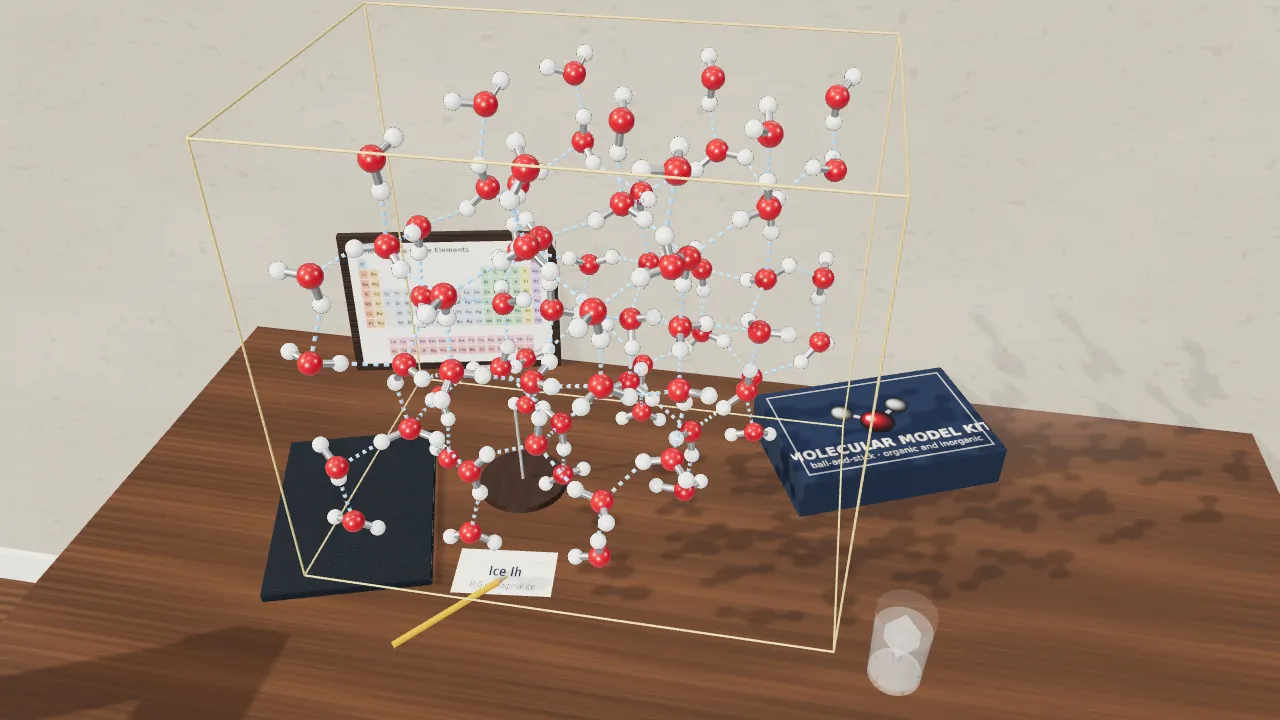
- Grab a hydrogen and pull: its covalent bond and its hydrogen bond to the next molecule stretch, and the crystal rings when you let go.
- Drag the empty space to turn the view and look straight down from above: the open hexagonal channels run right through the crystal.
- Grab a molecule and jiggle it fast to pour heat in. Above 0 °C the open lattice collapses into denser liquid water; leave it and it freezes again.
- Open Lab to set the temperature, or show and hide the hydrogen bonds and the volume box.
Challenges
- Pull a hydrogen to stretch its bonds, then let the crystal ring
- Look straight down the crystal to see its open hexagonal channels
- Jiggle a molecule fast until the ice warms past 0 °C and melts
Try this
- Melt the crystal and watch the box: the same molecules fit into about 8% less space as liquid water.
- Look down the channels with hydrogen bonds on. Every molecule makes four bonds, two through its hydrogens and two to its oxygen.
- Compare the density readout at −10 °C and at +4 °C: 0.917 g/cm³ for ice, about 1.000 g/cm³ for water.
Fun facts
- Ice is about 9% less dense than liquid water (0.917 versus about 1.000 g/cm³), so roughly nine-tenths of an iceberg is underwater.
- Liquid water is densest at about 4 °C.
- The six-fold symmetry of snowflakes comes from the hexagonal arrangement of molecules in ordinary ice.
- Ordinary ice is just one of many forms: around twenty different crystalline phases of ice have been identified at different pressures and temperatures.
An open crystal held by hydrogen bonds
Almost every substance is denser as a solid than as a liquid, so its solid sinks. Water is a famous exception: ice floats. The reason lies in how water molecules are arranged when they freeze.
The structure of ordinary ice
Ordinary ice is called ice Ih (the h stands for hexagonal). Each water molecule is joined to four neighbours by hydrogen bonds: it donates its two hydrogens to two neighbouring oxygens, and accepts hydrogens from two more. Those four neighbours sit at the corners of a tetrahedron, 2.76 Å away. Linked together, the tetrahedra form puckered hexagonal rings, stacked so that open channels run straight through the crystal. Viewed down those channels, ice looks like a honeycomb.
That honeycomb is mostly empty space. The strict geometry of hydrogen bonding holds the molecules apart, so ice packs fewer molecules into each cubic centimetre than liquid water does.
What happens when it melts
Melting breaks some hydrogen bonds and lets the rest bend and switch partners. The open lattice partly collapses and molecules crowd into the gaps, so liquid water is denser: about 1.000 g/cm³ compared with 0.917 g/cm³ for ice. A block of ice shrinks by about 8% in volume as it melts. Cooling water below 4 °C starts to form short-lived ice-like clusters, which is why liquid water is densest at about 4 °C.
Why it matters
Because ice floats, lakes and ponds freeze from the top down. The ice insulates the water below, which stays liquid, so fish and other life survive the winter. Floating sea ice reflects sunlight and shapes the climate. And water expanding as it freezes can split rocks and burst pipes.
For the curious: the ice rules
The oxygens in ice Ih sit on a hexagonal lattice (a = 4.52 Å, c = 7.36 Å). The hydrogens follow the Bernal–Fowler ice rules: each oxygen has exactly two hydrogens close to it, and each O···O link carries exactly one hydrogen. There are astronomically many ways to arrange the hydrogens that obey these rules, so real ice keeps a little disorder even near absolute zero, a “residual entropy” explained by Linus Pauling in 1935. This model places the hydrogens by orienting the network of O···O links along an Euler circuit, a trick that guarantees the ice rules inside the crystal. The liquid arrangement is an illustration: molecules are packed 8.3% closer, jumbled and set jostling, and a hydrogen bond is drawn only while two oxygens stay within about 3 Å. Each molecule has springs fitted to water’s own vibrations, and each hydrogen bond is a much softer spring, so a molecule rattles against its neighbours at roughly the frequency measured in ice.
Questions people ask
Why does ice float on water?
In ice every water molecule is hydrogen-bonded to four neighbours in an open hexagonal framework with a lot of empty space. When it melts the framework partly collapses and the molecules pack more closely, so liquid water is denser and ice floats on it.
What is the structure of ice?
Ordinary ice, ice Ih, is a hexagonal crystal. Each water molecule forms four hydrogen bonds to neighbours arranged in a tetrahedron, creating puckered hexagonal rings with open channels running through the crystal.
Why is water densest at 4 °C?
Two effects compete. Cooling makes molecules move less and pack closer, but below about 4 °C they also start forming open, ice-like hydrogen-bonded clusters that take up more space. The balance between the two gives the maximum density near 4 °C.