Hot Ice: Instant Crystals
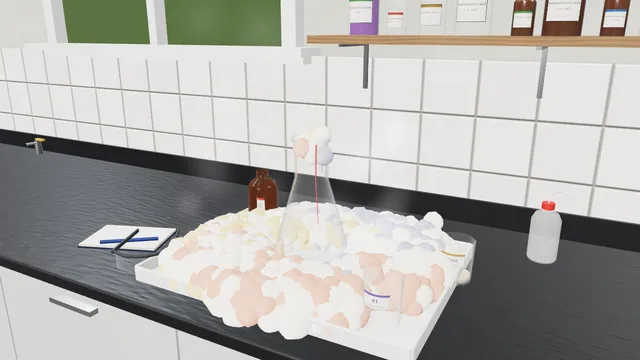
Pour hot ice onto a seed crystal and build a warm crystal tower.
How to play
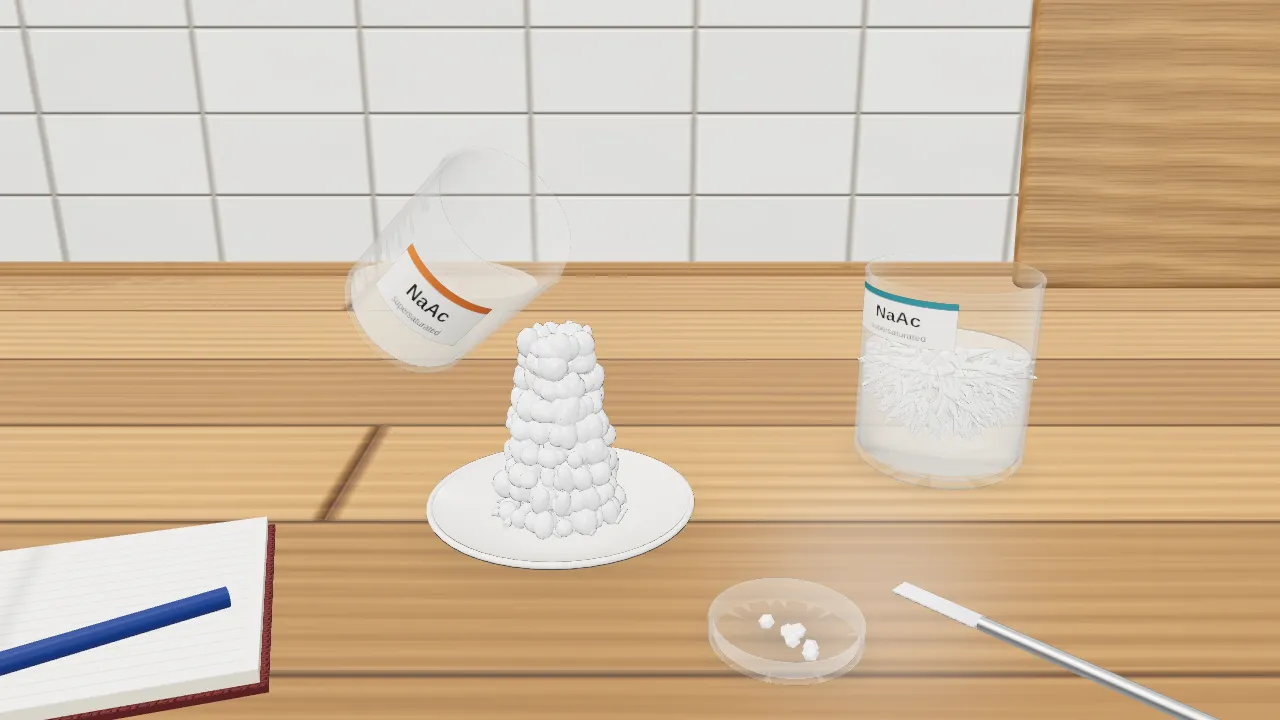
- Drag the jug over the seed crystal on the saucer and tip it very gently: a slow trickle freezes on top and the tower grows.
- Tip it further and the liquid arrives faster than it can freeze: it runs off and sets as a flat sheet instead.
- Drag the spatula into the little dish of seed crystals, then hold it over the jar to drop a seed in and watch crystals sweep through.
- Try the three Challenges, or open Lab to change the jar’s starting temperature.
Challenges
- Drop a seed crystal into the jar and let it freeze solid
- Pour slowly onto the seed and build a tower 4 cm tall
- Pour too fast on purpose and see the liquid spread into a flat sheet
Try this
- Watch the jar temperature as it crystallises. It climbs towards the mid-50s °C, warmed by the crystals themselves.
- Start the jar at 45 °C instead of 20 °C. The crystals creep instead of race, because the solution is barely undercooled.
- Pour onto the seed in short bursts. Each splash freezes in place, so the tower grows exactly where the stream lands.
Fun facts
- Reusable hand warmers use the same chemistry: clicking the metal disc inside starts the sodium acetate crystallising.
- Sodium acetate trihydrate melts at about 58 °C.
- Sodium acetate is a permitted food additive (E262) and gives salt and vinegar crisps part of their tang.
- It is called hot ice because the crystals look like ice yet feel warm: crystallising releases heat.
A liquid that is waiting to freeze
Sodium acetate is the salt you get from vinegar and baking soda. Dissolve a lot of it in a little hot water, let the solution cool without disturbing it, and something odd happens: it stays liquid even though it now holds far more salt than it normally could at room temperature. The solution is supersaturated.
Why it doesn’t crystallise on its own
To start a crystal, a handful of ions has to come together in exactly the right arrangement. That first tiny cluster is unstable and usually falls apart again, so a clean, still solution can stay supersaturated for days. Drop in a seed crystal, though, and the ions finally have a template. They line up on its faces, those new faces become templates in turn, and the crystal spreads through the liquid in a sweeping front.
What grows is sodium acetate trihydrate, which locks three water molecules into the crystal for every sodium acetate unit. That is why a whole jar of liquid can turn almost completely solid.
Why it gets hot
Turning a liquid into a solid releases energy, the same latent heat that has to be supplied to melt it. For sodium acetate trihydrate it is roughly 260 to 290 joules for every gram, enough to warm the mixture by tens of degrees. But the warming has a limit: the crystals melt at about 58 °C, and as the temperature approaches that, the urge to crystallise fades. The reaction slows itself down, so the jar settles in the 50s rather than shooting higher. Hand warmers rely on exactly this.
Building a tower
Pour the solution slowly onto a seed and every drop crystallises the moment it touches the crystals already there. The stream builds a column of solid where it lands, a “hot ice” sculpture that grows upwards as you pour.
For the curious: the model
The simulation moves the crystal front at a speed proportional to the undercooling, how far the mixture is below the melting point: v = v₀·(58 − T)/(58 − 20), with v₀ about 5 mm/s. Each slice that crystallises adds latent heat (raising T by roughly 88 K per unit of the jar, less a share lost to the glass), and the jar cools slowly towards room temperature by Newton’s law of cooling. Because v falls as T rises, the model reproduces the self-limiting warm-up. Real growth speeds vary with purity and container, so treat the numbers as typical.
Safety
Sodium acetate itself is mild, but making the solution means dissolving it in very hot water, which can scald. An adult should do the heating. Please read our disclaimer.
Questions people ask
What is hot ice made of?
Hot ice is sodium acetate, the salt formed when vinegar reacts with baking soda. Dissolved in hot water and cooled carefully, it forms a supersaturated solution that crystallises the moment it touches a seed crystal.
Why does hot ice get warm?
Crystallising releases the latent heat that was absorbed when the crystals were dissolved. Sodium acetate trihydrate gives out enough to warm itself towards its melting point of about 58 °C.
How do reusable hand warmers work?
They contain a supersaturated sodium acetate solution and a small metal disc. Flexing the disc releases tiny crystal seeds that start crystallisation, which releases heat. Boiling the pack melts the crystals again so it can be reused.