Hot-Air Balloon Fiesta
Fire the burner, climb into new winds and fly a balloon at dawn.
How to play
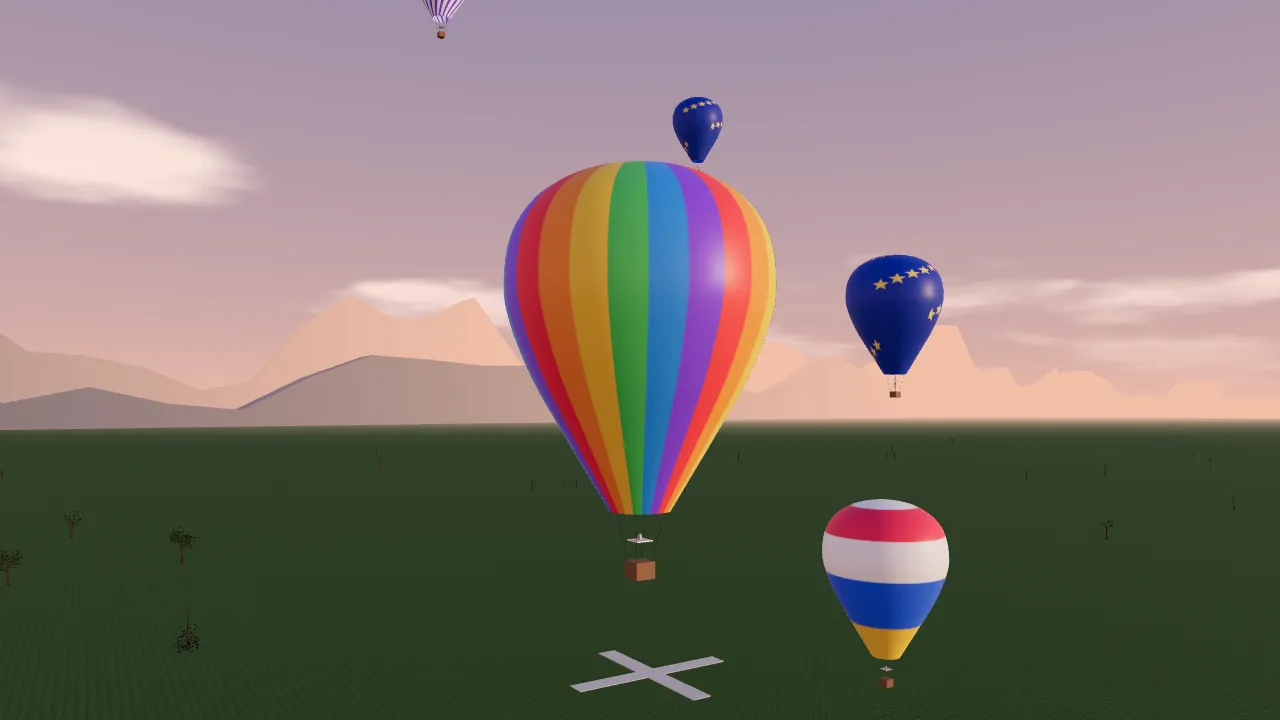
- Press and hold your balloon (the rainbow one) to fire the burner. Space works too.
- Let go and the envelope cools slowly. Drag down on the basket to pull the vent line and come down faster.
- Climb and sink to find winds going different ways, and drift towards the white target cross.
- Tap the basket to drop your marker bag: it falls with your drift. Try the three Challenges.
Challenges
- Hold the burner until your balloon lifts off the field
- Climb into the higher wind and drift back the other way
- Drop your marker within 25 m of the target cross
Try this
- Fire the burner for five seconds and watch the climb readout. Nothing seems to happen at first: the envelope holds thousands of cubic metres of air, which takes time to heat and to get moving.
- Climb above about 250 metres and watch the target distance: up there the wind carries you back the other way.
- Set the morning to 25 °C and try to take off. Warm air outside means less lift for the same envelope temperature, so the burner works harder.
Fun facts
- The first people to fly in a hot-air balloon were Jean-François Pilâtre de Rozier and the Marquis d’Arlandes, in a Montgolfier balloon over Paris on 21 November 1783.
- Balloon pilots cannot steer left or right directly; they climb or descend to find winds blowing the way they want to go.
- The Albuquerque International Balloon Fiesta in New Mexico, held each October, is one of the largest balloon festivals in the world.
- A balloon is lifted by the difference in weight between the cool air it pushes aside and the warm air inside it, not by the heat itself.
Flying by heat and by wind
At a balloon fiesta, dozens or even hundreds of balloons inflate in the cold morning air and rise together in a mass ascension. Mornings are popular because the air is usually calm and cool. This dawn field lets you pilot one balloon among the crowd, using the same physics that real pilots learn.
Lift from warm air
A balloon floats for the same reason a cork does: it is pushed up by the weight of the air it displaces. The envelope here holds about 3,200 cubic metres. Cool morning air of that volume weighs about four tonnes, while the same volume heated to 80 °C weighs about 20 percent less. That difference has to carry the envelope, basket, burners, fuel and people, about 680 kilograms in this balloon, so on a cool morning it floats level with its air at roughly 65 to 70 °C. Climb higher, or fly on a warmer day, and the outside air is thinner, so the balloon needs hotter air to stay up.
Why balloons respond slowly
The burner is enormous, about 3 megawatts, yet a five-second burn changes the envelope temperature by only a few degrees, because there is so much air to heat. The balloon also has to set thousands of kilograms in motion: the air inside it moves with it, along with some of the air around it. So there is a delay between burning and climbing, and pilots learn to burn early and gently. When the burner is off, the envelope cools slowly and the balloon sinks; pulling the vent lets hot air out to come down faster.
Steering with the wind
A balloon has no rudder: it drifts with the air around it. But wind speed and direction often change with height. In this scene the breeze near the ground drifts one way and the wind a few hundred metres up blows back the other way, so you can go out low and come back high. Some places are known for this pattern on calm mornings; at Albuquerque it is called the box. Pilots read the winds before launch and choose their heights to steer.
For the curious
The net upward force is F = (ρout − ρin)·V·g − m·g, with ρ = pM/(RT) for each air mass. The envelope heats as C·dT/dt = P − K(T − Tout), where C = ρinVcp is huge, and the balloon moves with inertia m + ρinV + ½ρoutV against quadratic drag relative to the wind.
Questions people ask
How does a hot-air balloon fly?
Burners heat the air inside the envelope. Warm air is less dense than the cooler air outside, so the balloon weighs less than the air it displaces and is pushed upwards by buoyancy.
How do hot-air balloons steer?
They can’t steer directly. Pilots climb or descend to find winds at different heights that blow in different directions, and use those layers to move where they want.
Why do balloons fly early in the morning?
Morning air is usually calmer and cooler. Cool air gives more lift, and calm, steady winds make take-off and landing safer than in the gusty air of a sunny afternoon.