Holi Colour Splash
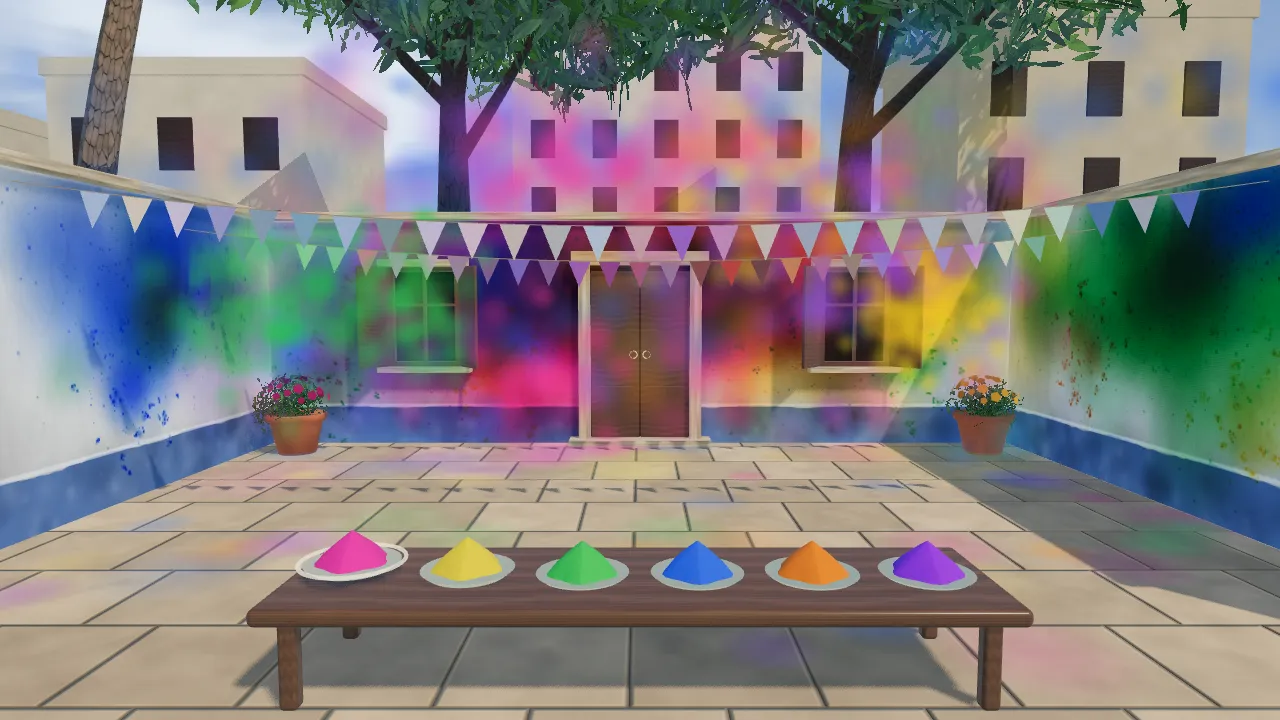
Throw clouds of gulal and splash white walls with colour.
How to play
- Tap a brass plate of powder on the low table to pick up that colour.
- Tap a wall, the floor or the bunting to throw a handful there. Hold and drag to keep throwing.
- Throw one colour over another to mix them on the wall, and hit the bunting to make the flags swing.
- Try the three Challenges, or open Lab for the grain size, throw speed, breeze and a Colour storm.
Challenges
- Throw colour at the bunting until five of its white flags are tinted
- Throw yellow and blue on the same patch of wall to make green
- Colour a third of the courtyard walls with your own throws
Try this
- Throw yellow at a spot, then blue at the same spot. The wall turns green, because powder pigments mix by absorbing light, not by adding it.
- Set the grain size to 10 µm and throw high: the cloud lingers for ages. At 150 µm the grains drop out almost at once, because settling speed grows with the square of the grain size.
- Turn the breeze up to 3 m/s. Watch a cloud stop rushing forward once its own push has died away, then drift sideways with the air.
Fun facts
- Holi falls around the full moon of the Hindu month of Phalguna, usually in March. On the evening before the colours, many communities light a bonfire called Holika Dahan.
- Gulal is the soft coloured powder thrown at Holi. Traditional colours came from plants, such as turmeric for yellow and the orange flowers of the palash tree, also called flame of the forest.
- In Nepal, Holi is also known as Fagu Purnima.
- A starch grain 40 micrometres across falls through still air at only about 7 centimetres per second, which is why a cloud of gulal can hang in the air for many seconds.
Why powder clouds rush, hang, drift and mix
Holi, the spring festival of colours, is celebrated mainly by Hindus in India and Nepal, and by many communities around the world. It welcomes spring and celebrates the triumph of good over evil, remembered in the Holika Dahan bonfire on the night before. On the day of colours, friends, neighbours and strangers smear and throw gulal and spray coloured water, and old quarrels are meant to be forgiven. Customs vary a great deal from region to region. In the Braj area around Mathura and Vrindavan, for example, the celebrations last for many days.
A handful becomes a cloud
When you throw a handful of powder, you are really throwing a puff of air loaded with grains. The puff keeps its momentum, but it keeps swallowing still air from around it, so it grows and slows down. In the simulation its speed falls as v = v0(1 + t/τ)−3/4, the behaviour of a turbulent puff. That is why a cloud rushes out and then seems to stop and hang: after the first second it creeps on more and more slowly, because its reach grows only as the fourth root of time.
Why fine powder floats
Once the puff has slowed, each grain falls at its own terminal speed, where air drag balances its weight. For tiny grains the drag follows Stokes’ law, F = 6πμrv, which gives a settling speed v = (ρp − ρa)gd² / 18μ, where μ is the viscosity of air. The speed grows with the square of the grain size. A 40 µm starch grain sinks at about 7 cm/s, while a 10 µm grain manages less than half a centimetre per second. Meanwhile small eddies jostle the grains in a random walk, so the cloud keeps spreading. Its width grows roughly like the square root of time.
Colours that mix like paint
Powder pigments mix by subtraction. Each pigment absorbs part of the light falling on it and reflects the rest. Yellow powder absorbs blue light, and blue powder absorbs red light, so where they overlap mostly green light survives. That is why yellow on blue turns green on the walls, and why a wall that has caught every colour slowly becomes a deep, muddy purple. Coloured lights do the opposite: they add up towards white.
Celebrate kindly
Many families choose colours made from natural ingredients such as turmeric, flowers and beetroot, because some cheap powders contain harsh dyes that can irritate skin and eyes. Keep powder away from faces and eyes, ask before you colour someone, and oil your skin and hair beforehand so the colours wash off more easily.
For the curious
Each grain’s velocity is the puff’s decaying velocity plus the breeze, which takes over as the puff dies (weight 1 − (1 + t/τ)−3/4), minus the settling speed. Each frame also adds a random step of size √(2DΔt). For larger grains the kit uses the Schiller–Naumann drag law, Cd = (24/Re)(1 + 0.15Re0.687), because Stokes’ law starts to overestimate the speed once the grain Reynolds number Re approaches 1.
Questions people ask
Why is Holi called the festival of colours?
On the main day of Holi, people throw coloured powder called gulal and spray coloured water at each other. The colours celebrate the arrival of spring, friendship and the triumph of good over evil.
Are Holi colours safe?
Colours made from natural ingredients such as turmeric, flowers and beetroot are the gentlest choice. Some cheap powders contain industrial dyes that can irritate skin and eyes, so check what you buy, keep powder away from eyes and wash it off with plenty of water.
Why does coloured powder hang in the air for so long?
Very fine grains fall slowly because air drag almost balances their tiny weight. By Stokes’ law the settling speed grows with the square of the grain size, so a grain a few hundredths of a millimetre across sinks only a few centimetres per second and is easily carried by the slightest breeze.