Hogmanay Fireworks
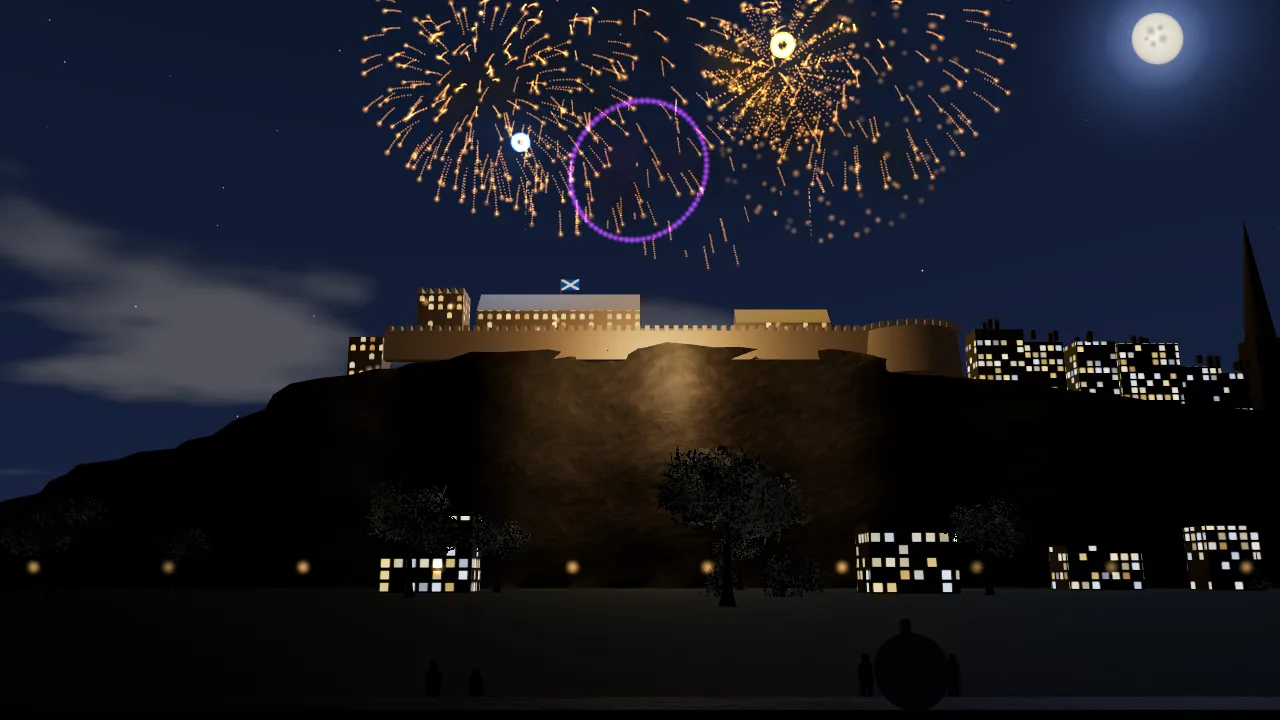
Fire midnight shells from a castle and time the boom in cold air.
How to play
- Press the sky above the castle to aim a firework, then let go. It is fired from the castle ramparts.
- Tap the brass stopwatch on the wall at a flash, and tap it again when you hear the boom.
- The distance is your time multiplied by the speed of sound, which is lower on a cold night.
- Try the three Challenges, or open Lab for the Air temperature slider and a Flash-to-bang test.
Challenges
- Burst a shell right above the castle’s great hall
- Time a flash-to-bang with the stopwatch to within a third of a second
- Burst a shell so far away that its boom takes more than 1.8 s
Try this
- Run the flash-to-bang test at −10 °C and again at 30 °C. The boom arrives noticeably later in the cold, from the same distance.
- Note the Speed of sound readout at 0 °C, then at 20 °C. It changes by about 12 m/s, roughly 0.6 m/s per degree.
- Launch shells of different sizes and watch the Boom delay: higher bursts are further away, so their booms take longer to arrive.
Fun facts
- Hogmanay is the Scottish name for the last day of the year, and its celebrations often carry on into New Year’s Day.
- The song “Auld Lang Syne”, sung at midnight in many countries, was written down by the Scottish poet Robert Burns in 1788.
- First-footing is the Scottish custom of being the first visitor to cross a home’s threshold after midnight, traditionally bringing small gifts.
- Sound travels about 0.6 metres per second slower for every degree Celsius that the air cools.
Why sound is slower on a frosty night
Hogmanay is Scotland’s celebration of the turn of the year, with parties, music, first-footing and, in many towns, fireworks at midnight. Edinburgh’s display is famously fired from the castle on its volcanic rock above the city. This scene is a made-up castle and old town, but it shows a piece of physics you can test yourself on any cold night: sound travels more slowly in cold air.
What sound really is
Sound is a travelling wave of squeezes and stretches in the air. Air molecules bump into their neighbours and pass the push along. How fast the wave moves depends on how fast the molecules are already moving, and that is set by the temperature. Warm air has faster molecules, so it passes the wave along faster. At 20 °C sound travels at about 343 m/s; at 0 °C it is about 331 m/s; on a −10 °C night it drops to about 325 m/s.
The flash-to-bang test
Light from a burst arrives almost instantly, so the gap between flash and boom is simply the distance divided by the speed of sound. If you know the temperature, you know the speed, and a stopwatch tells you the distance. The stopwatch on the garden wall lets you time it yourself, and the Lab’s test does it for one shell and reports the delay, the speed of sound and the distance. In this scene the bursts above the castle are a few hundred metres from the gardens, so the boom takes more than a second to reach you.
Does the cold change the fireworks?
Cold air is also denser, by about 11 percent between 20 °C and 10 °C below freezing. Denser air means a little more drag, so the scene recalculates each shell’s launch speed from the air temperature as well. The difference is small, but it is real, and it is one reason display teams check the weather on the night.
Customs of the night
Customs differ between families and towns. Many people sing “Auld Lang Syne” at midnight, often linking arms, and some keep up first-footing, hoping the first visitor of the year brings good luck.
For the curious
For an ideal gas the speed of sound is c = √(γRT/M), where γ ≈ 1.4 for air, R is the gas constant, T the absolute temperature and M the molar mass. That gives c ≈ 331.3 √(1 + T/273.15) m/s with T in °C, and for small changes about 0.6 m/s per degree.
Questions people ask
Does sound travel slower in cold air?
Yes. Sound is passed along by moving air molecules, and they move more slowly when the air is cold. At 0 °C sound travels at about 331 metres per second, compared with about 343 at 20 °C.
How can I tell how far away fireworks are?
Count the seconds between the flash and the boom and multiply by about 340 to get the distance in metres. On a very cold night use a slightly smaller number, such as 330.
What is first-footing?
It is a Scottish New Year custom: the first person to enter a home after midnight is the first-foot, and traditionally brings small gifts for luck in the year ahead.