Hermit Crab Shells
Drop empty shells in a rock pool and set off hermit crab house swaps.
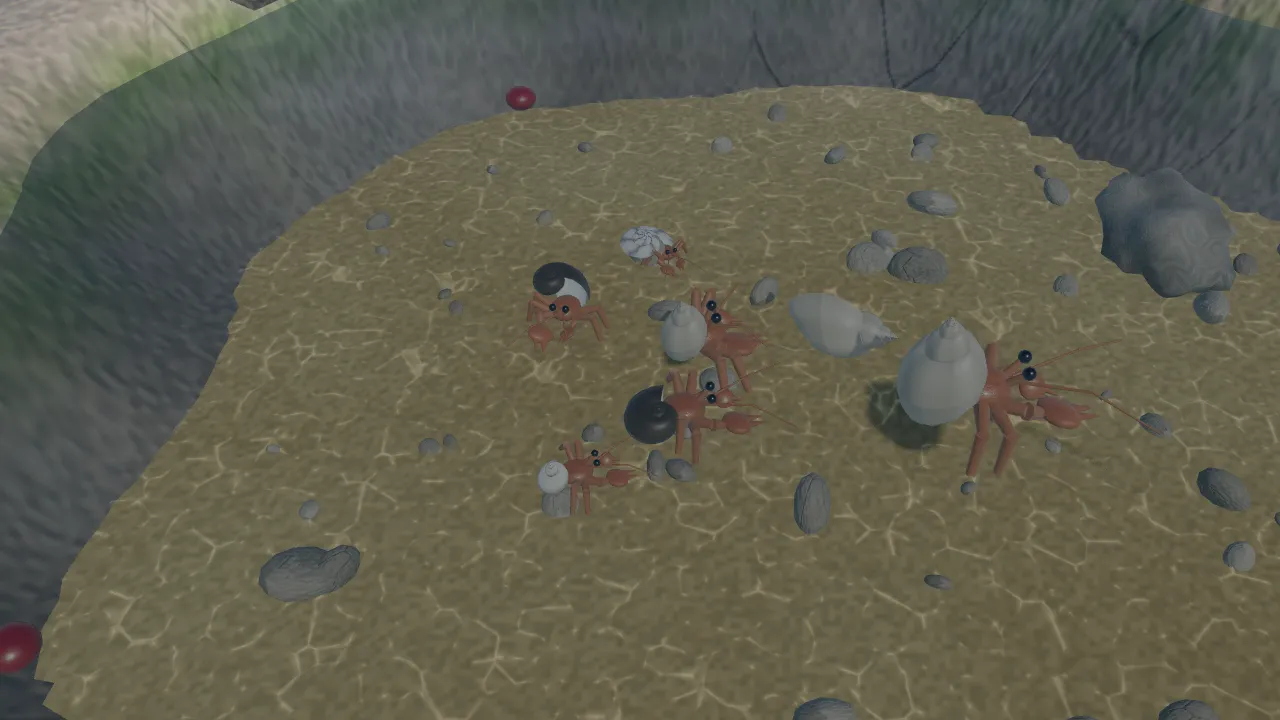
How to play
- Drag an empty shell from the rocks and drop it in the pool. Crabs nearby walk over to inspect it.
- A crab moves in only if the new shell fits it better. When it does, its old shell is free for the next crab in line.
- Tap a crab and it pulls back into its shell; a crab in a shell that’s too small can’t get all the way in. Tap an empty shell to turn it over.
- Try the three Challenges, or open Lab to show how well each crab’s shell fits.
Challenges
- Give a crab a better-fitting shell
- Start a vacancy chain: one new shell that lets three crabs move up
- Find a shell that fits well for every crab in the pool
Try this
- Drop the big whelk shell near the crabs. They gather beside it, line up by size and move up one after another.
- Drop one of the tiny shells. The crabs ignore it, because it is no bigger than the shells they already have.
- Turn on the fit rings in Lab, then tap a crab with a red ring: it can’t pull all the way into its cramped shell.
Fun facts
- Hermit crabs are not true crabs. They belong to a group called the Anomura, along with squat lobsters and porcelain crabs.
- A hermit crab’s soft abdomen curls to the right, to fit the right-handed spiral of most snail shells.
- Some hermit crabs carry sea anemones on their shells. The anemone’s stings help protect the crab, and the anemone picks up scraps from the crab’s meals.
- Hermit crabs cannot make their own shells, so on many shores the supply of good empty shells limits how many crabs can live there and how big they can grow.
Hermit crabs and vacancy chains: how one shell can rehouse a crowd
A hermit crab’s front half is armoured like any crab’s, but its long abdomen is soft and unprotected. To keep it safe the crab borrows the empty shell of a sea snail, curling its abdomen into the spiral and gripping the inside with small hooked hind legs. When danger threatens, it pulls right inside and blocks the opening with its bigger claw.
Growing out of a home
The shell does not grow, but the crab does. Each time it moults it gets a little bigger, until its shell is cramped: it can no longer withdraw completely, and a predator can pull it out more easily. So hermit crabs are always on the lookout for a better shell, and they are choosy. A shell that is too small leaves them exposed, while one that is too big is heavy to drag around and harder to defend. In this rock pool each crab has a preferred size, and it moves only if a shell fits it better than the one it has.
Inspecting a shell
A crab that finds an empty shell examines it carefully. It feels the outside with its legs, turns the shell over and pushes its claws into the opening to check the size and make sure nobody is at home. If it likes what it finds, it switches in a second or two, whipping its soft abdomen out of the old shell and into the new one. If it changes its mind, it can move straight back.
Vacancy chains
Every move leaves a shell behind, and that shell may be just right for a smaller crab. Biologists call this a vacancy chain: one new shell sets off a sequence of moves in which each crab takes the shell given up by the crab before it. Sociologists first described vacancy chains among people, for example when one new house lets several families move up in turn, and biologists later found them in hermit crabs. Sometimes crabs gather beside a shell that is too big for all of them, line up in order of size and wait. When a large enough crab arrives and takes it, the others swap down the line one after another. A single new shell can improve the homes of a whole group.
For the curious
Each crab here has a preferred shell opening c between 15 and 36 mm. A shell with an opening A fits with a score q = e−((A − c)/σ)², where σ is 17 % of c for a shell that is too small and 35 % for one that is too big, so a cramped shell is worse than a roomy one. A score above 0.8 counts as a good fit. A crab notices empty shells within about 60 cm, walks over at 3.5 to 5 cm/s, inspects for about a second and moves in only if its score rises by more than 0.05. Crabs interested in the same shell queue beside it in order of size. The length of a chain is the number of crabs that move because of one new shell.
Questions people ask
What is a vacancy chain?
A vacancy chain is a sequence of moves started by one new resource. In hermit crabs, one crab moves into a new, bigger shell, a smaller crab takes the shell it left, an even smaller crab takes that one, and so on, until a shell is left that nobody wants.
Why do hermit crabs change shells?
They grow, but their borrowed shells do not. A crab whose shell has become too small cannot withdraw fully to hide, so it looks for a better-fitting shell and switches when it finds one.
Is it all right to take empty shells from the beach?
It is kinder to leave them. On many shores empty shells are in short supply, and the one you pick up may have been a hermit crab’s next home. When you go rock pooling, check the tide times, watch your footing on slippery rocks and put any creature you lift back where you found it.