Ant Colony Trails
Drop sugar, wipe out scent trails and see ants find the shortest path.
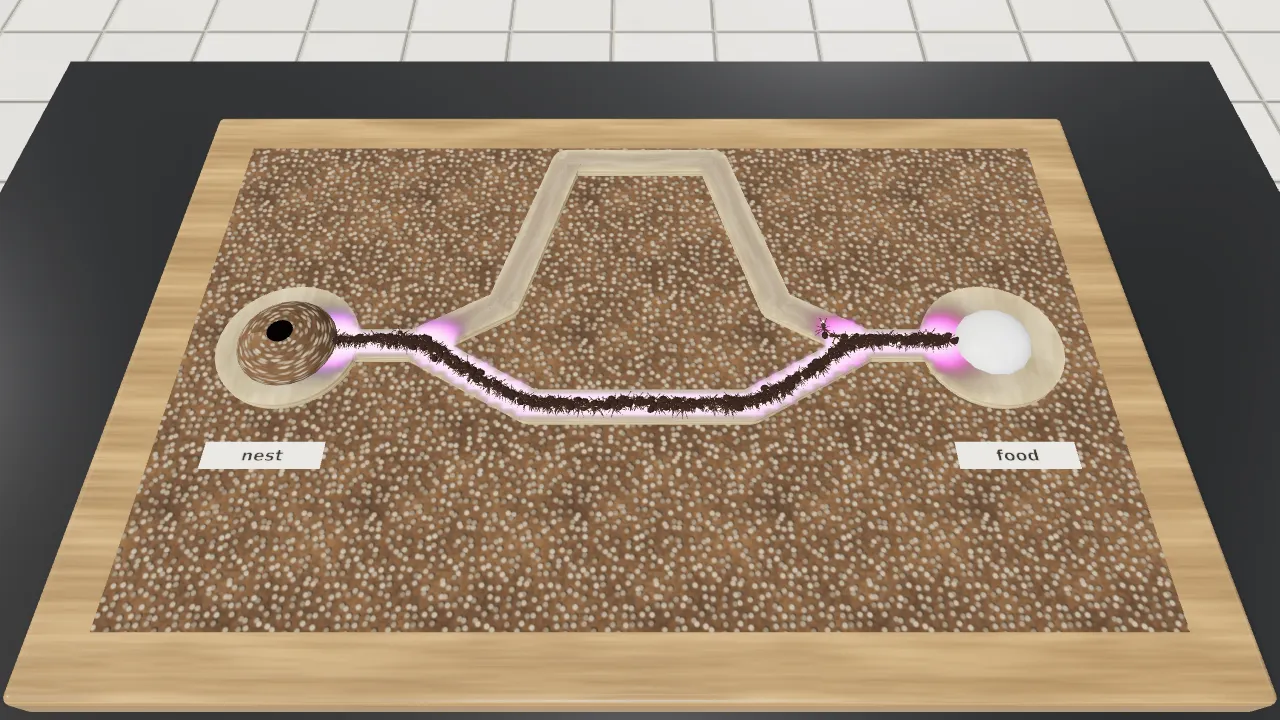
How to play
- Tap the arena to drop a sugar crumb anywhere ants can walk. Scouts find it and a trail grows to it.
- Tap the short branch of the bridge to put a barrier across it, and tap again to lift it.
- Rub your finger along a trail to wipe its scent away, and watch the ants that cross the gap lay it again.
- Try the three Challenges, or open Lab to switch arenas or change how fast scent evaporates. Right-drag to look around.
Challenges
- Drop a sugar crumb and see ants carry three loads of it home
- Block the short branch and see ten loads come home the long way
- Rub out a busy scent trail with your finger and watch the ants lay it again
Try this
- On the double bridge with a short and a long branch, wait until most ants use the short one, then compare the “Ants on branch” readout with the scent colours.
- Choose two equal branches and watch: the colony still ends up on one branch, chosen by chance. Reset and see if it picks the other one next time.
- Tap the short branch to block it, wait for a strong trail on the long one, then tap it open again. With little evaporation the ants often stay on the long branch. Raise evaporation and they switch.
Fun facts
- In 1989, researchers gave Argentine ants a bridge with two branches of different length between their nest and food, and most colonies ended up using the shorter branch.
- When the short branch was only added after the ants had established a trail on the long one, most colonies kept using the long branch.
- With two branches of equal length, colonies still tend to settle on one of them, picked by chance.
- Computer scientists borrowed the idea in the early 1990s: “ant colony optimisation” uses virtual ants and evaporating trails to search for short routes.
How ants find the shortest path without a map
No ant on this bridge knows which branch is shorter. Each one follows simple rules: lay scent as you walk, and at every step prefer to turn toward stronger scent. Yet within a few minutes the colony converges on the shorter path. This is self-organisation, where order arises from many local interactions rather than from a plan.
The double bridge
At first, ants reaching the fork choose a branch more or less at random. But ants that happen to take the short branch get to the food and back sooner, so the short branch receives fresh scent sooner. The next ant to arrive at the fork finds slightly more scent on it and is slightly more likely to choose it, which adds still more scent. This positive feedback amplifies a small early difference until most of the traffic uses the short branch. Researchers who ran this experiment with Argentine ants in 1989 found the same result, and also found that the advantage disappears if the short branch is added after a strong trail has already formed on the long one.
Why evaporation matters
Trail scent fades over time. That sounds like a weakness, but it lets a colony forget. Without evaporation, an old trail to a finished food source or a long detour would keep attracting ants for ever. With some evaporation, unused trails fade and the colony can switch to something better. Too much evaporation, though, and trails vanish before they can build up at all. Try the slider in the Lab to find the balance.
What the colours show
Ants smell with their antennae, and real trails are invisible to us. Here, pink shows the scent laid by ants carrying food home, which outbound ants follow to find the food. Blue shows the scent laid by ants heading out, which loaded ants follow home. Real Argentine ants mark trails in both directions with chemical signals. Using two separate scent fields is a common simplification in simulations like this one.
For the curious
The arena is a grid of 1 cm cells. Each ant senses scent at three points 2.2 cm ahead, to the left, centre and right, and turns toward each with probability proportional to (k + C)², the choice rule fitted to double-bridge experiments, where C is the local scent and k sets how much ants explore. Deposits weaken as e−t/τ with the time t since an ant left the nest or the food, with τ = 40 s, so trails are strongest near their source. Every second, a set percentage of all scent evaporates, and every few steps each cell blends 5% toward its neighbours’ average, a simple model of diffusion. Ants walk at 4.5 cm/s.
Questions people ask
How do ants find the shortest path?
They lay scent trails and tend to follow stronger scent. Ants using a shorter path complete trips sooner, so that path gets reinforced faster, attracts more ants and gets stronger still. This positive feedback leads the colony to the shorter route without any ant comparing distances.
What is the double bridge experiment?
It is a classic experiment in which ants can reach food by two branches of a bridge. When one branch is shorter, colonies of Argentine ants usually end up using it. When both branches are equal, they still tend to pick just one of them, chosen by chance.
Why do ant trails disappear?
Trail chemicals evaporate. If ants stop using a trail, for example because the food has run out, the scent fades and ants stop following it. This forgetting lets a colony switch to new food sources and better routes.