Halloween Jack-o’-Lanterns
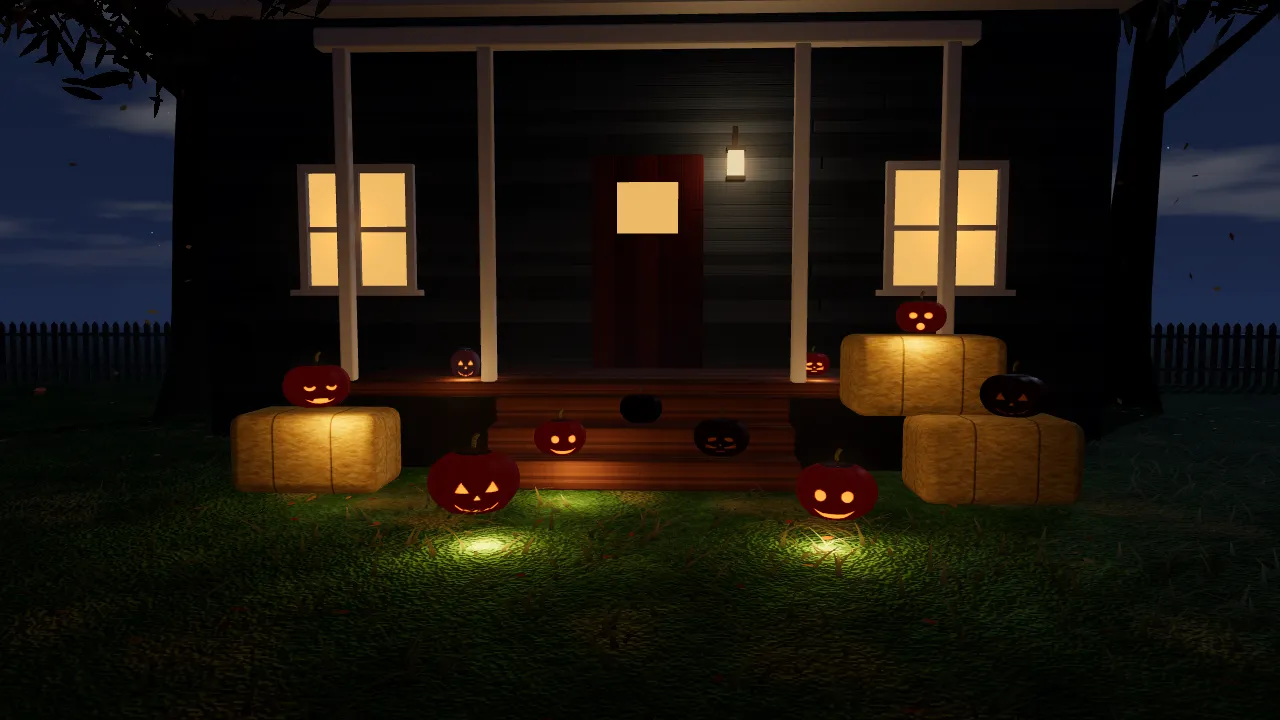
Light carved pumpkins on a moonlit porch and lift their lids.
How to play
- Tap a pumpkin to light the candle inside. Tap it again to blow it out.
- Tap a lid or its stem to lift it off, and tap again to put it back. Two lids were carved without a vent hole.
- Watch the readouts for the air flowing through the lantern and the temperature inside.
- Look for the pale lantern on the porch: a carved turnip, the older tradition. Lab changes all the lids and the size of the carvings.
Challenges
- Light the old-style lantern carved from a turnip
- Light every lantern on the porch so they all glow at once
- Lift the lid off a dim, sealed pumpkin so its candle can breathe
Try this
- In Lab, choose All: lid on, sealed. The faces dim and flicker as the candles run short of oxygen. Give them vent holes, or lift a lid off, and they brighten again.
- With the lid sealed, compare the small and the large carving. Bigger openings let more air through.
- Compare the inside temperature with the lid off and with a vent hole. When less air flows through, the air inside gets hotter.
Fun facts
- Carved lanterns were made from turnips and other root vegetables in Ireland and Scotland long before pumpkins were used.
- Halloween grew partly from Samhain, a Gaelic festival marking the end of the harvest and the start of winter.
- Irish and Scottish emigrants brought the custom to North America, where pumpkins were bigger and easier to carve.
- Warm air rising out of a chimney pulls fresh air in lower down. The same stack effect helps ventilate tall buildings.
How a jack-o’-lantern breathes: the chimney effect
Halloween, on 31 October, is the eve of All Saints’ Day, and it draws on much older autumn customs, especially the Gaelic festival of Samhain, which marked the end of the harvest. In Ireland and Scotland people carved faces into turnips and other root vegetables and set embers or candles inside. When emigrants brought the custom to North America they found pumpkins, which are bigger and much easier to hollow out. Today carving and lighting jack-o’-lanterns is a cheerful autumn tradition in many countries, and how people celebrate varies a great deal.
A candle needs to breathe
A candle flame burns wax vapour with oxygen from the air, and its hot exhaust has to go somewhere. Inside a pumpkin that happens all by itself. Air warmed by the flame expands, so it is less dense than the cool night air outside. Lighter air floats upwards and escapes through the lid opening, and fresh air is pulled in through the carved face to replace it. This is the stack effect, the same reason a chimney draws.
The flow is stronger when the warm air is hotter, when the openings are farther apart in height, and when both the top and bottom openings are generous. Seal the lid and the warm air has almost nowhere to go. Too little fresh air comes in, the candle runs short of oxygen, and its flame shrinks and flickers. Cutting a small vent hole in the lid fixes it, which is why many carvers do exactly that.
Where the heat goes
A tea light gives out heat at around 40 watts. Some is carried away by the air flowing through the lantern, and some soaks into the pumpkin’s cool, damp walls. The less air flows, the hotter the inside becomes, which is why a sealed lid can end up scorched.
A safety note
Real candles in pumpkins are a fire risk. Never leave them unattended, keep them away from anything that can burn, and consider a battery light instead. This virtual porch has no such worries.
For the curious
The simulation uses Q = CdAeff√(2gh·ΔT/T) for the airflow, with 1/Aeff² = 1/Atop² + 1/Aface², and the energy balance P = (ρcpQ + UA)·ΔT, solved together. A bright, clean flame here needs about 2 litres of air per minute, and the flame weakens when the flow falls short of that. Light from each face falls on the ground in front with the inverse-square law.
Questions people ask
Why were jack-o’-lanterns first made from turnips?
The custom began in Ireland and Scotland, where turnips and other root vegetables were what people had to hand. Emigrants to North America switched to pumpkins, which were plentiful there and much easier to carve.
Why does the candle in my pumpkin keep going out?
It is usually short of air. Warm air needs a way out at the top so that fresh air can be drawn in through the face. Cut a small vent hole in the lid, or leave the lid slightly open.
Why do people carve pumpkins at Halloween?
It comes from an older tradition of carving lanterns from turnips in Ireland and Scotland at the end of autumn. Pumpkins took over in North America, and carving them has become one of the best-known Halloween customs.